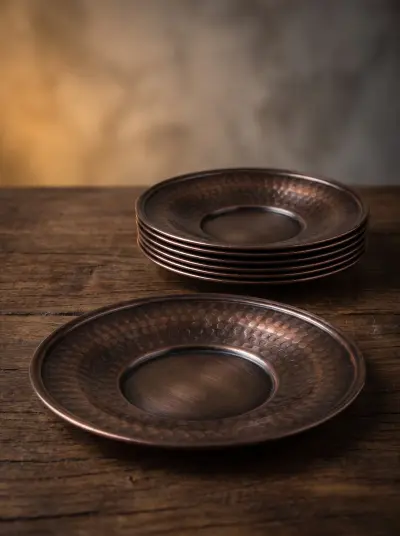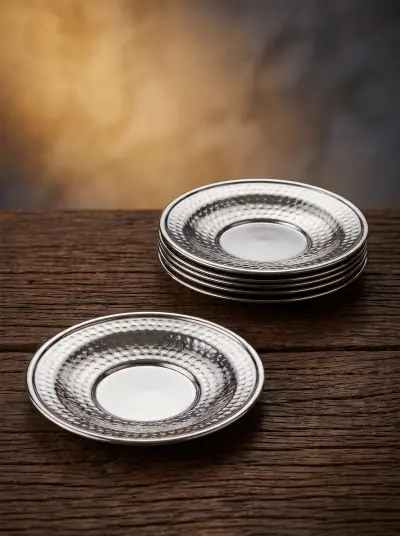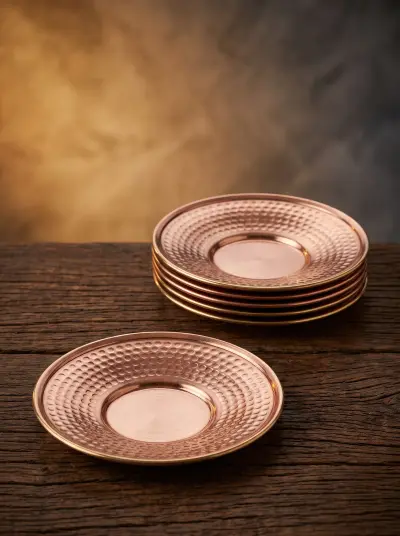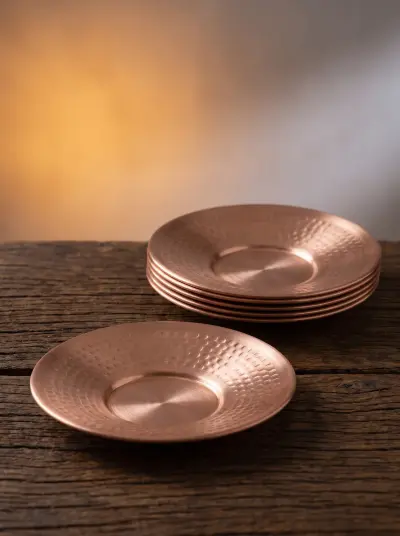
Otağ Copper Tea Saucer, Set of 6 — hand-hammered, brushed matt
TC30042-4
Does copper tarnish, how to clean copper pots after service, what must never touch copper, and what actually wears out: a care protocol for commercial kitchens.
Browse the range, add the pieces you need to your quote list and ask for prices in one message. No account, no online prices.
Copper cookware lasts for decades when it is used and cleaned correctly: the copper body is not what wears out, the interior lining is. Copper does tarnish, but tarnish is a surface film and a question of appearance, not a defect. The protocol is short: hand wash, dry immediately, and treat inside and outside as two different jobs.
It does. Copper reacts with oxygen in the air and builds a thin oxide film on the surface. The bright red first goes flat, then moves toward deep brown. That film sits on top of the metal. It does not penetrate the body, does not thin the wall, and does not change the thermal behaviour that made you buy copper in the first place.
The speed is not fixed. Humidity, salt in the air, smoke, handling and heat all accelerate darkening, while a piece on a dry ventilated shelf changes far more slowly. In the same hotel a tray working a breakfast buffet can shift visibly within a week while its twin in the store room looks unchanged for months. A polishing schedule is therefore built around where a piece works, not around what it is. Some operators deliberately run darkened copper in open kitchens, which is legitimate as long as it is a choice rather than an accident.
A greenish deposit is a different matter and should not be filed under tarnish. Green salts typically appear where a surface stayed damp with acidic or salty residue left on it, so a properly dried and stored piece will not produce them, and they are not expected on a lined food-contact surface. If one appears, take the piece out of food service, check the lining for continuity, and find the gap in the drying and storage routine.
The most expensive mistake in copper care is treating a pan as one object. The inside and the outside have different jobs, different risks and different products.
The exterior is a presentation surface. Its job is the impression the piece makes on a pass or a table, and failures here are cosmetic and reversible. This is where polishing happens, where a commercial copper cleaner is used, and where a soft non-abrasive cloth does the work.
The interior is the food-contact surface, and it is a lining: tin or stainless steel. Its job is to keep food away from copper, and a failure here is not cosmetic, it takes the pan out of service. No polish goes here. No abrasive pad, no steel wool, no metal spatula, ever. Tin is a soft metal and thins when scratched. The interior has one maintenance objective: keep the lining continuous.
Write the split into the inventory record. For cookware the interior carries the priority; for serveware and presentation the weight shifts to the exterior. Their care budgets are not the same.
Copper inventory is preserved by five steps repeated every shift, not by a deep clean once a week.
Cool it first. A hot pan does not go straight into cold water. Thermal shock distorts copper, loosens riveted handle joints and stresses the lining.
Wash by hand. Warm water, a soft sponge, a mild neutral detergent. Soak stuck residue rather than scraping it. Leaving copper submerged overnight is prohibited; prolonged wetness produces both marks and deposits.
Dry immediately. On copper this step is not negotiable. Water left to evaporate deposits its minerals on the surface and that mark becomes permanent, at which point removing it is a polishing job rather than a wash. Every washed piece is wiped with a soft dry cloth straight away. Hard mains water sharpens the difference: two sites running the same protocol can end up with visibly different inventory purely because of water hardness.
Store it dry and separated. Copper is not stacked directly on copper; put cloth, felt or paper between pieces. Damp cupboards and unventilated shelving are the most common source of green deposits. Hang serveware or store it in a single layer where space allows.
Use the right tools. Wood and silicone only. Never leave an empty pan over a high flame: tin melts at 232 °C, and an empty pan reaches that far faster than a full one. Heat behaviour and hob compatibility are a separate subject, covered in the copper pan hob compatibility guide.
Polishing is the largest recurring labour line in a copper inventory, which makes a blanket "polish everything" policy a budgeting error rather than a standard. The correct rule sorts by visibility.
Guest-facing surfaces are scheduled: service trays, buffet and chafing vessels, display pieces, pitchers and drinkware that reach a table. This group gets a calendar, weekly or more often depending on service volume.
Back-of-house vessels are not scheduled. The darkened surface on pots and pans is accepted. That is a deliberate decision rather than neglect: dropping them from the schedule removes a meaningful block of labour and affects no performance characteristic of the pan.
When polishing is done, the rules are firm: a commercial copper cleaner used to the manufacturer's instructions, tested on a hidden area first, and a thorough rinse and dry afterwards so no residue reaches food. Homemade mixtures do not belong in a commercial kitchen, because the liability for a stained surface or a damaged lining lands on the operator.
Lacquered decorative and gift items sit outside this section entirely. A lacquered surface is never polished; polish strips the coating and the copper underneath then darkens unevenly. Care here is a damp cloth and nothing more.
The table below is short enough to laminate and hang in the wash-up area, and on its own it prevents most of the damage copper inventory actually suffers.
| Never | Why | Instead |
|---|---|---|
| Dishwasher | Alkaline detergent, heat and the drying cycle dull the exterior, mark it permanently and degrade tin | Hand wash, warm water, mild detergent |
| Oven cleaner and strong descaler | Aggressive chemistry attacks both the lining and the copper surface | Soak in warm water, lift residue with a soft sponge |
| Chlorine bleach and chlorinated sanitiser | Causes corrosion and permanent discolouration on copper | The kitchen's approved chlorine-free sanitising procedure |
| Steel wool and abrasive pads | Thins a tin lining and leaves scratches on the exterior that will not come out | Soft sponge, microfibre cloth |
| Metal spatulas and whisks | Damage the lining at a point; the harm goes unnoticed for years | Wood or silicone tools |
| Overnight soaking | Prolonged wetness produces marks and green deposits | Wash, dry and put away at end of shift |
Every line in that table exists to protect the interior lining. For the daily care of a tin lining and the signs that it is wearing, the tin lining care module gives a step-by-step checklist.
The maintenance cost of copper inventory is not one number. It varies by product group, and that variation belongs in the purchasing decision.
| Product group | Per shift | Polishing | Lining renewal |
|---|---|---|---|
| Cookware | Heavy: wash and dry after every use | Not required, dark surface accepted | Regular, driven by usage intensity |
| Serveware and presentation | Moderate: wash and dry after service | Scheduled, driven by guest visibility | Infrequent; tracked on food-contact items |
| Drinkware and pitchers | Moderate: never store the drink, wash promptly | Scheduled, driven by table and display standards | Infrequent on lined items |
| Decorative and gift | Light: dust, damp cloth | None on lacquered items | Not applicable |
Drinkware and beverage equipment demands the most careful planning, because those pieces are food-contact and guest-facing at once and carry both regimes.
The only way to understand copper economics is to split the item in two.
The copper body is durable. It does not fatigue, rot or degrade on its own, and used correctly it stays in service for decades. Damage to a body almost always comes from an event rather than from time: a drop, a dent, distortion from thermal shock, a riveted handle working loose. Much of that is repairable rather than the end of the item.
The lining is a consumable. Tin thins with use and eventually needs renewing. There is no fixed interval, because it depends on how many hours a day the pan runs, at what temperature, and how disciplined the cleaning is. The signs are unambiguous: red copper showing through the matte grey over a broad area, blistering, or flaking. When they appear the pan leaves food service and is re-tinned by a workshop. How that process works and which items qualify is covered in the retinning guide.
Stainless-lined pans invert the equation. There is no renewal, but as long as the lining is undamaged it lasts the working life of the pan; once damaged it cannot be repaired and the pan leaves the inventory. Tin is a repairable consumable, stainless a long-lived but non-repairable component, and the full comparison of the two linings shows which way the choice tips at a given service volume.
When ordering tin-lined items, ask at quotation stage whether the lining can be renewed later, because a renewable pan runs cheaper over its life. Ask it in the message that goes with your quote list, so the answer arrives with the quote rather than after delivery.
Copper costs more up front than steel or aluminium. What balances that is service life: a long replacement cycle, real repairability and a scrap value that is not zero. The balance only holds if the maintenance lines are written into the budget.
| Cost line | Driven by | Reduced by |
|---|---|---|
| Polishing labour | Number of guest-facing pieces and service frequency | Removing non-visible items from the polishing schedule |
| Lining renewal | Usage intensity, heat regime, cleaning discipline | Respecting the heat limit, banning abrasives |
| Loss and damage | Storage discipline and staff turnover | Dedicated shelving, interleaving, induction training |
| Spares and repair | Handles, rivets and other separable parts | Confirming spare part supply with the same maker |
One caution when filling that table in: do not copy a fixed figure into it from an article. Copper is an exchange-traded commodity and lining labour varies by workshop. Populate the lines with your own wage and service data, and compare on total service life rather than unit price.
In kitchens holding copper, care breaks down at staff turnover. The person who knew the routine leaves, the replacement washes copper the way they wash steel, and six months later the inventory looks tired. The fix is to attach the routine to a rule rather than to a person.
The practical tool is a one-page instruction card posted in the wash-up area and in service prep. It carries five headings and nothing else: cool it, hand wash, dry immediately, store separated, never use these. The never list sits in the most visible part of the card, because the source of damage is nearly always an item on it.
The card should not be monolingual. If the wash-up team works in a different language from kitchen management, print it in that language too; a rule that is not understood is a rule that is not followed.
Its second function is induction. Copper items go into the first-day walkthrough for new staff and are explained in a single demonstration that takes five minutes and pays back for years. Third, assign ownership in writing: who runs the polishing schedule and who inspects linings.
You do not have to write that card from scratch. Make the supplier's care sheet an explicit clause when you send your quote list for pieces from the catalogue, and collect it before delivery rather than after the first dispute.
Yes. Copper reacts with oxygen in the air and forms a thin oxide film, so the bright red surface dulls and then darkens. That film is cosmetic. It does not eat into the metal, thin the wall, or change how the pan conducts heat. Tarnish is a decision about appearance, not a fault, and back-of-house pans are often left dark on purpose.
A copper body used correctly stays in service for decades; copper does not fatigue or corrode away in a kitchen. What has a finite life is the interior lining. Tin wears and is renewed by a workshop; stainless is not renewable but lasts as long as it stays undamaged. The lifespan question is about the lining, not the pan.
No. Machine detergents are strongly alkaline, and combined with high temperature, long exposure and a drying cycle they dull the exterior, leave permanent mineral marks and degrade a tin lining. Every copper item is washed by hand in warm water with a mild detergent, then dried immediately. This single rule prevents most of the damage seen on copper inventory.
Let the pan cool on the bench first, then wash by hand with warm water, a mild detergent and a soft sponge. Soak stubborn residue in warm water instead of scraping it. Never leave copper in water overnight, and dry every piece with a soft cloth straight away, because water left to evaporate leaves mineral marks that only polishing will remove.
Use a commercial copper cleaner and polish, and follow the manufacturer's instructions. Homemade mixtures do not belong in a commercial kitchen: get the ratio wrong and you stain the surface or damage the lining, and the liability stays with the operator. Test any product on a hidden area first, then rinse and dry the piece completely so no residue remains.
No, and treating polishing as universal is the most common budget mistake. Guest-facing pieces such as service trays, buffet vessels and display items are polished on a schedule. Back-of-house pots and pans are not, because the darkened surface affects nothing but looks. Lacquered decorative items are never polished at all; polish strips the lacquer.
A greenish deposit is not the same thing as tarnish. It typically forms where a surface stayed damp with acidic or salty residue left on it, which means a gap in the drying or storage routine. It is not expected on a lined food-contact surface. Take the piece out of food service, check the lining for continuity, and review the shift routine.
Ask at quotation stage, in writing: the lining type of each line item, its heat limit, the recommended care routine, and whether the lining can be renewed later. Ask for the care sheet in the language your kitchen team actually works in. These four answers decide the running cost of the item far more than the unit price does.
Other guides covering the same stage of the buying process - continue reading here.
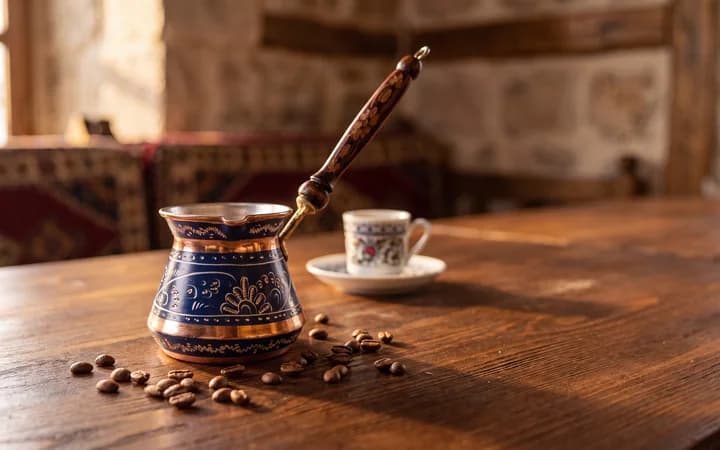
Is copper cookware safe? What unlined copper does to acidic food, how tin and stainless linings differ, its disadvantages, and what to write into your spec.

When copper pots and pans need retinning, how the process works, how to specify food-grade lead-free tin, and how importers plan renewal into total cost.
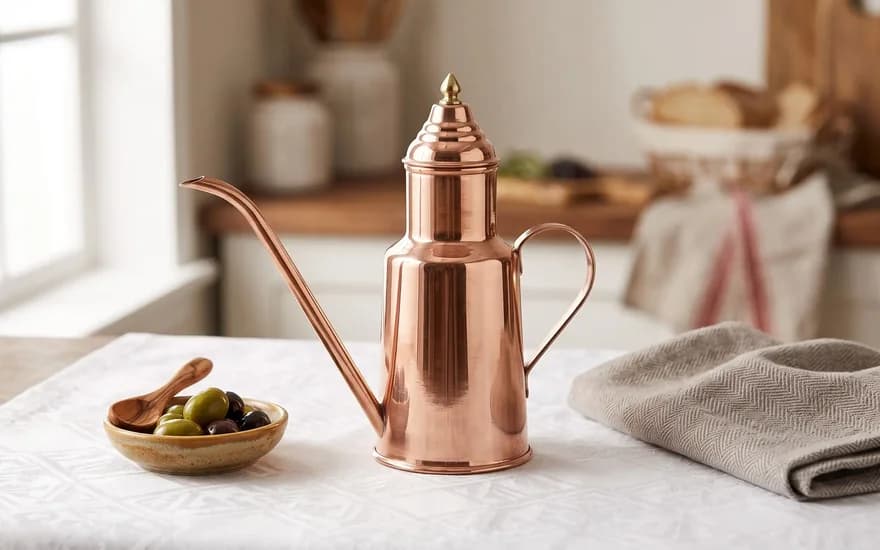
Gaziantep, Kahramanmaras, Trabzon and Erzincan compared: forming method, product depth, typical batch size and how to match a copper order to the right cluster.
Add the products you need to your quote list with quantities and send it by WhatsApp, e-mail or the form. We reply with unit prices and delivery terms.