
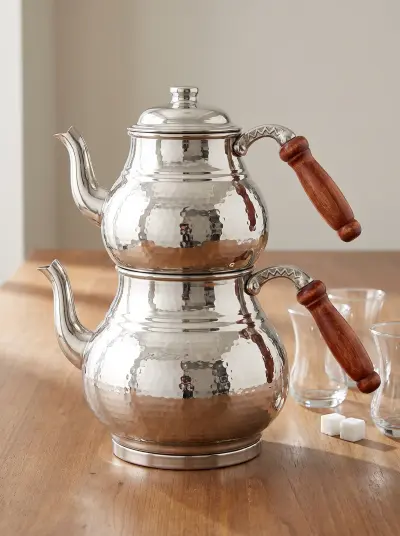
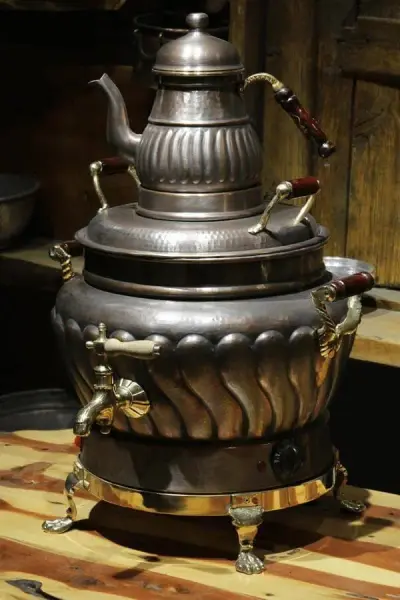
Klasik Copper Turkish Double Teapot — No. 3, light gauge, hand-hammered, nickel-plated
TC10060-2
Gaziantep, Kahramanmaras, Trabzon and Erzincan compared: forming method, product depth, typical batch size and how to match a copper order to the right cluster.
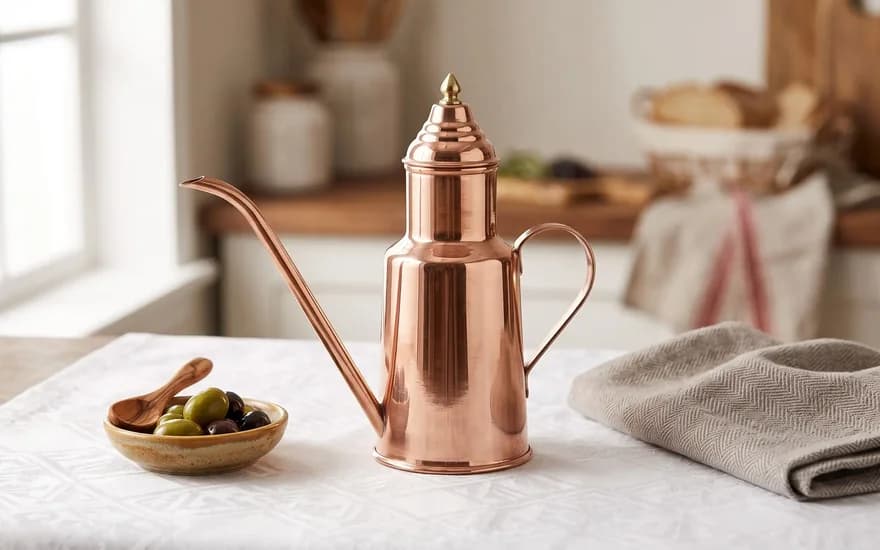
Browse the range, add the pieces you need to your quote list and ask for prices in one message. No account, no online prices.
Copper cookware production in Turkey concentrates in four craft clusters: Gaziantep, Kahramanmaras, Trabzon and Erzincan. They are not interchangeable. Forming method, product depth and comfortable batch size differ from city to city, so the right cluster is wherever your product type and your order quantity intersect.
Several workshops beating copper in one city does not make a cluster. A cluster is the environment that grew around the bench: the lathe shop that cuts dies, the foundry casting handles and rivets, the tinner, the polisher, the packer and the forwarder. Work one workshop cannot do alone is done half an hour away.
It is not an industrial zone. The benches are small independent businesses under separate ownership, bound by accumulated know how rather than a shared roof. A cluster is an ecosystem, not a supplier, and for a buyer three consequences follow.
The first is revision speed. Changing a handle profile after a sample means reworking tooling. Where the die shop is in the same neighbourhood that is measured in days; where it is not, in weeks. Sampling cost is driven less by the number of rounds than by the calendar time each one consumes.
The second is capacity substitution. When one bench fills up in peak season, another in the same cluster can run the job to a comparable standard, because both draw on similar sheet, use the same tinner and work with the same packer. Outside a cluster that substitution does not exist and the delay lands on the buyer.
The third is the training chain. Copper work is not a written procedure, it is hand knowledge passed at the bench. Where the apprentice to master chain still functions, new makers come up and a workshop closing does not take a technique with it. That is why the craft concentrates geographically instead of spreading evenly.
The useful question therefore comes before "which workshop": it is "which cluster". To pick pieces, browse the catalogue; for supplier evaluation criteria and sampling, copper cookware manufacturers in Turkey is the companion piece.
Gaziantep, in southeastern Turkey, carries the broadest product range of the four. Lined saucepans, cauldrons, pans, serving trays, coffee pots and decorative pieces are made in the same city and frequently sit in one workshop's catalogue. The production character is mixed: pressing, spinning, forging and tinning run side by side, and a share of workshops keep all those steps in house.
What really distinguishes the cluster is the density of supporting trades. Tooling, handles, rivets, packaging and freight are all solved in the same neighbourhood, so a special request is not capped by what one workshop owns. New tooling, a stamped branded run or a non standard dimension finds noticeably more traction here.
Typical batch size is medium to high. If you are consolidating a multi line order, planning a repeat programme or developing a private label collection, this is the natural starting point, and catalogue width raises the chance of working with a single counterpart.
The defining method in Kahramanmaras, inland from the Mediterranean coast, is forging. Sheet is shaped with a hammer on the bench rather than pressed into a die, and two physical consequences follow. A hammer texture lands differently on every piece, so no two pans are identical. And because the metal is worked cold, the body work hardens; rim strength and weight distribution differ from a pressed body.
The cluster concentrates on cooking and heavy service items: pans, saucepans, shallow dishes and large service vessels. Typical batch size is medium, because each piece consumes bench time and lead time extends close to linearly with quantity, so unit cost falls more slowly with volume than under pressing.
If handwork sits at the centre of your product story, if you run an open kitchen, or if you need heavy duty vessels, this is the right cluster. If your specification demands that every unit be visually identical, it is not; surface variation is the result of the method rather than a defect, and that belongs in the written specification. The durability and cost comparison between the two methods is covered separately in hand forged or machine pressed.
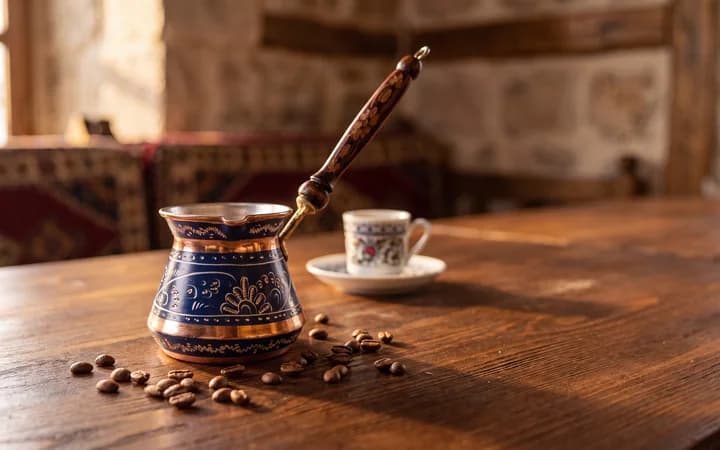
The character of the Trabzon cluster, on the Black Sea coast, sits in its form repertoire. These benches have produced the same shapes for a long time: cezve coffee pots, shallow dishes, casseroles, teapot sets and traditional service pieces. A long produced form carries a practical advantage: dimensions are settled, dies exist, and the maker knows at which step a shape gives trouble, so sampling rounds tend to be shorter.
The second distinguishing feature is that tinning survives as an active trade. Tin lining on a copper vessel is not decorative, it is functional: unlined copper reacts with acidic food and the lining interrupts that contact. Tin melts at roughly 232 degrees Celsius, which is why an empty vessel left on high heat degrades the lining directly, and why every lining is eventually renewed. Working in a cluster where the tinner is still at the bench produces more concrete answers on lining thickness and renewal terms. How that process runs is set out in the retinning guide.
Typical batch size is small to medium. For authentic forms, depth in coffee related groups, or lining quality at the centre of a specification, Trabzon is the entry point.
The Erzincan cluster in eastern Anatolia is small, and that is a position rather than a shortcoming. A limited number of makers produce a limited number of pieces, and labour time per piece runs above the average of the other clusters. The production character is hand forming and detail work, where the priority is the individual piece rather than line speed.
The cluster concentrates on decorative and gift groups: limited series collections, engraved work, pieces that can be described one by one. Batch sizes are small because of the method, not a shortage of capacity.
If you need container volumes of standard product, this cluster will not answer your requirement, and knowing that early saves weeks. If your product needs rarity and a story, as a specialist retailer, boutique hotel or corporate gifting programme, it offers what the others cannot. The constraint here is master hours rather than a production line, so one maker is not expected to run two large jobs at once and lead times are set wider. The decorative and gift category shows where this scale of work fits.
| Region | Production focus | Typical scale | Best fit |
|---|---|---|---|
| Gaziantep | Wide catalogue, lined pans, cauldrons, service, private label and custom collections | Medium to high volume | Multi line orders, repeat programmes, own brand production |
| Kahramanmaras | Hand forged pans, saucepans, shallow dishes, heavy duty vessels | Medium volume | Handwork led brands, open kitchens, heavy service |
| Trabzon | Cezve, shallow dishes, casseroles, traditional service, tinning | Small to medium volume | Authentic forms, lining sensitive specifications |
| Erzincan | Handwork, engraving, decorative and gift pieces | Small volume | Limited series, boutique collections, corporate gifts |
No row outranks another. The difference is character, not quality: the same item can be made in all four, but one specification will not land on the same cost and lead time in each. Quality is assessed at workshop level, never at city level.
The decision comes out of two variables, in this order: product type, then quantity.
Product type narrows the field. For heavy duty cooking vessels that will sit on a flame, Kahramanmaras and Gaziantep lead. For cezve, shallow dishes and traditional service pieces, Trabzon has the deeper repertoire. On the decorative and gift side, Erzincan and Gaziantep answer the same need at different scales. For a branded collection with tooling, supporting trade density decides it and Gaziantep moves ahead. The cookware category helps map subgroups to bench types.
Quantity then ranks the shortlist. A small mixed opening order and a large single line programme are not equally comfortable in one cluster. At high volume Gaziantep's combined capacity is decisive; at medium volume Kahramanmaras and Trabzon work comfortably; in limited series Erzincan has the advantage. Writing the quantity precisely in the RFQ largely settles the region question.
State a regional preference as a reason rather than a lock. "I want a forged surface" reaches more benches than "Kahramanmaras only" and produces the same outcome, because describing the method lets every workshop that uses it see the request. Region is a result; the specification is the cause.
Buying from more than one cluster makes sense in three situations: when product groups genuinely need different forming methods, such as a forged cooking group alongside a pressed service set; when one cluster's capacity cannot meet your delivery window; or when you do not want supply risk concentrated in one workshop. The cost is two production calendars and usually two preparation cycles. Order size decides whether that is worth it.
The four clusters sit in four different parts of the country, and that belongs in order planning. Gaziantep is in the southeast, relatively close to Mediterranean ports and the southern land borders. Kahramanmaras lies inland from the Mediterranean and shares much of the same corridor. Trabzon is on the Black Sea coast with its own port. Erzincan is inland in eastern Anatolia, away from any coast.
The practical consequence is consolidation. Because Gaziantep and Kahramanmaras are close, goods from both can be brought together at one point and moved as a single shipment, which lowers transport cost per line on a multi item order. Trabzon and Erzincan sit on different corridors, so bringing their goods into the same shipment adds an inland leg and extra planning time.
So when buying across clusters, three things go into writing at order stage: where the goods consolidate, who is responsible for inland transport, and when each cluster finishes production. The most common disruption is not in production but at that consolidation point, where one cluster is ready and the other late. Planning against the consolidation date rather than the production dates reduces that exposure.
Day counts and distances for a specific route move with transport mode, season and customs load, so a current plan from your own forwarder is the cheapest pre order check available.
The clusters diverge in method and scale but converge at one point. Every copper vessel intended for food contact gets its interior lined; some workshops do that in house, others send the work to a tinner nearby. A tinning chain is therefore part of the definition of a cluster: production is not sustainable where nobody does that work.
For the buyer, this chain speaks directly to product life. A vessel with a worn lining is not scrap; it is retinned and returns to service, provided someone is available to do it. On an export order that question belongs in the first conversation: does the workshop offer retinning, who pays freight for it, and if not, is there anyone in the destination market doing the work.
Four points belong in the specification: whether the interior is lined or unlined, by which method, the temperature range the item is intended for, and where responsibility for renewal sits. Unwritten at quotation stage, the prices coming back are not describing the same product and the comparison loses its meaning.
TC10060-2
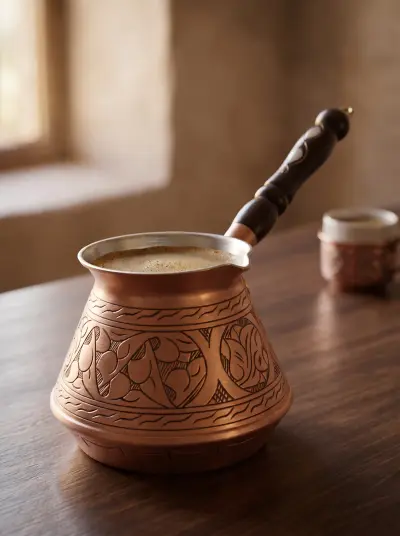
TC10055-4
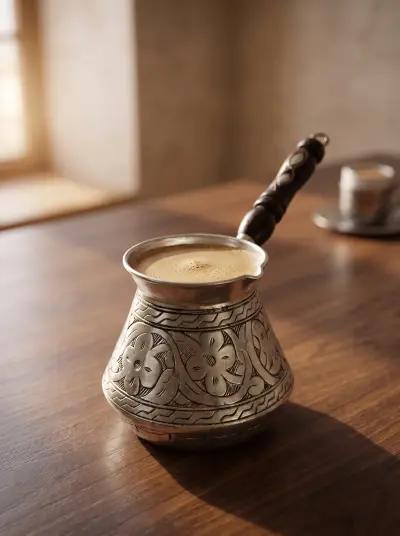
TC10055-6
TC10076-3
Production concentrates in four craft clusters rather than spreading across the country. Gaziantep in the southeast carries the widest catalogue and the highest combined capacity. Kahramanmaras, inland from the Mediterranean coast, is defined by hand forging. Trabzon on the Black Sea holds the traditional form repertoire and a living tinning trade. Erzincan in eastern Anatolia works at boutique scale.
A cluster is the environment that grew around the bench, not just a count of workshops. Die shops, handle and rivet makers, tinners, polishers, packers and freight forwarders sit within the same neighbourhood. For a buyer this translates into faster sample revisions, capacity substitution during peak season, and a training chain that keeps the craft alive.
Gaziantep, in most cases. New tooling, custom handles, non standard dimensions and stamped branding all depend on supporting trades being close to the bench, and that density is highest there. A collection that needs a new die is treated as normal work rather than as an exception, which shortens the sample loop.
Kahramanmaras is the cluster whose defining method is forging. Sheet is worked with a hammer on the bench rather than pressed into a die, so each piece carries a hammer texture that never repeats and the metal work hardens as it is shaped. Specifications that demand identical surfaces across every unit are the wrong fit for this method.
Trabzon. The benches there have produced the same forms for a long time, which means dimensions are settled, dies exist and the maker already knows where a given shape gives trouble. Sample loops tend to be shorter for those items. The active tinning trade in the same cluster also produces clearer answers on lining thickness and retinning.
In three cases: when your product groups genuinely need different forming methods, when one cluster cannot meet your delivery window, or when you do not want supply risk concentrated in a single workshop. The cost is logistical. Where goods consolidate, who owns inland transport and when each cluster finishes production all go into writing at order stage.
No. The difference is character, not quality. You can have the same item made in all four, but the same specification will not land on the same cost and the same lead time everywhere. Quality is assessed at workshop level through samples, references and documentation, never at city level.
The piece is retinned and returns to service, so a worn lining is not the end of the product. That only holds if someone is available to do the work. For export orders the question belongs in the first conversation: does the workshop offer retinning, who pays freight for it, and is there anyone in the destination market who does it.
Other guides covering the same stage of the buying process - continue reading here.

When copper pots and pans need retinning, how the process works, how to specify food-grade lead-free tin, and how importers plan renewal into total cost.
Is copper cookware safe? What unlined copper does to acidic food, how tin and stainless linings differ, its disadvantages, and what to write into your spec.

Does copper tarnish, how to clean copper pots after service, what must never touch copper, and what actually wears out: a care protocol for commercial kitchens.
Add the products you need to your quote list with quantities and send it by WhatsApp, e-mail or the form. We reply with unit prices and delivery terms.