

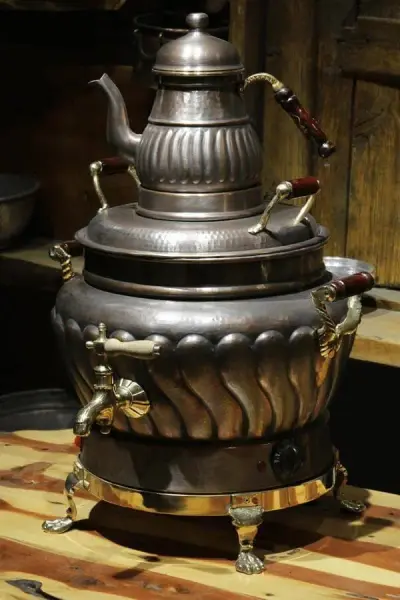
Klasik Copper Turkish Double Teapot — No. 3, light gauge, hand-hammered, nickel-plated
TC10060-2
How hand hammered copper differs from pressed and spun copper, how to spot an applied hammered finish, and which forming method suits your order volume.

Browse the range, add the pieces you need to your quote list and ask for prices in one message. No account, no online prices.
Hand hammering and machine pressing are not a quality ranking. They are two production economies: hammering makes every piece slightly different and scales with artisan hours, while pressing makes pieces identical and divides tooling cost across the run. The right method follows the product, the order volume and how much variation you can accept.
Every copper vessel starts as a flat disc, on one of four routes.
Hand hammering. The artisan works the sheet over a stake with a hammer and the metal moves blow by blow. On deep bodies such as stockpots the piece is annealed several times, meaning it is heated and cooled to soften it again before work continues.
Pressing and deep drawing. The disc is squeezed between a punch and a die and takes the tool's form in one stroke or several stages. On deep forms this is deep drawing, and because the metal is stretched the wall thins.
Spinning. The disc is pressed against a rotating chuck while the operator lays the metal over the form with a roller. Tooling is cheaper and more flexible than a press die, but every piece still passes through an operator's hands.
Hybrid production. The most common arrangement in practice, and the one buyers misread most often: the body is pressed or spun, then the rim, handles, mouth profile and surface work are completed by hand. The result contains hand work but is not hand hammered. If the specification does not define that boundary, both sides use the same word for different things.
Hammering has a real physical effect: copper work hardens when it is cold worked. The structure rearranges under repeated impact, and surface hardness increases, so a hammered body behaves more stiffly than annealed sheet of the same gauge, particularly at rims and convex surfaces. Overstating it is where most copy goes wrong; three limits apply.
First, work hardening is not a substitute for gauge. Hammering a thin body does not give it thermal mass; heat storage scales with weight, and weight scales with wall thickness. Thickness is a separate line item, as set out in the copper cookware thickness guide.
Second, the hardening is not permanent: annealing later in the sequence releases most of it, so hardness in the finished piece depends on the whole sequence rather than on the hammer alone.
Third, presses work the metal too. Deep drawing and spinning also deform copper cold and harden it. The difference is distribution rather than presence: hammering concentrates hardening where the artisan works, pressing puts it where the die geometry dictates. So "hammered is stronger" is not a specification line; durability is built from thickness, form, rim profile and handle attachment together.
This distinction is the most valuable thing in this guide, because the price gap starts here. A pressed body can be given a hammered surface after forming: by running pre-textured sheet, by texturing the die, or by passing the finished body under a mechanical hammer. From a distance the result looks hand hammered, and in a photograph the two are usually indistinguishable. With a sample in hand, these are the checks.
Regularity of the marks. Machine texture repeats: same depth, same spacing, often in tidy rows. Hand hammering varies in size, depth and angle and is denser in some zones than others. Scan one area and count how often the same mark repeats.
Agreement between inside and outside. In genuine hammering the hammer pushes metal through from one face, so every dimple outside has a counterpart inside. On an applied texture the interior is usually flat or the pattern is faint. Run a finger around the inside.
Edges and transitions. Machine texture stops at a hard boundary because it is applied to a defined area. On a hand worked body the pattern fades naturally toward the edge. The few centimetres below the rim carry the most information.
Weight and thickness distribution. On a hand hammered body a caliper reads differently at different points, and that is normal. On a pressed body the wall is systematically thinnest just above the base radius. Take readings at three points; the distribution itself identifies the method.
Symmetry. Pressed pieces are close to perfectly symmetrical; rotate a hand hammered body and the rim circle wavers by fractions of a millimetre. That is the signature of the method, not a defect.
None is conclusive alone; all five are read together. Whether the metal is genuinely copper is a separate check, covered in how to identify real copper.
There is stronger evidence than any sample: the production itself. Photographs or a short video of the forming stage for that item settle a hammering claim faster than the five checks above. Ask for it in writing at the quotation stage; not receiving it is information too. The wider discipline is covered in how to verify a copper supplier.
| Criterion | Hand hammering | Pressing and deep drawing |
|---|---|---|
| Piece-to-piece variation | Every piece slightly different | Pieces effectively identical |
| Start-up cost | No tooling, short set-up | Tooling investment paid up front |
| Cost against volume | Grows close to linearly with units | Unit cost falls as volume rises |
| Form constraints | Flexible on deep and large diameters | Limited to what the die allows |
The table is two cost curves, not a ranking. On small runs hammering starts faster and the first sample arrives sooner, because no tooling has to be cut. As quantity grows the curves cross, and past that point pressing reaches a unit cost hammering cannot match. Where the crossover sits depends on the item, the form and the workshop, so request quotes for both methods on the same item rather than guessing.
The fourth row can decide the question on its own. Tooling fixes geometry at the outset: very deep bodies, sharp internal corners and unusual mouth profiles push the die out of economic range, while in hammering the constraint is artisan time.
Pressed pieces are identical because they come off the same tool; hammered pieces each carry the trace of one artisan's hand. That is the definition of the method rather than a fault, but depending on the buyer it is either value or risk.
For hotel groups, restaurant groups and retail chains, repeatability is an operational requirement: the same presentation repeats across properties, a broken piece has to be replaceable with an identical one months later, and one catalogue image has to represent the item. The real exposure is not the first order but the top-up: a replenishment placed a year later has to stand next to the original delivery, and only the same tool makes that possible.
For chef-led kitchens, open kitchen concepts and brands built on a provenance story the logic inverts. There the variation is the product, and what the guest sees is a hand, not a standard. Specifying uniformity removes exactly what is being bought.
Either way, put the choice in writing. On hammered orders repeatability is expressed as a tolerance: which dimensions stay fixed, meaning diameter, height, capacity and a weight band, and which may vary, meaning surface pattern and the fractional waver of the rim circle. Without those two lists a buyer cannot demonstrate that an objection is founded.
In hammering, the centre of gravity is labour. Price follows how long a body takes, and total time grows close to linearly with quantity. Twice the units is roughly twice the artisan hours, and lead time is capped by how many artisans the workshop can assign. This is why doubling volume to pull the unit price down rarely lands on hammered orders.
In pressing, the centre of gravity is tooling. The die is cut once and paid up front, and each piece afterwards comes out fast and cheap; the more units from the same tool, the more thinly that fixed cost spreads. The trade-off is rigidity: changing diameter, depth or mouth profile after the die exists is a new investment. Where that decision starts to make sense in order-size terms is covered in the MOQ, pricing and lead time guide.
Hybrid production sits between the two and for most hospitality orders it is the honest answer: the body is pressed, the part carrying the character is done by hand. The pricing question then becomes which operation sits on which side. Ask for that as its own line in the RFQ; two workshops quoting very differently on the same item are often differing there.
| Product group | Method that tends to win | What decides it |
|---|---|---|
| Heavy duty cooking and stockpots | Hammering or heavy-gauge hybrid | Thickness, large diameter, mechanical load |
| Service and presentation | Pressing or spinning | Volume, repeatability, weight |
| Decorative and gift lines | Hammering or hand-finished hybrid | Surface character, small batch |
| High volume standard sets | Pressing | Unit cost, delivery speed, replacements |
The table is a starting point rather than a rule. On the cookware side the decision is taken together with gauge: on a large diameter, heavy-walled stockpot, deep drawing is physically strained and tooling cost alone can make hammering competitive. On the decorative and gift side volumes are low and surface character carries the value, so pressing often erases what made the item saleable.
Turkey's four copper clusters do not run the same processes, which is a matter of installed capability rather than a quality ranking. Kahramanmaras in southeastern Turkey is weighted toward hammering and hand-finished surfaces, so it suits small and medium batches where surface character matters. Gaziantep works with a broader catalogue and higher volumes, with deeper capacity in pressing and multi-line orders. Trabzon and Erzincan carry their own product weightings.
Sending an identical enquiry to every workshop invites some of them to quote a process they do not actually run, and that number will not hold. Naming the method filters the list to workshops that can genuinely bid. When you send a quote list for pieces from the catalogue, name the method on each line in the same way.
Left verbal, the method conversation gives neither side anything to point at. Five lines close it.
| Line | What to state | If left blank |
|---|---|---|
| Forming method | Hammered, pressed, spun or hybrid; if hybrid, which operations are by hand | The workshop assumes its own default |
| Surface texture | Whether hammer texture is required, and whether it must be applied by hand | Applied texture substitutes for hand work |
| Repeatability | Which dimensions are fixed, which may vary, within what band | No criterion remains at acceptance |
| Sample reference | Which property of the approved sample is binding | Series output drifts from the sample quietly |
| Thickness and lining | Separate lines, independent of forming method | A method answer replaces two other items |
The fourth line is the most frequently omitted and the most useful. An approved sample is a reference, not a photograph; unless you state which properties are binding, the two parties read different commitments into the same object. List them in order of priority: surface pattern, weight, mouth diameter, rim profile.
The fifth line stays separate as well. Interior lining is independent of forming method, and the choice between tin and a stainless liner is covered in the tin versus stainless lining comparison. Because tinning requires heat it comes at the end of the sequence, and depending on the temperature reached some of the hardness gained during hammering can relax, so the two belong on different lines of the same quotation.
TC10060-2

TC10055-4

TC10055-6
TC10076-3
Not automatically. Copper work hardens when it is cold worked, so a hammered surface can behave more stiffly than annealed sheet of the same gauge. But durability is set mainly by wall thickness, form, rim profile and handle attachment. Hammering a thin body does not make it a heavy one. Pressing and spinning also cold work the metal; the difference is where the hardening ends up, not whether it happens.
No, and this is the most common misreading in the category. A pressed body can be given a hammered appearance by using pre-textured sheet, by texturing the die, or by running the finished body under a mechanical hammer. To tell them apart, look at how regular the marks are, whether each dimple has a counterpart on the inside surface, how the pattern ends near the rim, and how symmetrical the body is.
If the same presentation has to repeat across properties, if a broken piece must be replaceable with an identical one months later, and if one catalogue photo has to represent the item, pressing is the safer side. For chef-led kitchens, open kitchens and boutique properties the logic inverts: piece-to-piece variation is the product, and specifying uniformity removes the thing you are paying for.
Rarely by much. In hammering, cost is concentrated in artisan hours and total time grows close to linearly with quantity, so twice the units is roughly twice the labour, and lead time is capped by how many artisans the workshop can assign. Pressing behaves the opposite way: the tooling cost is paid up front and is then divided across more units, so unit cost genuinely falls as volume rises.
The body is pressed or spun, then the rim, handles, mouth profile and surface work are finished by hand. In practice this is the most common arrangement in the category. The result contains hand work but is not hand hammered. Unless the specification defines that boundary, the buyer and the workshop will use the same word for two different products.
Run a finger around the inside surface. In genuine hammering the hammer pushes metal through from one side, so every dimple on the outside has a counterpart inside. On an applied texture the interior is usually flat or the pattern is noticeably faint. Then look at the few centimetres below the rim: machine texture stops at a hard boundary, while hand work thins out and fades toward the edge.
Four more lines: whether a hammered texture is required and whether it must be applied by hand, which dimensions are fixed and which may vary, which property of the approved sample is contractually binding, and wall thickness plus interior lining. The last two are independent of forming method, and a method answer never substitutes for them.
Other guides covering the same stage of the buying process - continue reading here.

Exterior finishes on copper cookware compared: hammered, mirror, brushed, antique patina and lacquer, with the spec lines and batch tolerances buyers leave out.
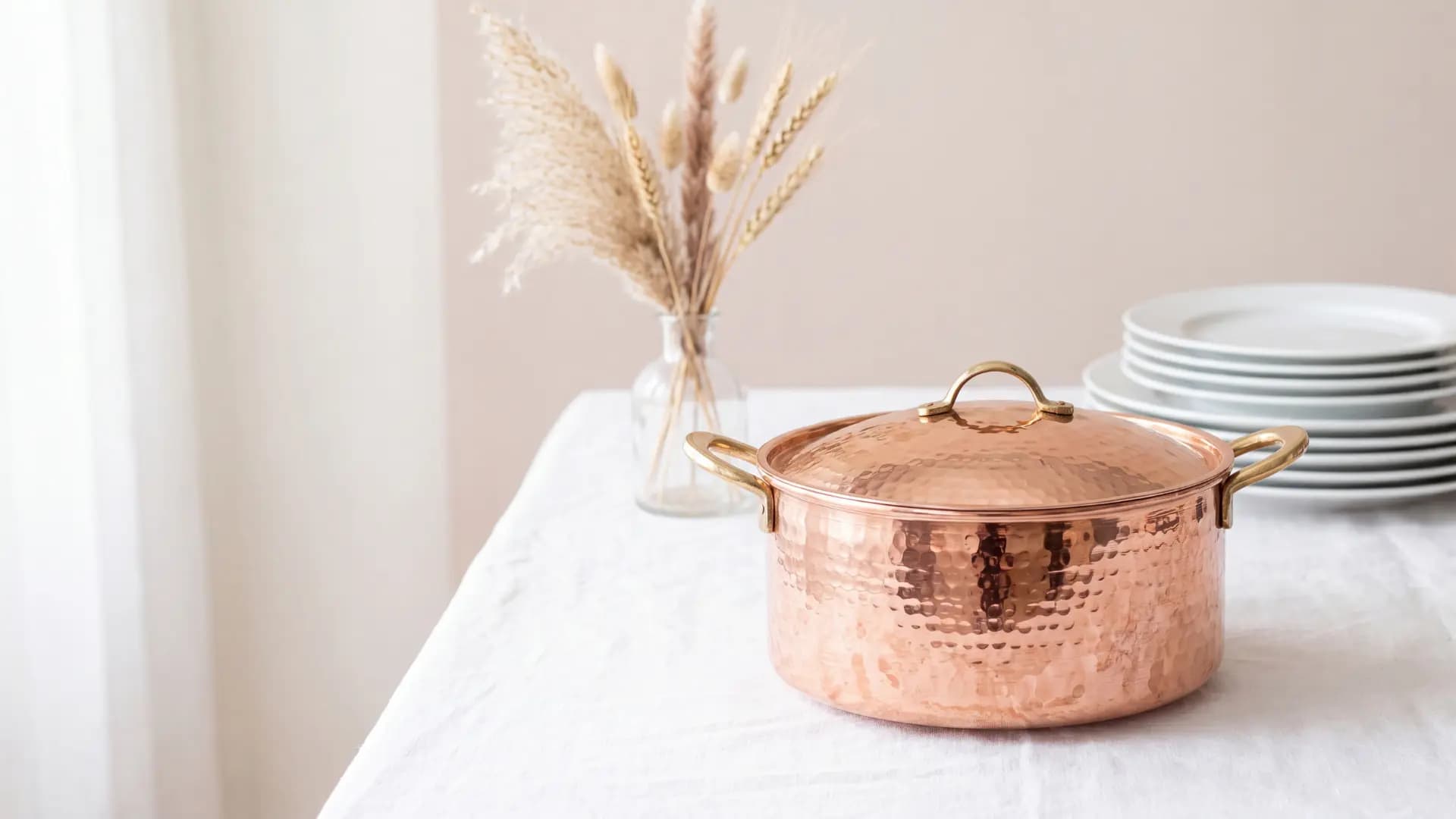
Which copper pan goes from stove to table: frying pan, lidded sahan, sac and wok pan or round gratin tray. Gauge, heat sources, tin limits and stock planning.

Copper, brass and cupronickel share one tariff heading but are three materials. Alloy definitions, the lead question and the spec lines that separate them.
Add the products you need to your quote list with quantities and send it by WhatsApp, e-mail or the form. We reply with unit prices and delivery terms.