
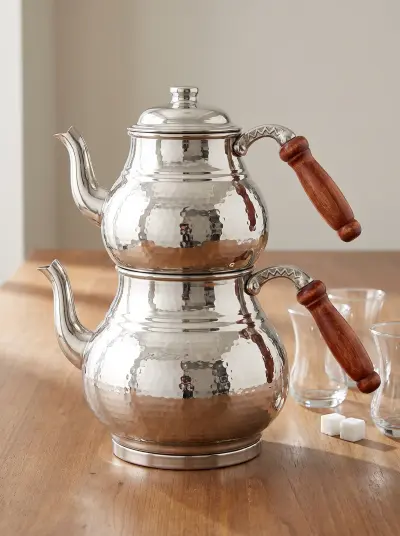
Klasik Copper Turkish Double Teapot — No. 3, light gauge, hand-hammered, nickel-plated
TC10060-2
A supplier verification method for copper cookware: three layers of proof, factory audit checklist, sample measurements, red flags and the document chain.
Browse the range, add the pieces you need to your quote list and ask for prices in one message. No account, no online prices.
Verifying a copper supplier means proving three separate things: that the company exists, that production happens at the address given, and that the product matches your specification. Each needs its own evidence, in that order, and one does not substitute for another. Skip a layer and you find out on the container, which is the expensive place to find out.
The first layer is corporate reality. Does the legal entity exist, is its registered activity manufacturing or trading, and does the person writing to you represent it. This layer runs on paperwork and is the cheapest of the three. What you are matching is consistency: registry details against the name on the quotation, the bank account title against that same name, the email domain against the company rather than a free mailbox.
The second layer is production capability. A company can be entirely real, invoice correctly and still not own a single bench. Here the questions are physical. Where is production carried out, who owns the equipment, is tinning done in house or subcontracted, what is monthly capacity, how many product lines can run at once. This is where trading desks and manufacturers separate, and it cannot be answered with documents.
The third layer is product fit, and a mismatch here is usually a definition problem rather than a dishonesty problem. If the gauge is not written in millimetres, every workshop quotes its own default and two offers stop describing the same object. The evidence is a sample, and a sample is measured rather than admired.
| Layer | What is proven | Evidence |
|---|---|---|
| Company | Legal entity, registered activity, authorised contact | Tax and registry records, corporate domain, matching bank title |
| Production | Site address, equipment ownership, tinning, capacity | Factory photos and video, live walkthrough, audit report |
| Product | Gauge, lining, dimensions, food contact file | Measured sample, laboratory report, pre-production approval |
Commissioning a sample from a contact who cannot clear the second layer is simply three weeks spent. How manufacturers, exporters and trading companies differ in this market is covered in the guide to Turkish copper manufacturers.
The most efficient verification tool is a question specific enough that a vague answer is visible as one. Asked in the first exchange, these six sort a shortlist faster than any profile reading.
Where is production carried out. An office address that differs from the workshop address is normal; refusing to name both is not. If you cannot get an answer at city and district level, someone else is probably making the goods. Cross-check what you are told against the geography set out in the guide to Turkey's four copper clusters.
Is tinning done in house. The lining is the surface that touches food, so subcontracting it moves quality control a step away. Subcontracting is not a problem in itself; not knowing who does it is. Tin melts at roughly 232 degrees Celsius, and that limit belongs in the product's use instructions.
Who owns the tooling for this item. For catalogue items the tooling belongs to the workshop. On private-label work, ownership, who pays for it and whether the cost is credited against the production run are agreed in writing before anything is cut. Skip this and you may meet your own shape in someone else's catalogue.
What is monthly capacity and how many lines run at once. Delivering the first order and repeating it identically six months later are different capabilities. Ask in the same sentence how lead time shifts in peak season.
Which countries have you shipped to. Export history saves time on packing and paperwork. Copper is heavy and soft, and a badly built pallet becomes dented goods at the destination port.
What food contact documents can you provide. An answer of "we can provide any certificate" is a warning rather than a reassurance. A good answer names the document, names who issues it and states which item it covers, a distinction developed in the food contact compliance guide.
Ask for photographs, but ask for the right ones: a generic bench shot can be found online. What is useful is the production step for your item, with cutting, forming, handle fixing and lining each distinguishable.
Video is the next step, and it should be short and continuous, because a continuous take is harder to assemble from footage shot in different places. Make the request concrete: ask for one unbroken walk from the tinning area to the forming bench. Then read it for scale and continuity. Does the number of benches match the capacity you were quoted, and do sheet stock, forming, lining and packing sit in the same building. A workshop that shows only its polishing bench is telling you the body is formed elsewhere, which shows where the chain breaks and lets you name responsibility for it in the contract.
A live video call is the strongest remote check available and it costs nothing. Book a time, then ask your counterpart to walk the production area and show your item on the bench. A refusal is itself information.
A third party factory audit makes sense at volume: an independent inspector visits, works through an agreed checklist and reports to you. In clusters like Gaziantep and Kahramanmaraş workshops sit close together, so one trip can cover several sites.
A sample does not test whether the piece is attractive; it tests whether your specification was understood at the bench. The task on arrival is measurement.
Take wall thickness with a caliper at several points between rim and base. Heavy-duty professional pieces are typically specified between 2 and 3 millimetres, and a deviation below a millimetre still shows up in weight.
Hold the interior to the light and follow the lining into the base corner, where a lining most often stops short and where wear starts in service. Check whether handles are riveted or welded and whether any gap remains at the joint, because a gap is where water sits. Confirm the piece sits level rather than rocking. Finally weigh it: in copper, weight is an indirect but reliable proxy for gauge. Field checks for confirming the metal itself are set out in how to identify real copper.
Keep the approved sample as the reference for the production run; a verbal understanding is worthless against a pallet that arrives eight weeks later. On custom sizes or branded work, ask for pre-production approval: the workshop makes the first few pieces, sends photographs, and the line continues only after you sign off.
None of these is conclusive alone. Two of them together is a reason to slow down.
Attach this block to your request for quotation. Asking every supplier the same twelve questions is what makes the returning offers comparable.
To put these questions to The Coppery, pick the pieces in the catalogue, add them to the quote list and send the questions with it by WhatsApp, e-mail or the form.
The common confusion in document verification is collapsing paperwork from different bodies into one word, "certificate". Separating the chain clarifies what to ask for and how much each document proves.
| Document | Issued by | What it proves |
|---|---|---|
| Declaration of conformity | The manufacturing workshop | That the maker declares the item fit for food contact use |
| Metal release test report | Accredited laboratory | That the tested sample measured within the stated parameters |
| Movement and origin paperwork | Chamber of commerce, handled by a customs broker | Origin of the goods and the regime they enter under |
| Proforma invoice and packing list | The manufacturing workshop | Order scope, weights and carton counts |
Requirements vary by destination market and by product, so confirm the final list with your own customs broker rather than with the supplier.
The last step of verification is not a document but a small purchase. A test order measures three things at once: whether the specification was understood at the bench, whether the packing survives the route, and whether the lead time holds. Unit cost rises because setup and freight divide over fewer pieces, and that premium sits far below the cost of learning the same lessons on a full run.
Staged scaling follows a simple sequence: a limited test batch, then a mid-sized repeat order under the same specification, then planned procurement. Each stage measures something different, namely product fit, then repeatability, then schedule discipline. A second order that drifts visibly from the first tells you quality control sits with a person rather than in a process. Photograph the pallet before opening it, because that image is usually the only evidence separating transport damage from a production defect.
Narrowing the product group speeds verification up: cookware and private label production call for different kinds of workshop, and looking for both in one supplier blurs every answer above.
A verified badge on a sourcing site means one specific thing at most: someone has confirmed a business's details and contact information. A certificate shown next to it is a separate claim with its own validity date. The two answer different questions: verification confirms who the business is, a certificate claims that an item meets a particular requirement.
What neither one does matters more. A badge does not run laboratory tests, does not issue certificates and does not guarantee product quality, and a certificate on display does not mean that document covers your order; you request its scope directly from the supplier during the quotation stage.
At best a listing helps with the first layer. The other two layers stay with the buyer, whichever supplier you buy from.
TC10060-2

TC10055-4
TC10055-6
TC10076-3
Ask three questions in the first email: where is the production address, who owns the tooling for this item, and is tinning done in house. A manufacturer answers all three without hedging and will send a short clip from the bench when asked. A trading desk generalises the answer, blurs the office address into the factory address and keeps postponing the video.
Yes. It is standard practice in international sourcing and a serious workshop does not treat it as distrust. The most useful format is one short continuous take rather than an edited montage, showing the forming bench, the tinning area and the packing bay in the same walk. A live video call works even better and costs nothing.
Take wall thickness with a caliper at several points between rim and base, not just once. Hold the interior to the light and confirm the lining runs continuously into the base corner. Check whether handles are riveted or welded and whether a gap remains at the joint. Put the piece on a flat surface to test that it sits level, then weigh it against the quoted weight.
An independent inspection company visits the site, works through an agreed checklist covering equipment, capacity, process control and packing, and issues a report to you. It is a paid service. On container-scale orders it usually amounts to a small percentage of total order value, which makes it cheap insurance on a first production run with a new supplier.
Insistence on full payment up front with no alternative discussed, a vague production address, a claim to manufacture every product category, slow and generic answers to technical questions while price answers arrive instantly, and a test report from one item presented as covering the whole catalogue. Any single signal can be innocent; two together justify a pause.
A manufacturer issues a declaration of conformity under its own signature. Laboratory testing for metal release is a different act, performed by an accredited laboratory, and the report covers the tested sample rather than the factory. Movement and origin paperwork comes through a chamber of commerce and is handled by a customs broker. A supplier that merges all three into one word is not informing you correctly.
Yes, and it is usually worth it. Setup and freight are divided over fewer pieces, so unit cost rises. In exchange you measure three things at once: whether the specification was understood at the bench, whether the packing survives the route, and whether the quoted lead time holds. That knowledge costs far less than discovering the same facts on a full container.
No. A verified badge confirms at most a business's details and contact information, and an uploaded certificate is a claim with a validity date. Neither one tests a product, issues a certificate or guarantees quality. Product fit is still established by the buyer through samples and the purchase contract.
Other guides covering the same stage of the buying process - continue reading here.
Compare Turkish copper cookware manufacturers by region, gauge, tinning and capacity. How to shortlist suppliers and request a wholesale quote.
How to set payment terms with a small Turkish workshop: deposit and balance logic, when a letter of credit is proportionate, the EXW trap, and FOB vs DAP.

How OEM and private label copper production works: three levels of customisation, tooling cost and ownership, sample sign-off, branding methods and packaging.
Add the products you need to your quote list with quantities and send it by WhatsApp, e-mail or the form. We reply with unit prices and delivery terms.