
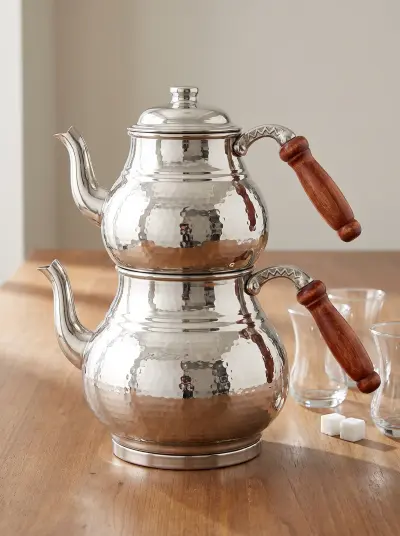
Klasik Copper Turkish Double Teapot — No. 3, light gauge, hand-hammered, nickel-plated
TC10060-2
Food contact copper cookware compliance explained: EU 1935/2004, LFGB test reports, FDA rules, Turkish documentation, and what to verify before you order.
Browse the range, add the pieces you need to your quote list and ask for prices in one message. No account, no online prices.
Compliance for food contact copper cookware is not a single certificate. It is the combination of what lines the inside of the vessel, which regulatory framework applies in the destination market, and which specific article a laboratory report actually covers. Before you order, ask three questions: what is the lining, where is it going, and what exactly does the report in front of you test.
Copper conducts heat better than almost anything else a kitchen can afford, which is why it has never left professional cooking. The same metal reacts when it meets acidic food, and copper migrates into the dish. Tomato sauce, vinegar, citrus juice, brines and wine accelerate that reaction; long contact times and high temperatures amplify it.
That is why cooking vessels are lined. The traditional lining is tin, applied by hand and renewed periodically; the lining that spread with industrial production is stainless steel. For a buyer the difference is thermal: tin melts at 232 °C, not a defect but a physical property that has to appear in the use instructions. Steel tolerates far higher temperatures and never needs renewal, at the cost of the softer heat response. Lining lifespan and re-tinning intervals are covered in tin lining care.
The compliance question depends on what the article does. A pan or stockpot heated on a flame makes hot, prolonged contact with food and is the most closely scrutinised class. A serving tray or pitcher makes short, usually cold contact. Ornaments never touch food and are not expected to carry food contact documentation — until the catalogue positions them as serveware.
Drawing that line at the quotation stage removes most of the arguments that surface later. Open cookware and serving and presentation items as separate lines even within one enquiry, and state the documentation you want for each line independently.
The foundation is Regulation 1935/2004, the framework regulation on materials and articles intended to come into contact with food. It sets the general principle: a food contact material must not transfer its constituents to food in quantities that could endanger health or unacceptably change the food's composition, taste or odour. The framework also addresses traceability and labelling — which is why articles not yet in contact with food carry a food contact statement or the glass-and-fork symbol.
The second layer is Regulation 2023/2006 on good manufacturing practice. It looks at the process rather than the article: quality assurance, raw material selection, record keeping. A workshop's standing on this layer is read from process documentation, not from a single test report.
The point most importers get wrong sits on the third layer: there is no harmonised EU-level specific measure for metals and alloys. Do not expect the single binding list that exists for plastics. The gap is filled from two directions: the Council of Europe technical guide on metals and alloys used in food contact materials, which sets out release references for individual metals and gives laboratories a working basis but is not binding EU law; and national legislation in individual member states, which is not identical from one to the next.
In practice a German importer and an Italian importer can reasonably ask for different document packages and both be correct. The productive question is not whether an EU certificate exists, but which national rules apply at the point of entry and whether your report covers the measurements they expect.
A written declaration of compliance is the document in which the manufacturer states that the article conforms to the applicable rules. Because metals fall outside a specific EU measure, the obligation to issue one does not read directly off the framework — yet member state rules and commercial contracts request one almost universally. A useful declaration names the manufacturer and the article, specifies base material and lining, states the intended conditions of use (temperature, contact time, food type), and cites the date and reference number of the test report behind it.
Traceability is separate: whether you can tie a shipped batch back to a production run and a raw material intake. That link determines how wide a recall has to be.
LFGB is the German body of law covering food, everyday consumer commodities and animal feed. It is not a certification scheme. What circulates in the trade as an "LFGB certificate" is a laboratory report on a specific sample, stating that the result met the expectations applying under that law.
A laboratory measures what the interior surface releases when brought into contact with defined food simulants at a defined temperature and time. For copper articles the focus is copper release; for tin-lined articles the tin and other constituents of the coating alloy may also be assessed.
What it tells a buyer is precise: the sample tested, under the conditions tested, was found compliant. What it does not tell you is equally precise. It does not extend to the factory's whole range, it does not run indefinitely, and it does not survive a change of lining method or supplier. If the laboratory is not accredited, the paper carries little weight at customs or in an audit.
The FDA regulates substances that come into contact with food through rules, not by issuing approvals to factories or individual items. "FDA approved copper cookware" is therefore a sales phrase, not a verification, and should read as a warning sign in supplier assessment.
The model rules the FDA publishes for food service establishments, adopted at state level, restrict contact between copper or brass and acidic foods such as vinegar, fruit juice and wine, with defined exceptions such as beer brewing vessels. For a buyer selling into US hotel and restaurant kitchens the consequence is direct: an unlined copper cooking vessel can create problems in a commercial kitchen inspection, while the same article assessed as decorative is judged differently.
Responsibility for holding the evidence rests with the importer of record. Without a material and lining specification and an accredited laboratory report in your own files, a supplier's verbal assurance offers no protection. Most buyers working this lane split orders into two headings: full documentation for food contact items, and an explicit non-food-contact description for decorative ones.
In Turkey, materials and articles in contact with food are governed by regulations under the Turkish Food Codex, which follow the same logic as the EU framework: no unacceptable transfer of constituents to food, good manufacturing practice in production, and traceability.
The Turkish Standards Institution is a separate layer: it publishes standards and issues conformity certificates. A TSE certificate shows the product was assessed against the relevant Turkish standard; it does not substitute for what your destination market expects.
The realistic document set an exporting copper workshop can produce is: a food contact test report from an accredited laboratory, a written declaration of compliance, a material and lining specification, a TSE certificate where one exists, and production and batch records. Which combination is sufficient for which market depends on the article. Requirements vary by market and by product; final confirmation belongs with your own customs broker and the authority of the destination market.
| Market | Governing framework | What to request from the supplier |
|---|---|---|
| European Union | Regulation 1935/2004 framework, 2023/2006 good manufacturing practice; for metals, the Council of Europe technical guide plus national rules | Written declaration of compliance, accredited metal release test report, traceability records |
| Germany | Expectations applying under LFGB | Sample-based LFGB conformity test report, lining specification |
| United States | FDA food contact substance rules; state-adopted model rules in food service | Material and lining specification, accredited laboratory report, explicit statement of where unlined copper is used |
| Turkey | Turkish Food Codex food contact regulations | Food contact analysis report, declaration of compliance, TSE certificate where held |
Three parties sit in the document chain and each can only produce what it creates. The workshop supplies the material and lining specification, the declaration of compliance, batch records, and its own certificates. The laboratory supplies the test report; the signature and accreditation number on it belong to the laboratory, not the workshop. The customs broker tells you the declaration and labelling obligations current at the point of entry, and neither tests nor certifies the article.
Knowing this saves time: asking a workshop to widen a report's scope is meaningless, because scope is set by the sample. What you ask for is a new sample and a new test for the article not covered.
Separate a certificate from a test report. A certificate is a body attesting to a system or product; a test report is a laboratory's measurement on a specific sample. In food contact work the weight sits with the report.
Read the scope. Which article, which lining, which contact conditions? A report for a tin-lined sauté pan does not carry a steel-lined stockpot.
Check the date and the laboratory. An out-of-date report, or one from a laboratory without recognised testing accreditation (ISO/IEC 17025), will not carry you. Look for the accreditation number printed on the report.
Test your own sample. On high volumes or with a new supplier, send a sample you chose to a laboratory you chose. The cost is small next to a container sitting at the border.
Confirm that production matches the sample. Keep a reference unit, write the lining type and application method into the contract, and draw units from the batch at pre-shipment inspection. How order terms and minimum quantities interact with this is covered in the MOQ, pricing and lead time guide.
While the paperwork sits in a file, the article itself has to say the right thing. For tin-lined pieces the instructions state the heat limit plainly: no high flame under an empty vessel, no very high temperature frying. Tin melts at 232 °C, and a melted lining ends both the article and its food safety. Steel-lined pieces carry a much higher ceiling and different wording.
Instructions in the language of the destination market, a food contact statement or symbol on the packaging, and cleaning and re-tinning guidance belong to the same package. For explaining copper authenticity and lining at the point of sale, see how to identify real copper.
Food safety information sits at two levels, and a buyer should keep them apart. At product level there is the supplier's declaration: the certification under which the item is offered. At producer level there is the document: the test report or certificate file itself.
The separation matters. An item that is declared but undocumented is not documented; a badge on a listing says a document was seen, not that it covers your article; and once a validity date passes, the document no longer supports the claim. A badge is not a laboratory test, and the file itself is what you request from the supplier during quotation.
The working flow: pick the items in the product catalogue, add them to the quote list and state your documentation requirements when you send it — naming the destination market, the lining, and the article each report should cover. The Coppery replies with a wholesale quote for that order. For cluster specialisation, see the guide to Turkish copper manufacturers.
TC10060-2

TC10055-4

TC10055-6
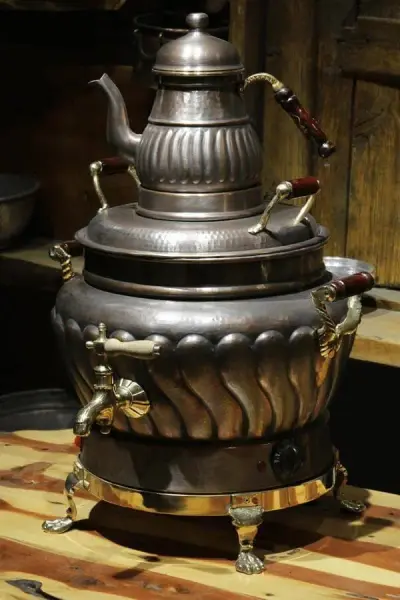
TC10076-3
Not for general cooking. Bare copper reacts with acidic food and copper migrates into the dish, which is why cooking vessels are lined on the inside with tin or stainless steel. Unlined copper is normally reserved for exteriors, decorative pieces, and parts that never touch food.
No. LFGB is the German body of law covering food, consumer commodities and animal feed. What suppliers call an LFGB certificate is a laboratory test report on a specific sample, stating that the tested article met the expectations that apply under that law. It is not a permanent licence granted to a factory.
As a rule, no. A report covers the sample tested, the lining that sample carried, and the contact conditions used in the test. A report for a tin-lined saucepan does not cover a steel-lined stockpot or an unlined serving tray. If a report claims to cover a product family, that claim has to be written into its scope section.
The package usually requested is a written declaration of compliance for food contact use, a current metal release test report from an accredited laboratory, a material and lining specification, batch traceability records, and use instructions in the language of the destination market. The final list depends on the article and on the member state of entry.
The FDA regulates food contact substances through rules rather than by approving individual factories or items, so the phrase FDA approved cookware is a marketing claim, not a verification. For goods entering the United States, evidence of compliance is the material specification and test documentation the importer holds.
Tin melts at 232 °C. The limit belongs in the use instructions and, where possible, on the packaging: no high flame under an empty pan, and no very high temperature frying in a tin-lined vessel. Steel-lined pieces tolerate considerably higher temperatures and need different wording.
Keep a copy of the approved sample as a reference, write the lining type and application method into the purchase contract, and draw units from the batch at pre-shipment inspection. Document verification and production consistency are two separate controls, and the second one is established contractually, not by a certificate.
No. Certificates and test reports come from accredited laboratories, not from a seller. Buyers request the document for each article from the supplier during the quotation process and check that its scope, validity date and destination market match the order.
Other guides covering the same stage of the buying process - continue reading here.
How to plan a first mixed wholesale copper order from Turkey: choosing a trial range, reading stock codes, setting quantities and writing a quote request.
A decision roadmap for importing Turkish copper to resell: choosing a channel and product families, market rules, landed cost, a first order and after-sales.

How to classify copper kitchenware under heading 7418, build a landed cost sheet line by line, and assemble the document pack behind your customs value.
Add the products you need to your quote list with quantities and send it by WhatsApp, e-mail or the form. We reply with unit prices and delivery terms.