
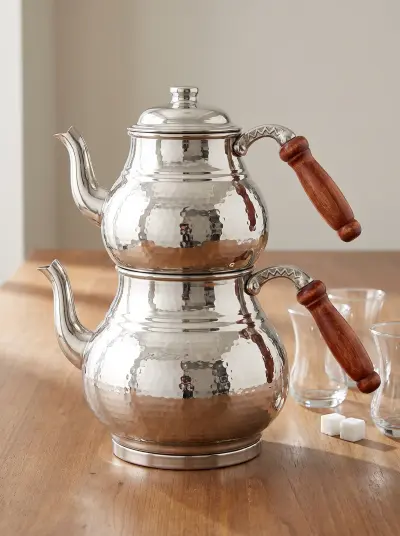
Klasik Copper Turkish Double Teapot — No. 3, light gauge, hand-hammered, nickel-plated
TC10060-2
How to plan a first mixed wholesale copper order from Turkey: choosing a trial range, reading stock codes, setting quantities and writing a quote request.
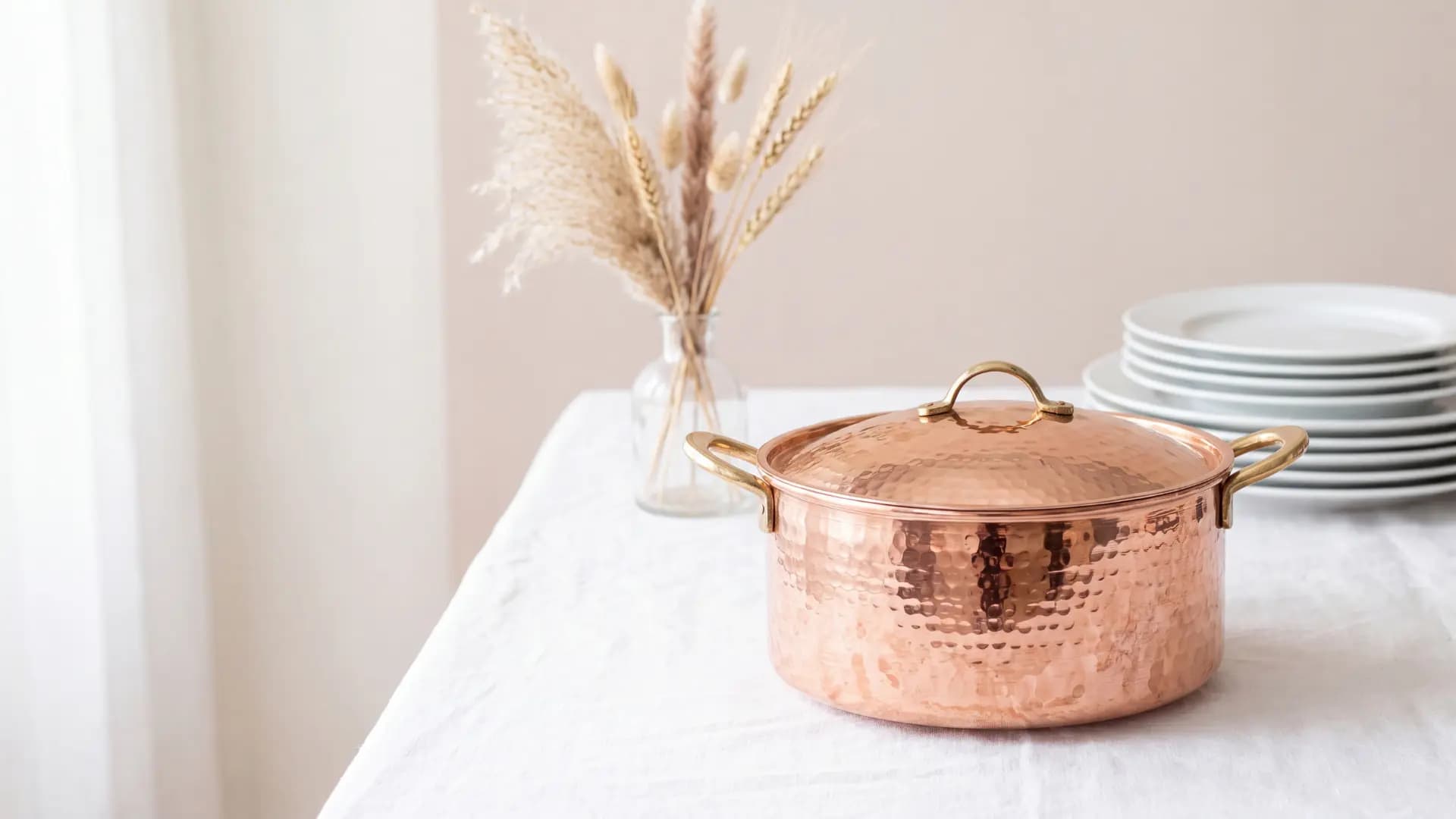
Browse the range, add the pieces you need to your quote list and ask for prices in one message. No account, no online prices.
To place a first wholesale copper order from Turkey, send a short, mixed trial range as one quote request. Every line carries the stock code, variant and quantity, and the message adds destination, preferred Incoterm and target date. A list built that way gets a written quote you can accept without follow-up questions.
A trial assortment is a small cross-section of the range you eventually expect to buy, chosen so that the first shipment tests every product family, finish and packing problem you will meet later. Think of it as a test of the riskiest parts of the full order, not a miniature of it.
Start from use, not from the category tree of the copper wholesale catalogue. A restaurant group needs pieces that go on heat, pieces that go to the table and pieces that carry drinks, and each family behaves differently in service, in washing and in transit. A boutique retailer needs entry-price pieces that turn quickly, a few display pieces that anchor the shelf and at least one gift-ready item. A new importer needs enough breadth to show prospective customers the range without tying up capital in untested lines.
A practical rule is three to five product families, two or three sizes or finishes inside each, and nothing that you would not reorder if it sold. For a first copper order that typically means one family from copper Turkish coffee pots, because the cezve (the Turkish coffee pot) is one of the most recognisable Turkish copper objects and easy to explain to an end customer; one drinkware family from copper cups, tumblers and Moscow mule mugs, because drinkware is bought in larger counts and exposes finish consistency quickly (bars should also read wholesale copper barware for bars); and one tableware family from copper serving plates and platters, because large flat pieces show how well the packing protects a surface.
Leave out, for now, anything that depends on a decision you have not made yet: a branded collection before you know which shapes sell, a full cookware battery before your kitchen has tested one pot, or a large-format piece whose freight cost you have not seen. Those belong in the second order, sized from what the first one taught you. For the broader picture of what can be sourced and how the categories fit together, the wholesale copper kitchenware sourcing overview maps the whole range.
Sector-specific shortlists already exist if you want a starting point. Hotel buyers can work from the hotel OS&E copper procurement guide, and restaurants with a Middle Eastern menu from the Middle Eastern restaurant copper checklist.
Every product in the catalogue carries a stock code made of TC, five digits, a hyphen and a variant suffix, and that full code is what should appear on your quote list. The five digits identify the product; the suffix identifies the exact version you want priced.
Take four real lines from the catalogue:
In most product lines the single-digit suffix names the finish: 1 for polished copper, 2 for nickel-plated, 3 for oxidised and 4 for brushed matt, with a few lines using other digits for fully tinned or copper-and-tin two-tone versions. So TC20001-2 is the same tumbler in nickel-plated finish, and TC20001-3 the oxidised one. Where a drinkware line is also sold in boxed sets, a two-digit suffix usually combines set size and finish: TC20001-21 is a set of two in polished copper, TC20001-41 a set of four, TC20001-61 a set of six. The pattern is a reading aid, not a rule to rely on blindly; the product name on the card is the authority, so check it before you type a code by hand.
The product page also lists the specifications that matter for a buyer where they are recorded: capacity or diameter, height, sheet thickness, weight and handle material. The Kervan coffee pot, for example, is listed at 0.70 mm and 124 g, the Külah plate at 0.80 mm and 696 g. Weight per piece is the number your freight forwarder will ask for first, and thickness is the number you will check on arrival.
A product marked in stock can ship from existing inventory, while an out-of-stock product is made for your order, so the two kinds of line carry different lead times and sometimes different minimums. A first order runs fastest when its core lines are in stock.
The product card shows the difference plainly. In-stock items display "In stock"; the others display "Currently out of stock — ask about a production run". Out-of-stock items are not withdrawn. You can still add them to the quote list, and the written quote will treat them as a production line with their own timing.
Stock is tracked per variant, not per product, and this is the detail first-time buyers miss. For example, the single polished tumbler TC20001-1 is in stock while the boxed set of six, TC20001-61, is not, or one finish may be available while another needs a run. If timing matters, check the stock badge on each exact variant before you finalise the list, and consider whether a different finish or set size that is already in stock would serve the purpose equally well.
When you include production lines, say whether the order may ship in two parts: one consignment saves on freight and clearance, while shipping the in-stock lines first protects an opening date. The supplier can only plan for the option you state.
Quantity per SKU should come from expected use or sell-through for one replenishment cycle, not from a round number per line. Enter the quantity you would actually order, because the price on each line is calculated from it.
For a restaurant, count what is in service at the busiest sitting, add what is circulating through the wash-up, and add an allowance for damage and loss. Small items such as sauce dishes and coffee pots disappear faster than plates and trays, so their allowance should be larger. For a retailer, estimate how many units of each line you expect to sell between deliveries and how many you need on display; a display piece may justify only a handful of units, while a best-selling tumbler or cezve justifies a deeper position. For an importer, quantities should reflect the customers you already have in conversation, not the ones you hope to find.
Two adjustments keep a first list realistic. Weight the quantities towards the lines you are most confident about rather than spreading them evenly, and if a line looks too small to be worth quoting, merge it into another variant instead of dropping it; the written quote will show any line that falls below its minimum. How minimums are set and how they move with quantity is covered in copper cookware MOQ, pricing and lead times.
A complete quote request gives every line a stock code, a variant and a quantity, and gives the order as a whole a destination, a delivery term, a target date and a buyer profile. The quote list carries the lines; the note field and the form carry the rest.
When you add products to the quote list, each line already holds the stock code and lets you set the quantity. The form then asks for your full name, company, country, e-mail and phone or WhatsApp number, and offers a note field for everything else. Use this checklist for that note.
| Field | What to write | Why it matters |
|---|---|---|
| Stock code and variant | Full code with suffix, for example TC20001-1 | Removes any doubt about finish or set size |
| Quantity per line | The number you would actually order | Price and minimum are calculated per line |
| Destination | Country and city or port of delivery | Drives freight, documents and duty |
| Preferred Incoterm | For example EXW, FCA, FOB or DAP | Defines who pays and arranges each leg |
| Target date | When the goods must arrive, and why | Tells the supplier whether stock or production fits |
| Buyer type | Restaurant group, retailer, distributor or importer | Shapes packing and paperwork |
| Packing | Bulk export carton or retail box | Retail packaging is a separate cost |
| Split shipment | One consignment or in-stock lines first | Changes the shipping plan |
| Branding or custom size | Describe it, with the closest stock code | Quoted as a separate line |
Two lines of context help more than a long introduction: opening a second restaurant with a given number of covers, or testing copper in a homeware shop before a wider rollout, tells the supplier which questions to ask.
A good first quote list fits on one screen: a handful of lines across two or three families, each with a full stock code and a quantity, followed by a short note. The example below shows the shape; the quantities are placeholders to illustrate structure, not a recommendation.
| Stock code | Product | Quantity | Line note |
|---|---|---|---|
| TC10011-1 | Kervan Turkish coffee pot, 150 ml, polished | your quantity | Core line, in-stock variant |
| TC20001-1 | Copper tumbler, 450 ml, polished | your quantity | Single pieces, not boxed sets |
| TC20001-4 | Copper tumbler, 450 ml, brushed matt | your quantity | Second finish for comparison |
| TC30040-1 | Külah round serving plate, 23 cm | your quantity | Check surface on arrival |
| TC10169-1 | Dalyan sauce dish, 14 cm | your quantity | Higher allowance for loss |
The note under such a list might read: delivery to Rotterdam, preferred FCA or DAP to our warehouse, goods needed before the start of the spring season, boutique retailer with two stores, bulk export cartons, one consignment preferred, please confirm the interior surface of each food-contact item in writing.
That last request matters. Copper that touches acidic food needs a lining, and whether a given piece is tin-lined, stainless-lined or unlined should be stated line by line in the written quote rather than assumed from a photograph. For buyers in the United States, the FDA Food Code (section 4-101.14) does not allow copper to contact food below pH 6; the consequences are set out in the US Food Code rule on tin-lined copper. Asking in the first message saves a correction later.
The written quote answers your list line by line, with a unit price, the minimum quantity that applies, the lead time and the shipping terms for your order, and it becomes the reference document for everything that follows. There is no fixed online price; wholesale prices are quoted per order, by quantity and destination.
Read the quote against your own list before you reply:
| Quote element | What to check |
|---|---|
| Line items | Every stock code and variant matches your list |
| Unit price | Stated per line, at the quantity you gave |
| Minimum quantity | Any line where your quantity falls short |
| Lead time | Separate timing for stock and production lines |
| Delivery term | The Incoterm and named place you asked for |
| Packing | Bulk or retail packing as requested |
| Validity | How long the quoted figures stand, if stated |
If a line has changed, for example a different finish offered because the requested one needs a production run, accept or reject it explicitly in writing. A quote that you accept without comment on such a substitution has, in practice, changed your order.
On a first order, samples confirm the product, payment terms manage the trust gap, and the Incoterm fixes where responsibility for the goods passes from seller to buyer; each of these is agreed in writing before production starts.
Samples. Ask for samples of the lines that carry the most risk: cookware that goes on heat, a finish you have not seen in person, a piece where colour consistency across batches matters. Low-risk lines can go straight onto the trial order. How sample fees, approval and the approved reference piece work is set out in sample orders and pre-production approval.
Payment. A deposit and balance structure is common for a first order between parties who have not traded before, and the size of the order should match the level of trust on both sides. A deliberately small first order is often the cheapest way to build that trust. The options and their trade-offs are covered in payment terms and Incoterms for copper orders.
Incoterms. Under the Incoterms 2020 rules published by the International Chamber of Commerce, EXW and FCA place most transport on the buyer, FOB and CIF are for sea and inland waterway transport, and DAP delivers to a named place in the destination country with import clearance left to the buyer. If you have no forwarder yet, say so, and ask for a quote on the term that makes the least work for your side. Before you send a deposit to any supplier, run the basic checks in how to verify a copper supplier.
Inspection confirms that what was made matches what was quoted, and packing decides whether it still matches when it arrives; both should be named in the first order rather than left to default practice.
Inspection. State in your order that the goods will be checked against the quoted specifications before shipment, and say who will do it: your own representative, a third-party inspection company, or the supplier with a photo and measurement report. For copper, check wall thickness against the listed figure, any lining, finish consistency across a batch and handle fixing. Sampling levels, defect classes and how to tie the report to the balance payment are explained in pre-shipment inspection for copper orders.
Packing. Copper is soft and its surface marks easily, so every piece needs its own protection inside the carton and pieces must not touch one another. Copper is also dense, at about 8.96 g/cm³, so a carton of plates or trays reaches its weight limit long before it fills its volume, which is why piece weights on the product page matter for freight planning. In a mixed order, mark each carton with the stock codes it contains so the packing list can be checked line by line. The full specification, from inner wrap to pallet, is in copper export packaging and container loading.
On arrival, check the shipment against your quote list, the accepted written quote and the packing list, in that order. Photograph any transit damage before unpacking further, and measure a few pieces of each line against the product page specifications. That check, together with the following weeks of sales or service data, sizes your second order.
TC10060-2

TC10055-4

TC10055-6
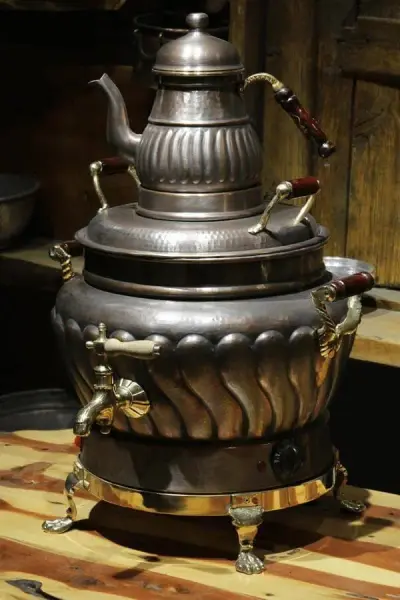
TC10076-3
The minimum order quantity (MOQ) is set per order and per product rather than as one fixed figure for the whole catalogue. In-stock pieces usually carry a lower minimum than items that need a production run, and a mixed order is judged as a whole as well as line by line. The written quote states the minimum that applies to each line, so you can adjust quantities before you commit.
For evaluating quality, a sample request is a better tool than a single-unit order, because it is priced and shipped as a sample with its own terms. Keep samples for the few pieces you need to see in person, and order the rest of the trial range in the quantities you would actually use or sell.
Yes. Each finish has its own stock code, so polished, nickel-plated, oxidised and brushed matt versions of the same tumbler are separate lines on the quote list with their own quantity. Mixing finishes is common for retail shelves. For a restaurant table, choose one finish per product family so that pieces bought in different batches still look like one set.
Yes. The written quote answers the lines and quantities you sent, so you can reply with revised quantities, drop a line or swap a finish before you confirm. Because unit price and minimum quantity are calculated per line, a changed quantity gets a revised quote. Confirm the final version in writing before any deposit is paid.
No. The quote list can be sent three ways: through the form, by WhatsApp or by opening a pre-filled message in your own e-mail app. Each route carries the stock codes and quantities for you. Use the channel your purchasing team already works in, and keep the written reply as the reference document for the order.
Describe it in the note field of the quote list: the closest catalogue item by stock code, the dimension or capacity you need and the quantity. A custom size or a branded piece is quoted as a separate line from stock items because it usually involves preparation work before production. Keep custom requests separate so they do not slow down the quote for the standard range.
That depends on your country and on the Incoterm you choose. Under the delivered terms DAP and DPU the seller arranges more of the transport, but import clearance and duties remain the buyer's responsibility; only DDP moves them to the seller. Many first-time importers appoint a customs broker or freight forwarder for this. Confirm the tariff classification and any food-contact rules with them before you order.
Other guides covering the same stage of the buying process - continue reading here.
A decision roadmap for importing Turkish copper to resell: choosing a channel and product families, market rules, landed cost, a first order and after-sales.

Copper cookware and CBAM: what Annex I actually lists, why HS 7418 is absent, plus the packaging rules and green claim limits that do apply to your shipment.
Copper cookware enters the US at roughly 53 percent duty: the MFN rate, the Section 232 tariff on full customs value, and how to contract around a moving scope.
Add the products you need to your quote list with quantities and send it by WhatsApp, e-mail or the form. We reply with unit prices and delivery terms.