
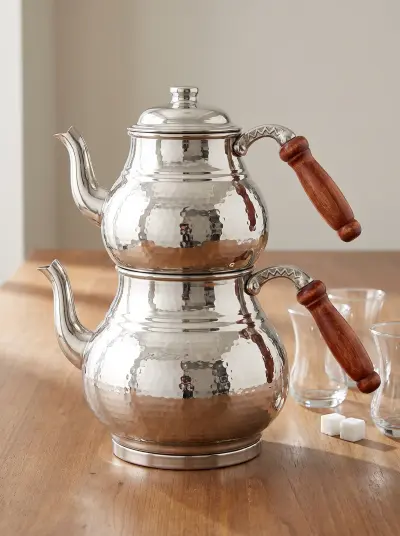
Klasik Copper Turkish Double Teapot — No. 3, light gauge, hand-hammered, nickel-plated
TC10060-2
A decision roadmap for importing Turkish copper to resell: choosing a channel and product families, market rules, landed cost, a first order and after-sales.
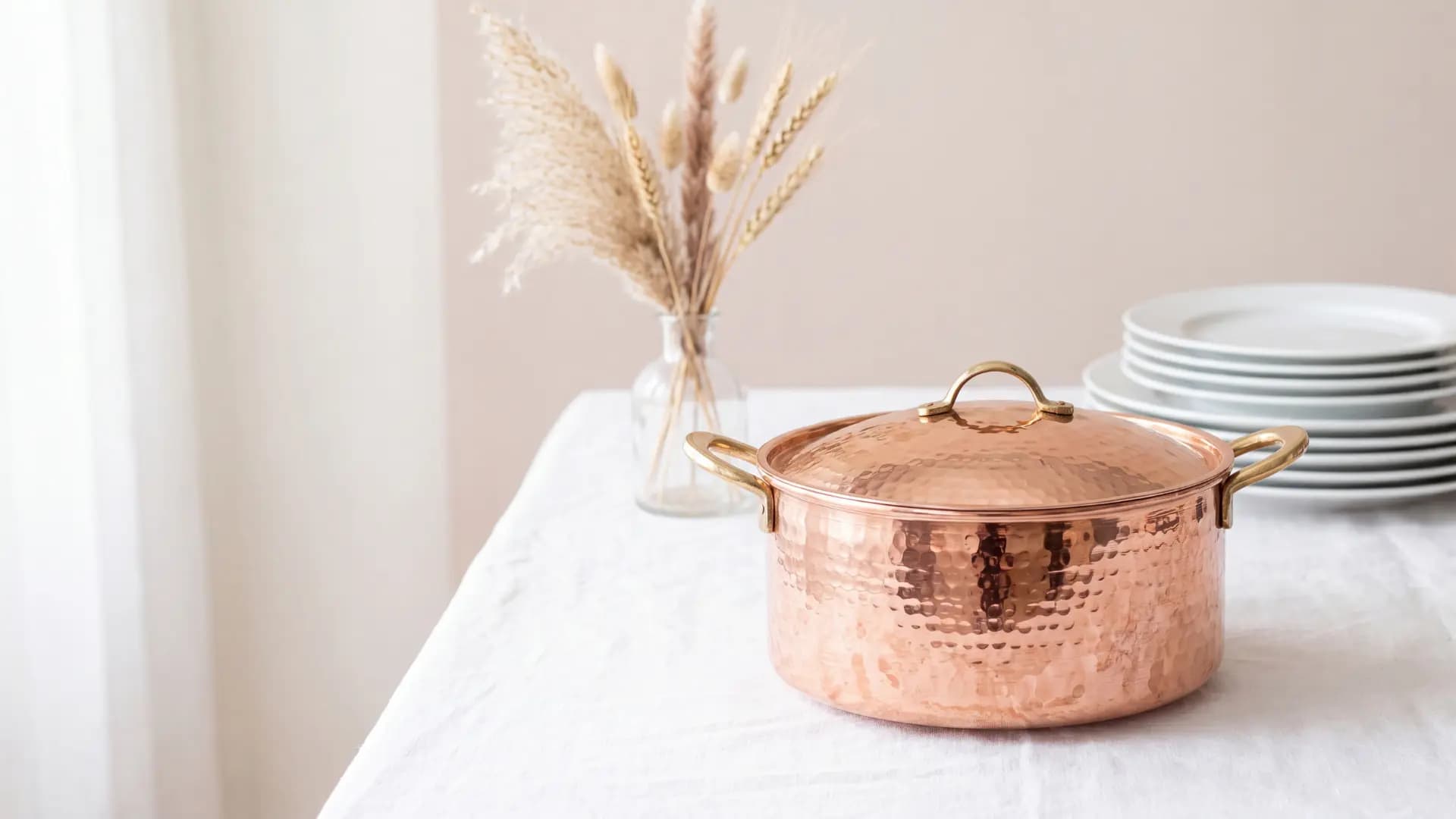
Browse the range, add the pieces you need to your quote list and ask for prices in one message. No account, no online prices.
To start a copper import and distribution business, pick one sales channel first, then the product families that channel actually buys, check the import rules of your target market, and price the full landed cost before ordering. Turkey supplies a broad handmade copper range; a small, deliberate first order through a written quote tests the plan.
Start with the channel you can already reach, because each channel buys different copper, asks for different paperwork and pays on different terms. Restaurants, retail stores, online shoppers and corporate gift buyers are separate businesses that happen to share a product.
Most new copper importers come from one of three backgrounds: an existing housewares or gift distributor adding a premium line, a HORECA supply company (hotels, restaurants and catering) whose customers ask for copper, or an entrepreneur who knows a community or a niche that values Turkish copper. Each background brings customer relationships in one channel. Building the range around those relationships is faster than designing a range first and looking for buyers afterwards.
The table summarises how the channels differ in practice.
| Channel | Who buys | Best product families | Key requirement |
|---|---|---|---|
| HORECA supply | Restaurant owners, hotel purchasing, bar managers, caterers | Pots and pans for show cooking, serving plates, trays, sauce dishes, pitchers, tumblers | Lining confirmed per item, consistent finish on reorders, a renewal plan |
| Retail stores | Homeware shops, concept stores, gift shops | Cezve (Turkish coffee pot), tumblers, sugar bowls, spice jars, planters, candle holders | Retail packaging, care cards, clear food-contact labelling |
| Online direct | End consumers through your own shop or a marketplace | Light, compact pieces such as cezve, mule mugs, small planters, incense burners | Parcel-proof packing, good photographs, piece weights for postage |
| Corporate gifts | Gift agencies, company purchasing teams | Tumblers, coffee sets, double teapots, decorative pieces | Engraving or logo, a firm delivery date, gift boxes |
| Trade distribution | Other shops and restaurants in your region | Deep stock of proven lines across the above | Stock holding and reorder continuity |
Two patterns show up repeatedly. HORECA customers buy fewer designs in larger quantities and judge you on whether the second delivery matches the first. Retail and online buyers want variety, so the range is wide and shallow, and margin depends on how fast each line turns. Choosing one of the two as the core of the business and treating the other as an extension keeps purchasing decisions coherent.
Choose product families by how the end user handles them: heat, food contact, washing and display each impose different demands. A family that is easy to import can still be hard to sell if your channel cannot explain or maintain it.
Cookware is the most technical family. The copper cookware range covers saucepans, rondeaus, frying pans, sauce dishes and wok pans; the TC10083-1 saucepan, for example, is listed at 26 cm, 0.70 mm and 1880 g, and the Soylu frying pan TC10120-1 at 16 cm, 0.80 mm and 390 g. Cookware suits HORECA and specialist kitchen retailers, but it brings the lining question with it: copper that touches acidic food needs a tin or stainless steel interior. The catalogue does not list a lining field, so the interior of each food-contact stock code must be confirmed in the written quote.
Serveware is the natural HORECA family and a strong retail one. The copper serveware range includes serving plates, trays, bowls, sugar bowls, pitchers and raki glass coolers (raki is the Turkish anise spirit); the London pitcher TC30079-1, for example, is listed at 1.00 mm and 840 g. Ice buckets such as the Mercan TC40016-1 (24 cm, 1220 g) sit in the catalogue's storage group but serve the same tables. These pieces go to the table, where appearance matters more than heat performance, and many carry no acidic food at all.
Drinkware turns fastest in both retail and bars. The copper drinkware range covers tumblers, mule mugs, handled cups and wine and cocktail glasses. The TC20015-1 Moscow mule mug is listed at 500 ml, 0.80 mm and 240 g, light enough for parcel shipping. Unlined copper drinkware is for water and other non-acidic drinks; most cocktails and juices are acidic.
Home décor and gifts carry the least regulatory weight because they never touch food: planters such as the Kabak planter TC50010-1 (10 cm, 290 g), candle holders, vases and incense burners such as TC50030-1 (0.50 mm, 185 g). This family is the easiest starting point for an online or gift business with no food-contact compliance file yet, although general product safety rules still apply; in the EU that is the General Product Safety Regulation (EU) 2023/988.
Turkish coffee and tea sit across channels. The cezve (the small long-handled Turkish coffee pot) and the caydanlik (the stacked Turkish double teapot) are recognisable products that explain the Turkish origin on their own, which helps both a café supplier and a gift retailer.
A new business rarely needs all five families. If your plan depends on your own brand or a shape that is not in the catalogue, that is a separate process with its own samples and lead times, set out in the private label copper OEM guide; start with catalogue lines and add branded ones once the range has sold. Two or three families, chosen from the channel table above, keep the first order readable and let you learn which shapes sell before you widen the range. The full wholesale copper catalogue is useful for browsing, but buy from a shortlist.
Three sets of rules decide whether a copper line is viable: the tariff line and any additional copper duty, import VAT or sales tax, and food-contact rules for anything that touches food. For kitchenware, compliance usually decides more than the duty rate, so read your destination's guide before you finalise the product families.
| Market | What usually decides the plan | Guide to read |
|---|---|---|
| United States | Additional copper duties whose scope has changed repeatedly, plus food-contact rules for lined and unlined copper | US copper duty and Section 232 |
| United Kingdom | Duty is zero for every origin; import VAT, food-contact duties and labelling carry the work | UK copper import beyond the duty rate |
| EU, with Germany as example | Turkey and the EU share a customs union; the A.TR document and the EU food-contact framework matter | Germany market page |
| Gulf, with the UAE as example | 5% duty with no CEPA reduction on HS 7418; food-contact articles need an ECAS conformity certificate before sale | UAE market page |
| Russia | Payment routes between Turkish and Russian banks shape the deal more than customs | Russia market page |
Two points apply everywhere. First, the importer of record is responsible for the declared tariff classification, so a code suggested by any supplier is information to pass to your customs broker, not a guarantee. Second, food contact is a product decision as well as a legal one. In the United States, the FDA Food Code (section 4-101.14) does not allow copper to contact food below pH 6, which covers wine, citrus, vinegar, tomato and most cocktails; the US Food Code rule on tin-lined copper sets out what that means for a range. Other markets regulate the same risk through their own frameworks, and the food contact copper compliance guide explains the documents an importer typically holds: a material and lining specification, test reports and a declaration of compliance.
If your market is not in the table, ask your broker three questions before ordering: which tariff heading copper kitchen articles fall under, whether any additional duty or quota applies to copper, and which food-contact or product-safety documents a retailer will ask you for.
Landed cost is the full cost of a piece sitting in your warehouse, ready to sell, and it is the number your selling price must be built on. The supplier's unit price is only the first line, and on heavy goods like copper it is often not the line that moves the total most.
| Cost line | Who sets it | Where the number comes from |
|---|---|---|
| Goods | Supplier | The written quote, per stock code and quantity |
| Export packing | Supplier | The written quote; retail boxes are a separate line |
| Freight and insurance | Forwarder or supplier, depending on the Incoterm | A freight quote based on carton weights and volume |
| Duties and additional duties | Destination customs | Your broker, from the tariff classification |
| Import VAT or sales tax | Destination tax authority | Your broker or accountant |
| Clearance and broker fees | Customs broker | The broker's tariff |
| Compliance work | You | Testing, documents or certificates your market requires |
| Inland delivery and storage | Carrier or logistics provider | Local quotes |
| Allowance for damage and slow stock | You | Your own estimate, revised after each order |
Copper is dense, at about 8.96 g/cm³, so cartons of pots, trays and pitchers reach their weight limit long before they fill their volume. That makes the listed piece weights on product pages part of your costing, not a detail for later. A carton of tumblers and a carton of large saucepans of the same size can carry very different freight costs.
Build the sheet per stock code rather than per order. A single average hides the fact that a light decorative piece and a heavy pan carry different freight and sometimes different duty. The method, from tariff heading to a per-piece figure, is in the HS code and landed cost guide. Run it on a draft list before you order, then again on the real invoice so the second order is priced from actual numbers.
Choose a supplier whose catalogue, stock codes and written terms let you reorder the same item reliably, because a distribution business depends on repeat purchases. Product photographs matter less than whether every line can be identified, quoted and matched months later.
The Coppery is a single supplier with a wholesale catalogue that publishes no prices. Every product carries a stock code made of TC and five digits plus a variant suffix, with recorded specifications such as diameter, capacity, sheet thickness and weight where available. Buyers add products to a quote list and send it by WhatsApp, e-mail or the form; the wholesale price, minimum quantity, lead time and shipping terms come back in a written quote for that order. There is no online checkout and no fixed price list, which suits a business that buys mixed assortments in changing quantities.
Whichever supplier you work with, run the basic checks before paying a deposit: company identity, a physical address you can verify, consistency between what is quoted and what is shipped, and clear answers on lining, finish and packing. The 12-question supplier verification checklist turns those checks into questions you can send in writing. For an overview of how Turkish copper is made and sourced, from hand-hammered to machine-formed pieces, see wholesale copper cookware sourcing from Turkey.
The first order should be large enough to test every part of the business, from freight and clearance to how customers react, and small enough that a mistake does not decide the future of the company. Treat it as a paid experiment with a written plan.
A useful frame is to decide, before ordering, what the first order has to prove. A HORECA supplier might need to prove that one restaurant group will adopt a copper serving line and reorder it. A retailer might need to prove that two price levels of drinkware sell at different speeds. An online seller might need to prove that parcels arrive undamaged and that returns stay low. Each goal points to a different list: few lines in depth for the first, a good-better-best spread for the second, light pieces with careful packing for the third.
Samples come before the order, not as part of it. Request samples only for the lines that carry real risk: cookware that goes on heat, a finish you have not seen in person, or a piece whose colour must match across batches. Low-risk lines can go straight onto the trial order. Stock status also matters at this stage: in-stock variants ship from inventory, while for an out-of-stock variant the written quote states whether it can be produced for your order and how long that takes, so a first order built mostly on in-stock lines arrives sooner and gives you sales data faster.
The mechanics of building that list, including how to read stock codes, set quantities per line and write the quote request, are covered step by step in the first wholesale copper order guide. This article stops at the decision; that guide takes over at the list.
A small importer usually needs a freight forwarder, a customs broker and a decision about where stock lives, and these three choices are best made before the first shipment leaves Turkey. Leaving them to the week of arrival is the most common cause of storage charges and missed delivery dates.
Forwarder and Incoterm. The Incoterm in your written quote decides who arranges each leg of transport and where risk passes. If you have no forwarder, say so in the quote request and ask for the term that leaves the least work on your side. Under the Incoterms 2020 rules, import clearance and duties stay with the buyer under every term except DDP, so a DAP or DPU price delivered to your door still leaves you as the importer. Only DDP moves import clearance and duties to the seller, and it needs the seller to be able to act as importer in your country, so ask before assuming it is available.
Mode. Air freight suits small, urgent or high-value consignments such as a first retail order or a hotel opening. Sea freight suits larger, heavier consignments, and copper's weight makes that cut-off arrive earlier than for lighter housewares. Your forwarder can compare both on the actual carton weights.
Stock location. HORECA orders can often be delivered straight to the customer after clearance. Retail and online businesses need somewhere to store, pick and pack. A third-party logistics provider avoids a lease in the first year, provided it keeps protective packing intact; copper marks easily and loose pieces should never touch.
Receiving. Check each delivery against the quote list, the accepted written quote and the packing list. Measuring a few pieces per line against the listed thickness and weight gives you a quality record to compare with future orders.
If you sell tin-lined cookware to restaurants, a retinning and care plan is part of the product, because the tin lining wears with use and your customers will ask who renews it. A distributor that answers that question keeps the account; one that does not often loses it at the first worn pan.
Tin is a soft lining that thins over years of service and melts at 232 °C, so a tin-lined pan must never be heated empty. When copper starts to show through the lining, the piece needs retinning: the interior is cleaned and a new layer of tin is applied in a workshop. There are two broad ways to provide this to your customers. One is a local tinsmith in your market, where the trade still exists, with confirmation that the tin used is food-grade and lead-free. The other is a consolidated return shipment of worn pieces to the producing country. Many distributors combine the two and hold a small spare stock of the busiest items so a kitchen is never short while pieces are away. Ask your supplier in writing what renewal options exist for the stock codes you buy.
Stainless-lined copper needs no retinning but cannot be re-lined in the same way; unlined pieces are for non-acidic contents only. Retail and online customers mostly need clear care instructions: hand washing, drying, polishing for a bright finish, and a note that natural darkening is a property of the metal. The process, timing and cost logic are explained in the copper retinning guide.
Turn the plan into a quote list by moving from decisions to stock codes: one channel, two or three product families, a target market with known rules and a landed cost sheet, then a short list of exact variants with quantities. The written quote that comes back gives you the last numbers the plan was missing.
A compact sequence that works for most new importers:
The quote list carries stock codes and quantities into the message for you, whether you send it by form, WhatsApp or e-mail. Keep the written reply as the reference for the order, for inspection on arrival and for every reorder that follows.
TC10060-2

TC10055-4

TC10055-6
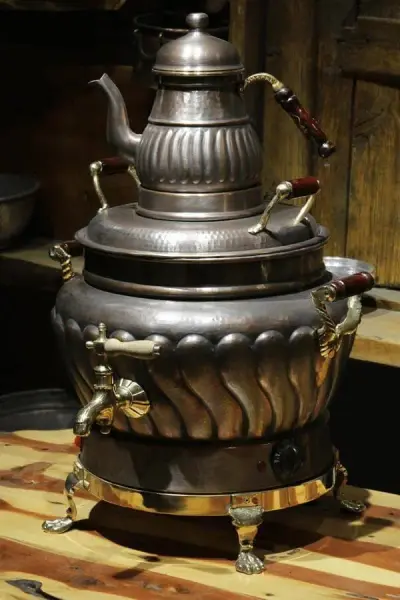
TC10076-3
Most countries do not issue a product-specific licence for copper kitchenware, but they do require the importing business to be registered with customs. In the EU and the UK that means an EORI number; in the United States the importer of record usually works through a licensed customs broker and a customs bond. Food-contact rules apply on top of this, so ask your broker what your market requires before the first shipment.
Yes, as long as you meet the marketplace's own category rules as well as the law of the country you sell into. Large marketplaces often ask sellers of kitchen and food-contact products for compliance documents, safety information or a responsible person in the selling country. Check the category requirements before you choose the products, because they can rule out a line that is otherwise easy to import.
Exclusivity is a commercial term, not a catalogue feature, so it has to be asked for and agreed in writing. Suppliers generally link it to a defined territory, a product scope and a purchase commitment over a period. Raise it in your quote request if it matters to your business plan, and expect it to be discussed after a first order has shown that the range sells in your market.
There is no standard figure, because it depends on the channel, the number of product lines and how long stock sits before it sells. Budget for the goods, freight, duties and import taxes, compliance work, packaging, storage and a reserve for slow lines. A deliberately small first order, priced through a written quote and a landed cost sheet, gives you a real number instead of an estimate.
Yes, within limits. A logo on the piece and your own retail packaging are quoted as separate lines and approved on a sample first, so branded stock takes longer than catalogue stock. Your brand does not replace the origin: some markets, such as the United States, require the country of origin to be marked on imported goods, so check the marking rule with your broker.
Not necessarily. A first order can be placed from a written quote, samples of the risky lines and a supplier check done in writing or by video call. A visit pays off when you plan custom work, a large range or an exclusive arrangement, because you can see production and agree finishes on real pieces. Either way, keep every agreed term in writing.
Other guides covering the same stage of the buying process - continue reading here.
How to plan a first mixed wholesale copper order from Turkey: choosing a trial range, reading stock codes, setting quantities and writing a quote request.

Copper cookware and CBAM: what Annex I actually lists, why HS 7418 is absent, plus the packaging rules and green claim limits that do apply to your shipment.
Copper cookware enters the US at roughly 53 percent duty: the MFN rate, the Section 232 tariff on full customs value, and how to contract around a moving scope.
Add the products you need to your quote list with quantities and send it by WhatsApp, e-mail or the form. We reply with unit prices and delivery terms.