United Kingdom: copper cookware duty and compliance
Selling copper cookware into the UK: zero duty for everyone, the assimilated 1935/2004 rules, no UK-established responsible person, and the English label rule.
What is on this page
Selling copper cookware in the United Kingdom faces fewer obstacles than in Europe. Duty is zero and it is zero for every origin, so no agreement is needed to obtain it. On compliance the EU framework applies almost unchanged, but it diverges at two points, and both matter directly to an exporter.
Duty is zero, and origin proof is not even needed
The third country rate for copper table and kitchen articles in the UK tariff is zero, and that rate is erga omnes — it applies to every origin. A preference for Türkiye is separately defined but makes no practical difference, since the rate is already zero for everyone.
There is a consequence that is easy to miss: because no preferential rate is being claimed, proof of origin is not needed in practice. Selling into the EU requires an A.TR movement certificate; here that step falls away.
The framework is assimilated law, and the term matters
The EU framework regulation for food contact materials was carried into UK law and remains in force. The name of that body of law changed on 27 February 2025: the correct term is now assimilated law, not retained EU law. The detail looks cosmetic but using the old term in supplier correspondence signals that your information is out of date.
The framework applies directly; offences and penalties are created by national instruments, and here there is no single UK regulation. England, Wales, Scotland and Northern Ireland each have their own. Where your buyer sits determines which text applies.
Two points of divergence from the EU
This is the most practical part of the page, and the two run in opposite directions.
The first is in our favour: there is no UK-established responsible person requirement. The EU text requires the label to carry the name and address of a responsible manufacturer, processor or seller established within the Union, which is why a Turkish maker needs an importer or authorised representative in the EU. The UK version omits those words. A workshop established in Türkiye can label for this market with its own name and address.
The second is an obligation: language. At retail the food contact statement, the instructions for safe use and any active material information must be in English, or in English and Welsh. The name and address of the maker sits outside that requirement.
On metals the UK stands where the EU stands: there is no product-specific measure. The materials that have one are plastics, recycled plastics, active and intelligent materials, epoxy derivatives and BPA. What applies to copper is the general safety and inertness obligation together with good manufacturing practice.
What this market actually buys
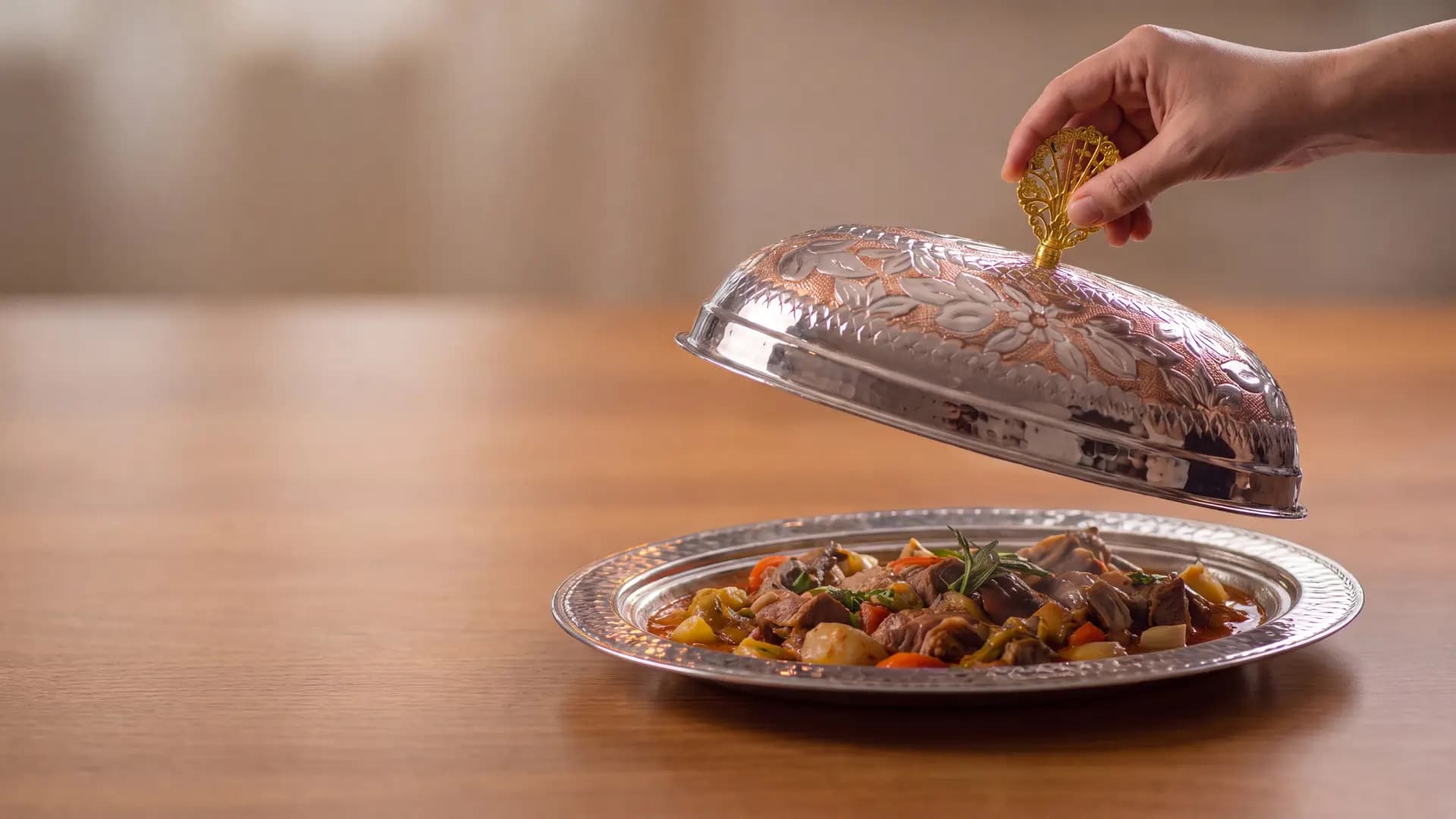
The largest volume of copper serveware demand here comes from an unexpected direction: Indian restaurant service ware. Lidded serving bowls, deep pans and plates are the standard lines of that channel, and supply is met almost entirely from India.
That is a direct overlap for us, because the workshops in Gaziantep and Kahramanmaras already make the same forms. India sets the price ceiling, so competition cannot be run on price. Where it can be run is clarity: solid or plated, what lining, what gauge. Putting those three in the first line of a quotation moves the product out of the volume contest.
The second area is tin-lined cooking vessels for commercial kitchens. Lining choice and service life are covered in the lining comparison, and gauge language in the gauge specification guide. For serving and buffet lines see the serving equipment guide, and for the production side the four copper clusters of Türkiye.
Northern Ireland is assessed separately
This page is written for Great Britain. Northern Ireland sits under a distinct arrangement and the UK exit instruments were adjusted specifically for that distinction. If you are shipping there, confirm with your customs broker which text applies; the framework described here does not carry over unchanged.
Guides that cover this channel in detail
What the zero rate settles and what it leaves with you, including where classification responsibility sits, is worked through in the UK zero duty guide.
Sourcing the Indian-cuisine serving and cooking forms that make up a large part of UK import volume is covered in the Indian cuisine serveware guide. For wording the material line in a quotation, see the solid copper specification guide.
Duty and taxes
| Item | Value | Source |
|---|---|---|
| Customs duty | Zero — third country duty, erga omnes | UK Trade Tariff, 7418100000 |
| Preference for Türkiye | Zero — separately defined, but the rate is already zero for everyone | UK-Türkiye Free Trade Agreement (2021) |
| Practical consequence | Because the rate is zero for all origins, proof of origin is not needed in practice | UK Trade Tariff, 7418100000 |
Compliance regime
| Topic | What it means for the product | Source |
|---|---|---|
| Framework | Regulation 1935/2004 is in force in UK law as assimilated law; the general safety and inertness obligation applies. | legislation.gov.uk/eur/2004/1935; adapted by S.I. 2019/704, substituted by S.I. 2020/1504 |
| Terminology | The correct term is assimilated law, not retained EU law; the wording changed on 27 February 2025. | S.I. 2025/82, Sch. 11 para. 8(c) |
| National enforcement | There is no single UK regulation; offences and penalties are created by four separate national instruments. | England SI 2012/2619; Wales WSI 2012/2705; Scotland SSI 2012/318; Northern Ireland NISR 2012/384 |
| Responsible person | The words established within the Community were omitted from the UK text. No UK-established responsible person is required; the maker may label with its own name and address. | 1935/2004 Art. 15(1)(c) UK version, footnote F1 (S.I. 2019/704 reg. 24(a)(i)) |
| Language | At retail the food contact statement, the instructions for safe use and any active material information must be in English, or in English and Welsh. | 1935/2004 Art. 15(4) UK version, footnote F4 |
| Specific measure for metals | As in the EU there is no product-specific measure for metals; the specific measure list covers plastics, recycled plastics, active and intelligent materials, epoxy derivatives and BPA only. | SI 2012/2619 reg. 2, definition of specific measure |
This page is a map, not legal advice. Rates and rules change during the year; confirm with your own customs broker and the competent authority of the target market before you file.