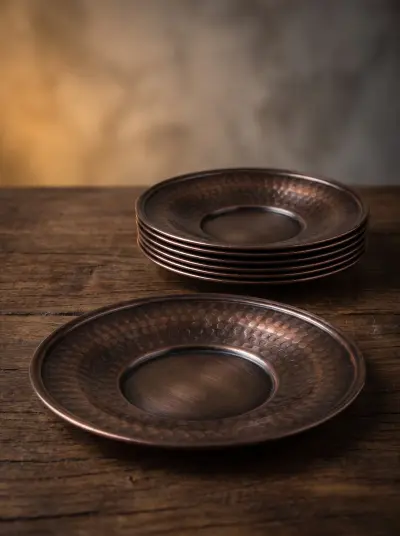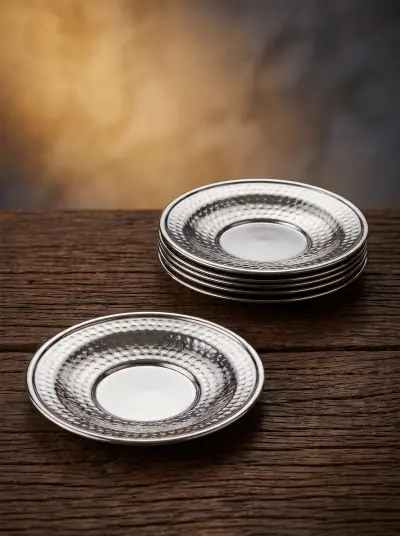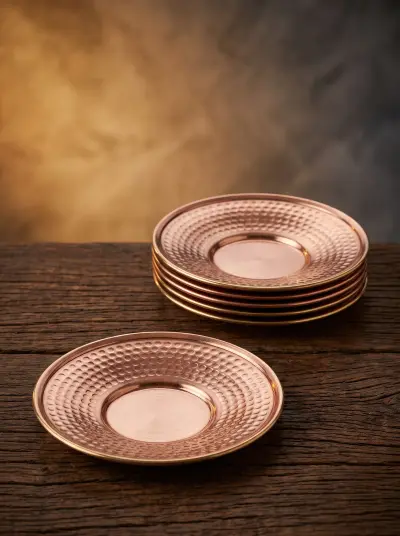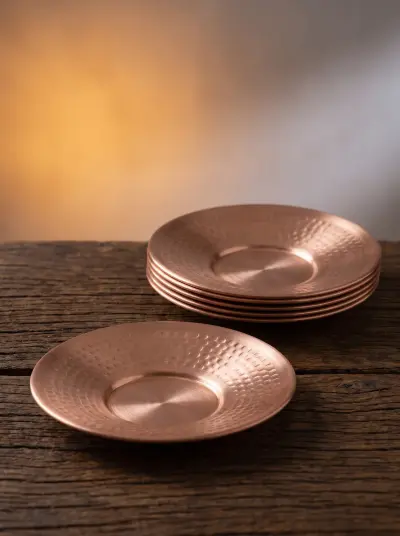
Otağ Copper Tea Saucer, Set of 6 — hand-hammered, brushed matt
TC30042-4
How to specify copper serving trays, chafing dish sets and mezze bowls for hospitality: telling solid copper from copper-plated stainless, lining and packing.
Browse the range, add the pieces you need to your quote list and ask for prices in one message. No account, no online prices.
Specifying copper for a hospitality service line comes down to four decisions: solid copper or copper-finished stainless, the interior lining, how long the piece sits under heat, and how it will be washed. If those four are missing from the specification, incoming quotations cannot be compared, because each workshop prices its own assumption.
Copper does not equip an entire service operation. It earns its place at specific points and stays an expensive choice everywhere else. The useful question is not copper against stainless, but which pieces the guest actually sees.
That distinction matters more here than in cookware, because on a heated service line copper is not carrying the heat at all. Heat travels through the water pan or the electric element; the body simply holds it. What copper contributes is a warm metal surface in the guest's line of sight. Back-of-house pans, grates and racks stay stainless, while the lid, the tray, the bowl and the basket can reasonably be copper.
| Item | Common size range | Must be fixed in the spec |
|---|---|---|
| Serving tray | roughly 35-60 cm diameter | diameter, depth, rim form, handle |
| Chafing dish | full and two-thirds pan sizes, or round | heat source, water pan, lid hinge |
| Mezze and sauce bowl | roughly 0.2-1 litre | lining, lid, stackability |
| Bread and pastry server | roughly 20-30 cm | perforated or solid, rim finish |
The ranges above are values commonly seen in the trade, not a standard; they move with the workshop and the tooling already on the bench. Writing your own line dimensions into the enquiry produces a better result than accepting a range. The catalogue equivalents sit under service and presentation, with the tray breakdown under serving trays.
Service type shifts the list as well. A breakfast service runs long with fast turnover, so heated vessels and the bread group dominate and durability outranks everything. Banquet and reception service moves pieces by hand constantly, so rim strength and weight balance decide the choice. A mezze line is a third case: small volumes, high piece counts and mostly acidic contents, so the decision turns on the lining rather than the dimensions.
This is where most money is lost on a copper service order, and listing text rarely makes it clear. A substantial share of chafing dishes presented as copper are stainless steel bodies carrying either copper plating or a purely cosmetic copper-toned finish. Some manufacturers say so openly, offering the same frame in a hammered silver or copper finish, which is a direct admission that the metal underneath is the same in both cases.
This is not deception; it is a separate product class. The problem is that it reaches the buyer through the same catalogue language and often at a price close to solid copper.
The practical difference shows up in three places. First, service life: once plating wears through, the steel underneath is exposed and the piece cannot be recovered, whereas a solid body can be resurfaced. Second, repairability: a solid body can be relined, while relining a plated shell is meaningless. Third, weight and hand feel, which on a piece the guest picks up has a commercial value of its own.
| Check | Solid copper | Copper-plated or copper-finish stainless |
|---|---|---|
| Magnet on outer body | does not hold | usually holds |
| Weight at the same size | noticeably heavier | lighter |
| Scratch in a hidden spot | copper again underneath | a different coloured metal appears |
| Rolled rim and base seam | reads as one metal | a two-layer separation is visible |
Two details matter when you run these checks on this product group. On a chafer the water pan is stainless on many products, and that is not by itself a fault; the test belongs on the lid and the outer frame. On electric units the base plate and heating housing may be magnetic by design, so again the visible copper surface is the correct test point. The rim inspection is most readable on a tray: look at the rolled edge from the side, and a visible separation between two layers tells you the piece is plated.
There are signals in the listing itself. If the material line names a surface rather than a metal, if the same item is offered in more than one metal colour, or if piece weight is not published at all, the probability of a non-solid body is high. None of the three is proof, but together they justify a direct question.
Ask for three things before you move to sampling: a written declaration of the body material, a close-up photograph of the rim in cross section, and the weight per piece. A supplier who cannot supply all three should be clarified before a sample is produced rather than after. Stating in the enquiry that solid copper is required and plated bodies will not be accepted costs one sentence and removes most later disputes. The same distinction, applied to drinkware, is covered in the wholesale copper cup sourcing guide.
A tray never meets a flame but carries the most load, so its specification is built on mechanical strength rather than thermal behaviour.
Diameter and depth are written together. Depth governs not only capacity but the safety of carrying liquid: a shallow tray for a breakfast run and a deep-rimmed tray carrying glassware at a banquet are not the same product. Rim form is a separate line. A rolled rim protects the fingers and stiffens the edge zone, which makes it the most dent-resistant form available. A cut flat rim looks cleaner but is exposed to impact and needs finishing so it does not stay sharp.
The handle decision drives service life directly. Riveted handles can be removed and retightened in a working environment; welded joints give a surface that is easier to clean but are difficult to repair on site. Which one you want belongs in the quotation text, because two trays that look identical will not last the same time.
This specification covers the tray itself, an item with a ready catalogue category behind it. The censer now has one too, under copper incense burners. When the order extends to Gulf service forms that have no catalogue counterpart — the copper breakfast set, bespoke dimensions — the route changes: selection from a catalogue gives way to custom dimension and contract manufacturing, and with it the drawing, sample and tooling loop. How that route runs is set out in the Gulf copper serveware sourcing guide.
Gauge on trays is normally lighter than on cookware, and that is correct, since rim strength rather than conduction governs. The right gauge follows the diameter and the load, so gauge is never specified independently of size. How to phrase gauge in a quotation request is covered in the gauge specification guide. One last item is stacking: trays travel stacked, and without a separator between them scratching is certain.
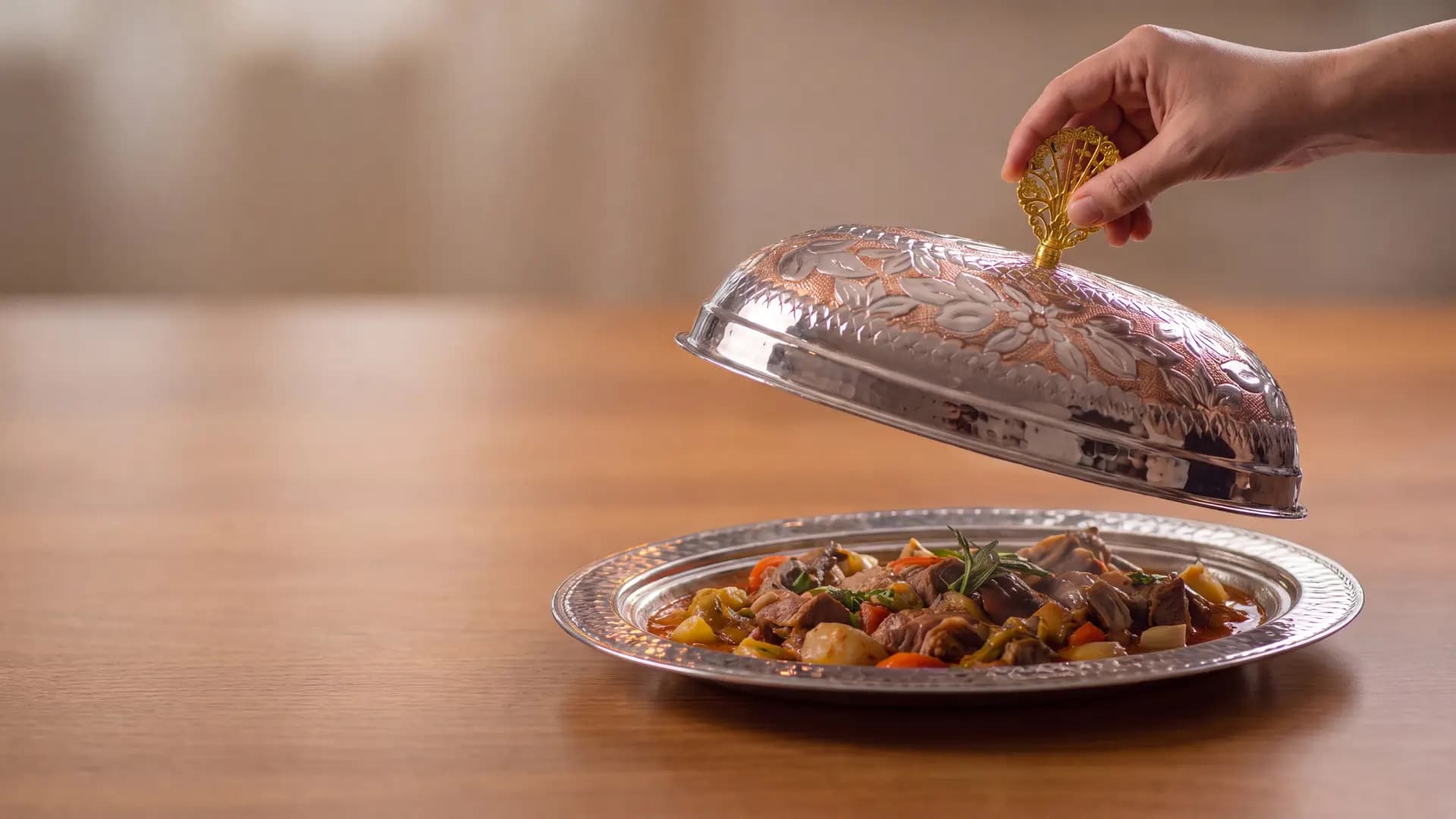
A chafing dish is the most complex item on the line, because it is not one body but four interdependent parts: the frame, the water pan, the food pan and the lid.
The heat source is the first decision. Fuel-based units run on gel or liquid fuel, need no power and are the only practical option for outdoor and off-site banqueting. Electric units hold a steadier temperature and carry no open flame, but tie the line to a socket plan. The choice is about the venue rather than product quality, and it must be stated in the enquiry because it changes the frame design.
The water pan is the second. A design where the flame strikes the body directly is not wanted; water spreads the heat and prevents local overheating and point fatigue in the lining. Ask separately what the pan is made of, since on many products it is stainless while only the lid and outer frame are copper. That is not a fault, but it must be written down.
Pan sizing is a third line and is frequently skipped. If standard gastronorm pans already circulate in your kitchen, the copper frame has to accept the same standard. A custom-sized food pan detaches the line from your existing stainless inventory and turns every replacement part into a new order. Ask at quotation stage whether the frame takes standard pans, and test it on the sample with your own pan.
The lid hinge is the most overlooked decision. A lift-off lid has nothing to fail but needs somewhere to be put down during service. A hinged or roll-top lid speeds service, but the hinge is the hardest-worked part on the line. Ask about spare hinges and lids on the first order; asked two years later, the answer is usually no. The catalogue equivalent sits under chafing dishes.
Tin melts at roughly 232 degrees Celsius. In cookware that limit is a distant theoretical risk, because a vessel holding water and food does not reach it. On a heated service line the situation is different, and the difference comes from duration rather than the product.
The vessel sits under uninterrupted heat for hours. The water pan evaporates and the level falls; once it runs dry the vessel heats without a buffer and the temperature keeps climbing until the fuel is spent. In a tin-lined food pan that means local softening of the lining, pooling and exposed copper at that point. On long services the real protection is not the product choice but a written water-level check protocol stating who checks the level and at what interval.
This also feeds back into the lining decision. A stainless-lined food pan is more tolerant of that scenario, while tin belongs on lines with disciplined heat management. The two linings are compared in a separate article: tin versus stainless lining.
Unlined copper reacts with acidic food, and on a service line the most acidic items sit in the mezze and sauce group. The lining decision therefore follows the individual piece rather than the product family, and two items on the same line may legitimately be specified differently. Those groups sit under sauce and mezze bowls, with the bread and dry-goods items under a separate heading in the same parent category.
Total cost does not end at the purchase price; the second line is staff time, and it scales with piece count. Commercial dishwasher detergents are alkaline and attack the copper surface and any tin lining, while long hot drying cycles accelerate staining. Accepted practice is hand washing with a mild detergent and immediate drying. Two hundred mezze bowls means two hundred hand washes, which is precisely why the copper list should stay short and limited to pieces the guest actually sees.
Packing is a specification line rather than a detail, because copper does not crack in transit, it dents, and a dented tray rim cannot be corrected on site. State four things: individual wrapping, internal carton dividers, pieces per carton, and pallet height. For lidded items, ask whether the lid ships fitted or separately, since a fitted lid creates rim-to-rim contact in transit. Delivery should be phased rather than given as a single date, with pre-opening critical items, follow-on items and a spare-parts batch on separate lines. The production cluster behind these items is Gaziantep, covered in the guide to Turkey's four copper clusters.
A comparable quotation comes from a comparable specification. For this product group the enquiry should carry: the item list with a quantity range per item, dimensions and capacity per item, the requirement that bodies be solid copper, gauge, lining choice, exterior finish, handle and lid type, heat source and water pan material for heated items, logo method and placement if any, packing format with pieces per carton, a phased delivery schedule and any spare-part requirement.
Add one more line: the sample acceptance criteria. Writing down which checks will be run tells the workshop what is expected and removes the argument at acceptance. In this group the criteria are binary: magnet on the outer body, weight per piece, visual inspection of the rim section, lid seating on the pan, and lining consistent with the declaration. Send the finished list through the quotation request form; quotations are sealed, so each producer sees only its own. If you are planning this alongside a full property list, the HORECA copper sourcing guide is the companion piece.
Often it is not. A large share of hospitality chafers sold under a copper description are 304 stainless bodies with copper plating or a copper-toned surface finish, and some manufacturers list the same frame in both a silver and a copper finish. That is a legitimate product class, but it is not the same product as a solid copper body and should not carry the same price.
Four checks are enough. Hold a magnet to the outer body, weigh two pieces of the same size against each other, scratch the surface lightly in a hidden spot, and look at the rolled rim or base seam edge-on. Solid pieces read as one metal throughout; plated pieces show a second layer at the seam or a different colour under the scratch.
On the visible copper surfaces only, meaning the lid and the outer frame. The water pan is stainless on many products and that alone is not a defect. On electric units the base plate and the heating housing may also be magnetic by design. Testing the wrong component produces a false negative and an unnecessary dispute with the workshop.
A tray never meets a flame, so the governing factor is rim strength rather than heat transfer. The right gauge follows the size of the tray and the load it carries, since a large tray flexes far more readily than a small one at the same thickness. Thinner bodies save weight and cost but raise the risk of a dented rim, and copper does not crack on impact, it deforms permanently and does not return to shape.
Tin melts at roughly 232 degrees Celsius. That limit is remote while water and food are present, but a chafer runs for hours and the water pan evaporates. Once the pan runs dry the vessel heats without a buffer and the fuel keeps burning until it is spent. A written water-level check interval matters more here than the choice of product.
As a rule, no. Machine detergents are alkaline and attack both the copper surface and a tin lining, and long hot drying cycles accelerate staining. Professional practice is hand washing with a mild detergent and immediate drying. Because that labour scales with piece count, keeping the copper list short is part of the purchasing decision, not an afterthought.
Unlined copper reacts with acidic food, and the most acidic items on a service line usually sit in exactly this group: lemon dressings, vinegar pickles and tomato-based preparations. An unlined body is not a serious option there. Dry-goods items are judged differently. The lining decision follows what the individual piece will carry, not the product family it belongs to.
Copper is soft. It survives transit without cracking but dents easily, and a dented tray rim cannot be corrected on site. Individual wrapping, internal carton dividers, pieces per carton and pallet height should all be stated, otherwise every workshop applies its own standard. Stating pieces per carton also speeds up goods-in checks and stock counting.
Other guides covering the same stage of the buying process - continue reading here.
Sourcing copper serveware for Gulf hospitality: dallah coffee pots, kabsa trays and custom OEM forms, with gauge, lining and Saudi, UAE, Egypt compliance notes.
Sourcing copper serving platters for kebab, grill and fish restaurants: boat plates, charcoal-heated platters, lidded fish platters, lining and quote lists.

Sourcing copper handi, kadai, balti dishes, thali sets and lassi cups from Turkey: tin lining, gauge, capacity tolerance and what an RFQ has to specify.
Add the products you need to your quote list with quantities and send it by WhatsApp, e-mail or the form. We reply with unit prices and delivery terms.