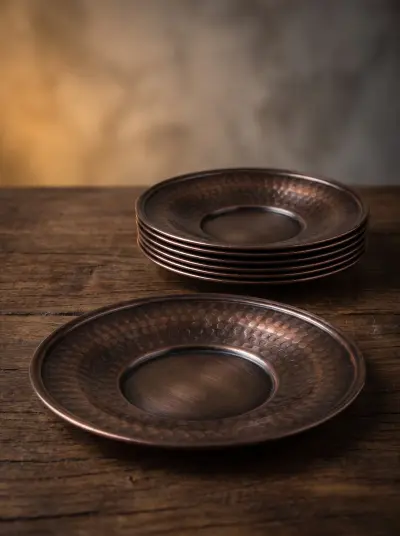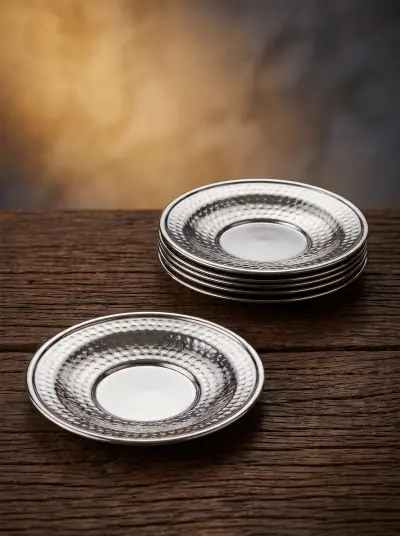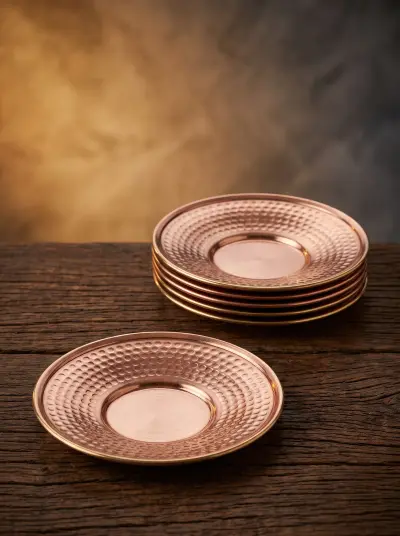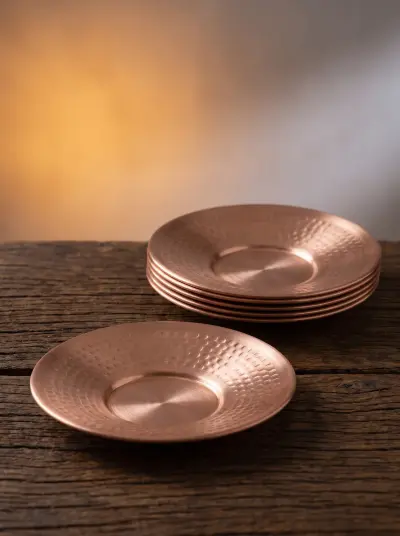
Otağ Copper Tea Saucer, Set of 6 — hand-hammered, brushed matt
TC30042-4
Sourcing copper serving platters for kebab, grill and fish restaurants: boat plates, charcoal-heated platters, lidded fish platters, lining and quote lists.
Browse the range, add the pieces you need to your quote list and ask for prices in one message. No account, no online prices.
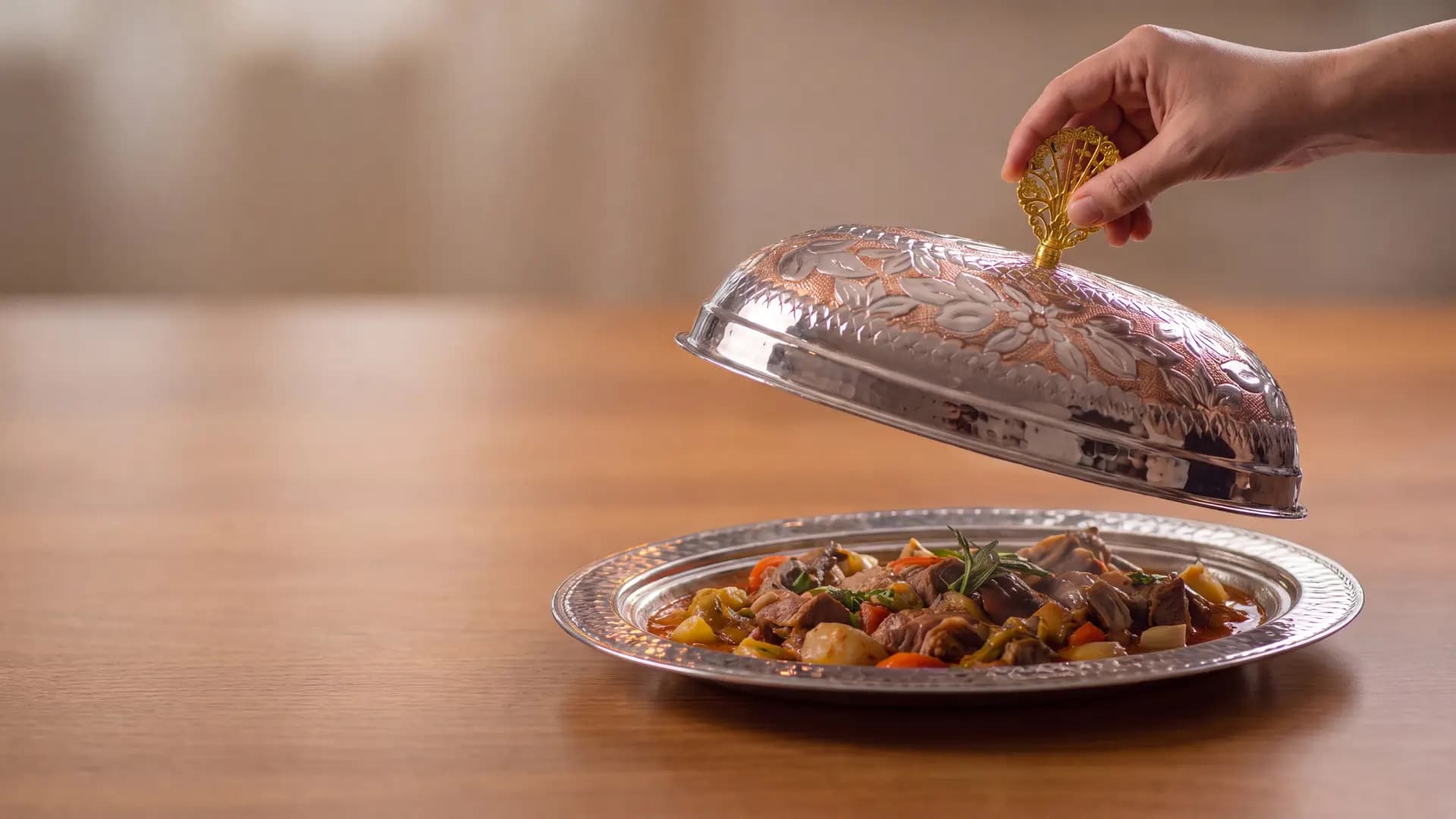
A copper serving platter in a kebab or grill restaurant is chosen to bring food to the table hot and with visual impact, not to cook it. The pieces worth buying in copper are the ones guests see: boat plates for kebab and pide, footed charcoal-heated platters for mixed grill, lidded platters for whole fish and round sharing plates.
The Coppery supplies restaurant groups and foodservice distributors outside Turkey directly from Kahramanmaraş, as a single supplier. Prices are not published on the site; they are quoted in writing for each order. This guide helps you match every dish on your menu to a form in the copper serving plates range and choose sizes before you ask for a quote.
A serving platter does not need copper to conduct heat for cooking; its job is to carry food to the table and be part of what the guest sees. Copper's fast heat response, the reason it is prized in a saucepan, matters little on a platter that never goes on a burner.
That changes three things in your specification. First, gauge is chosen for rigidity, not thermal performance. Most serving plates in the range are 1.00 mm sheet, and the full spread runs from 0.80 mm to 1.20 mm, enough to stop a long boat plate loaded with hot, oily food from flexing when a server picks it up. Second, 1 mm sheet stores little heat; warmth at the table comes from a lid, embers or a pre-warmed plate. Third, a platter is a front-of-house surface. Finish, consistency across a dining room and polishing frequency are minor questions for a stockpot and central questions here.
So which dishes belong on copper? Those that arrive at the table as a single piece, stay in front of the guest for a while and have a moment of presentation. Gastronorm pans on the line, spare plates in the warmer and prep containers gain nothing from copper.
The range lists 58 serving plates in five form families, and each family maps naturally onto a part of a kebab or grill menu. Sizes and finishes below come straight from the product records in the serving plates category; at the 2026-11-14 catalogue sync all 58 were shown as in stock, and each product card shows the current status.
| Form family | Sizes listed | Finishes | Typical dish |
|---|---|---|---|
| Kebab boat plate, open | 25, 30, 35, 40 cm | Polished, nickel, oxidised | Iskender, pide, single kebab |
| Lidded boat plate: Saltanat, Hanedan, Odabaşı | 25 to 47 cm | Polished, nickel, engraved two-tone | Signature kebab, sharing dish |
| Footed charcoal-heated platter | 30 to 120 cm | Lidded polished, open oxidised | Mixed grill, skewers, group table |
| Orkinos lidded fish platter | 40, 50, 60 cm | Polished | Whole fish, seafood platter |
| Round plates: Külah, Paşaçadırı, Kümbet | 23 and 30 cm | Polished, nickel, oxidised | Mezze, rice, single covered dish |
The boat plate, long with raised sides, is the workhorse of a kebab restaurant. The open kebab boat plate is the lightest piece in the range: 440 g at 25 cm and 916 g at 40 cm. On a busy lunch service, where a server carries several plates at once, that matters.
Three lidded lines share the boat shape. Saltanat has a domed lid, five sizes from 25 cm to 47 cm, and the heaviest gauge in the group at 1.20 mm on the 25 cm plate. Hanedan has a classic lid and includes four plates with hand-engraved decoration, listed as copper and tin two-tone. Odabaşı uses its own lid form. For a chain that wants single portions and sharing plates to look identical, Saltanat's five sizes give the widest ladder within one line.
The footed charcoal-heated platter stands on feet with a chamber for embers underneath, and it is the only form that keeps food warm at the table. The Orkinos lidded fish platter brings a whole fish under a cover, and its 60 cm size leaves room for a large sea bass or bream. The round plates take their names from cone, tent and dome shapes, with listed heights between 20.5 cm and 25.2 cm. That is unusual for a flat plate, so confirm on each product page whether a domed top is included.
A distributor or importer supplying grill restaurants needs a narrow core range that covers many clients' menus, and the catalogue data suggests two shortcuts. The open boat plate comes in every size in three finishes, so one model code serves very different dining-room concepts. And instead of stocking all ten sizes of the lidded charcoal-heated platter, hold the two or three sizes that fit your clients' tables. Keeping heavy, bulky stock out of the warehouse until a project is confirmed is the simplest way to protect margin.
Lidded versus open is a service-flow decision as much as a look. A lid covers the food between the pass and the table, gives a reveal at the table and slows heat loss over a short distance. An open platter is faster to serve, takes less space and is a single piece to wash.
| Factor | Lidded platter | Open platter |
|---|---|---|
| Heat | Slows heat loss between pass and table | Only the food and plate carry heat |
| Service speed | Lid is lifted at the table and needs a landing spot | Plate goes straight down |
| Pot wash | Two parts to wash and pair up again | One part, stacks easily |
| Storage | Needs taller shelving | Stacks more tightly |
Many grill restaurants use both: fast-turning single kebabs on open boat plates at lunch, signature dishes and sharing platters lidded in the evening. If you mix forms, keep the finish consistent across them.
The detail buyers miss with lidded plates is lid fit. Small dimensional differences between hand-hammered pieces are normal, so check on delivery that each lid sits properly and ask at quote stage whether lids of the same size are interchangeable between bodies.
A footed charcoal-heated platter brings its own heat source to the table. Embers in the chamber keep a mixed grill or skewers warm through a long meal, which suits group tables and slow evening service.
Size here follows table width more than portion. The lidded line runs from 30 cm to 120 cm in 10 cm steps, ten sizes in all; the open oxidised line is listed at 30, 60, 90 and 120 cm. Weight climbs fast: the lidded 30 cm platter is 2,930 g, the 60 cm is 5,110 g and the 120 cm is 10,700 g. In the open line, 30 cm is 2,240 g and 120 cm is 7,760 g. Large sizes are set on the table or on a service trolley, not carried one-handed.
Using embers indoors falls under your own fire safety, ventilation and insurance rules, and those differ by country and often by city. Check the local rule as the operator; what a supplier can give you is the size, weight and material of the platter. If the interior is tin-lined, add one service rule: embers are used only while food is on the platter, because an empty tinned surface over heat wears the lining.
Food touches the copper directly, so ask in writing what the interior surface is. The catalogue does not hold the interior lining as a separate field; it lists the material as copper and the exterior as polished, nickel-plated or oxidised. If your market requires documents for food-contact materials, write your interior expectation and the documents you need in the quote note.
The regulatory side, market by market, is covered in the food-contact copper compliance guide, and the practical difference between tin and stainless steel linings, including which can be renewed, is in the tin versus stainless lining comparison.
Two parts of a kebab menu make the interior question more pressing. Acidic accompaniments such as tomato sauce, yoghurt and sumac onions react with bare copper if they sit on it for long, and a lining is there to prevent that contact. Hot butter and sauce, as on an Iskender, are poured over the whole plate. If those dishes are on your menu, put the interior question at the top of your quote note.
Pick one exterior finish per dining room and reorder the same line in the same finish every time. The range has three main finishes, polished copper, silver-toned nickel and oxidised, plus the engraved two-tone Hanedan plates.
Small catalogue details matter. In the Odabaşı line, nickel-plated plates are listed at 30, 35 and 40 cm, while polished copper plates are listed at 31, 37 and 40 cm; allow for that if you mix finishes. On the charcoal-heated platters, the lidded line is polished only and the open line is oxidised only, so choosing a finish also chooses whether you get a lid.
How each finish ages is explained in the surface finishing guide. The practical rule for a restaurant group: record the line name, size and finish of the first order as a reference list, and order every new site from it.
Sauce dishes, small bowls and trays complete the set, and choosing them in the same finish makes the whole table read as one. The sauce dishes and mini casseroles group lists 14 products.
There are three styles in that group. The Dalyan lidded sauce dish is 14 cm and hand-hammered, so it matches the platters' handwork. Salsa and Alebat sauce dishes are machine-hammered; Salsa comes with a brass or wooden handle and Alebat is listed at 9, 11 and 12 cm. The Mini Copper Casseroles hold 60, 90 and 140 ml in 1.85 mm sheet, sized for butter, chilli sauce or a single mezze portion. Every sauce dish in the group is polished copper, so on a nickel or oxidised platter line, think about finish matching separately.
The trays category adds 34 cm round serving trays and Otağ tea saucers for restaurants that serve tea after the meal. Buffet lines, chafing dishes and water-bath food warmers are a different equipment family, covered in the serving trays and buffet equipment guide.
The life of a copper platter depends on the pot wash more than on the metal. Commercial dishwasher detergents are alkaline: they dull the copper exterior, wear a tin lining, and the hot drying cycle leaves marks. The accepted method in professional service is hand washing in warm water with a neutral detergent, then drying straight away.
Polished copper is brought back with copper cleaner as service volume requires; nickel and oxidised finishes are never treated with abrasives. Large charcoal-heated platters need their own washing space and a routine for clearing ash from the ember chamber.
The tips of boat plates and the rims of lids take most of the knocks, and a soft separator between stacked plates reduces scratching. The full routine, including the tin renewal cycle, is in the copper care and lifespan guide. Sharing it with your pot wash lead before the order reduces surface damage in the first months.
Build the quote list from the menu, not the catalogue: for each dish, decide the form, then the size, then the quantity.
The minimum order quantity (MOQ) is not published on the site; how a list of mixed lines and sizes counts towards it is set out in writing in the reply. Stock status is shown on each product card; if an item is not shown as in stock, flag it separately in the note so lead times for in-stock and made-to-order items come back separately.
For a new chain standard, order two or three of your most-used sizes as samples before the volume order. How a sample is approved and how the approved reference piece is used in production is explained step by step in the sample order and pre-production approval guide.
The catalogue lists the open Piyade boat plate at 25, 30, 35 and 40 cm and the lidded footed charcoal platter from 30 to 120 cm in 10 cm steps. For a shared plate, the 35 and 40 cm boat sizes and the smaller footed sizes are the starting range; portion weight and table width decide, so put both in your quote note.
The catalogue lists these pieces as serveware, not cookware, so oven or salamander use needs written confirmation for each model. If the interior is tin-lined, the limit is physical: tin melts at 232 °C, and an empty platter under direct heat can reach that quickly. State any reheating step in your quote note.
Yes. The quote list works per model and size, with a quantity on each line, so different lines, sizes and finishes can go in one list. How mixed lines count towards the minimum order quantity (MOQ) is set out in writing in the reply for your order. No fixed threshold is published on the site.
No. A sizzler plate is usually cast iron, heated in the kitchen and served on a wooden base so the food keeps sizzling. A copper boat plate is a presentation piece that carries food from the pass to the table. The footed charcoal-heated platter is the copper form that keeps food warm at the table, using embers underneath.
Ask for one or two of the sizes you will use most before placing the volume order. Put the sample on a real table with a real portion, check how the lid sits and how the server carries it, and keep the approved piece as the reference for production. Sample terms are confirmed in writing per order.
Yes. Listed weights run from 2,240 g for the 30 cm open platter to 10,700 g for the 120 cm lidded platter. Feet and lids need extra protection in the carton, and large sizes change pallet and freight calculations. Give the destination country and your delivery terms in the quote note so packing can be planned.
Yes. Polished copper tarnishes and is brought back with a copper cleaner. Nickel-plated and oxidised finishes must not be treated with abrasive polish, because it damages the plating or removes the aged look. All three should be washed by hand and dried straight away, which your pot wash team needs to know before the order.
Other guides covering the same stage of the buying process - continue reading here.
How to specify copper serving trays, chafing dish sets and mezze bowls for hospitality: telling solid copper from copper-plated stainless, lining and packing.
Sourcing copper serveware for Gulf hospitality: dallah coffee pots, kabsa trays and custom OEM forms, with gauge, lining and Saudi, UAE, Egypt compliance notes.
How to choose copper serving platters with lids for banquets and room service: boat, round and fish shapes, 23-60 cm sizes, lid styles, lining and quantities.
Add the products you need to your quote list with quantities and send it by WhatsApp, e-mail or the form. We reply with unit prices and delivery terms.