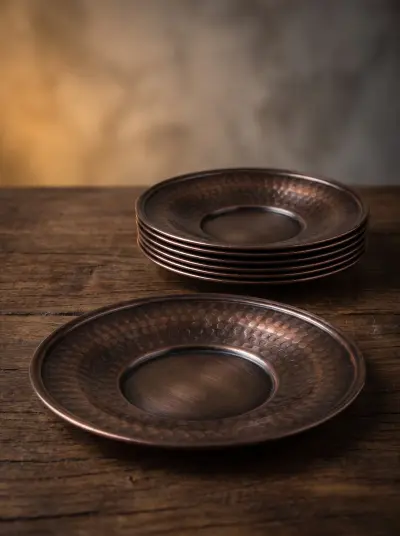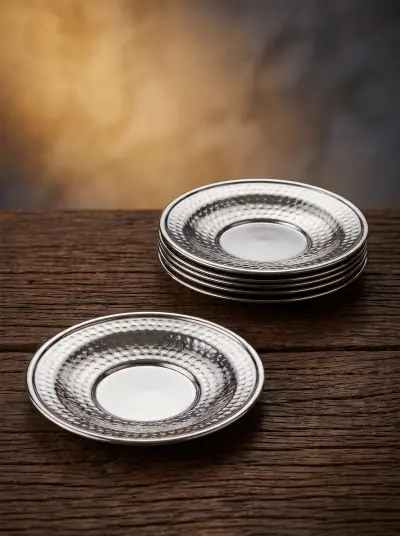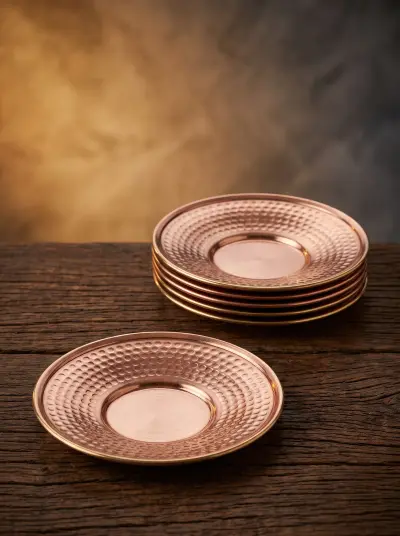
Otağ Copper Tea Saucer, Set of 6 — hand-hammered, brushed matt
TC30042-4
Sourcing copper for hotels and restaurants: back of house versus guest-facing specs, custom collections, quantity planning and what your RFQ must contain.
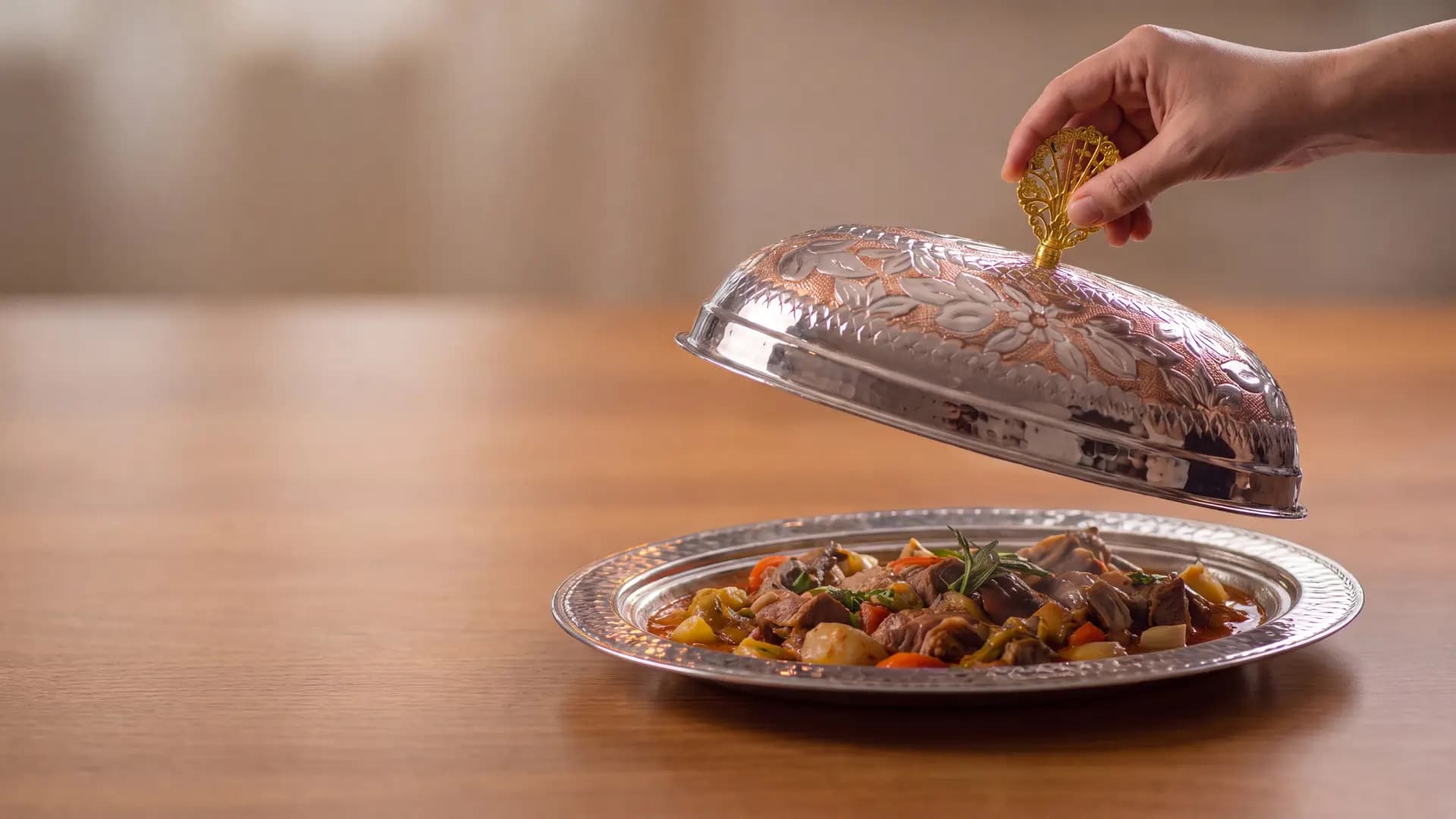
Browse the range, add the pieces you need to your quote list and ask for prices in one message. No account, no online prices.
There is no single correct copper list for hospitality. The specification follows two questions: will the piece work back of house or sit where guests see it, and is this a one-site purchase or a repeatable standard for a group. Wall thickness, surface finish and the maintenance protocol all change with those two answers.
Copper does not equip a whole kitchen. It does something stainless steel does not do in a handful of specific places, and outside those places it is an expensive default. The useful question at specification stage is not copper versus steel, but what this piece does and who sees it.
Six use zones separate cleanly in practice, and each carries a different governing requirement.
| Use zone | Typical items | Governing requirement |
|---|---|---|
| Open kitchen and chef's table | pans, sauté pans, service skillets | gauge, tin lining, heat behaviour |
| Serving and presentation | trays, mezze bowls, bread baskets | surface finish, batch-to-batch colour |
| Buffet and chafing line | chafing units, lidded bowls, urns | lid fit, heat source compatibility, transport durability |
| Coffee and tea service | cezve pots, samovars, coffee sets | handle insulation, capacity match |
| Room service and amenity | small trays, jugs, carafes | weight, scratch resistance |
| Decorative areas | wall pieces, engraved objects | no food contact, design freedom |
The open kitchen has blurred the top row. Cookware that once stayed behind a wall is now in the guest's sightline, which means a single item is judged twice: heat behaviour by back-of-house criteria, surface finish by front-of-house criteria. Operations working with an open pass should group those items separately in the specification, because they are the line items where quotations diverge most. Product grouping is visible in the serving and presentation category and the cookware category.
One material fact belongs at the top of any hospitality specification. Unlined copper reacts with acidic food, so tomato, citrus, vinegar and wine preparations need a tin or stainless interior. An unlined body is only a sensible choice where there is no food contact or in specific confectionery uses. Leaving the interior surface out of the RFQ is the most common reason quotations come back incomparable.
This split is the backbone of a copper purchase. Both groups sit in the same catalogue and are judged against independent criteria.
A pan behind the line heats, cools, travels and gets washed several times a day. What matters here is service life, not appearance. Gauge, handle attachment, rim strength and whether the lining can be renewed are the deciding factors. Riveted handles can be tightened or replaced in situ; welded joints give a cleaner surface to clean but are harder to repair. Say which you want in the RFQ, because two visually identical pans behave differently on this point over three years.
Finish choice back of house usually goes the other way from front of house: brushed or matte surfaces hide handling marks and do not generate a daily polishing task.
Where guests see the piece, being individually attractive is not enough. Ten pieces on the same table have to look like each other. Copper is a hand-worked material, so small piece-to-piece variation is normal, but when that variation is not tied to a tolerance it reads as untidiness across a buffet line.
A buffet is the hardest case. Chafing units, bowls and trays standing side by side are read as one visual object, so a single darker piece shows up on the whole line rather than on itself. Buy buffet items in one batch from one workshop where possible, and keep the approved sample as the reference for anything added later. The product side of this is in the chafing dish group.
Two things therefore need to be written down for guest-facing items: the accepted surface finish, and the expectation for batch-to-batch colour consistency. Sample approval matters more here than anywhere else, because the approved sample becomes the benchmark for repeat orders.
A purchasing desk is not really buying pans. It is buying repeatability. A chafing unit specified today has to be orderable in two years at the same dimension, the same finish and the same logo placement, or every new property drifts into its own standard and the brand identity dissolves across the estate.
That translates into concrete contract items: a frozen technical drawing, a retained approved sample, a written position on tooling ownership, availability of spare parts and complementary orders, and phased delivery against the opening programme.
Spare parts deserve their own line. If a chafing lid, a tray handle or a carafe lid can be supplied on its own, damage does not force replacement of the whole set. Ask this at first order. Asked two years later, the answer is often that the tool is no longer on the bench. The same logic applies to complementary orders when a property opens or a service grows: the ability to add to an existing standard is what determines how long a collection lives.
Sourcing preference follows from this. A desk planning repeat orders is better served by a workshop that produces in house and controls its own tooling. What each Turkish cluster concentrates on is covered in the guide to Turkey's four copper clusters.
A single site buys the opposite thing: flexibility. Menus change, the concept settles, and service style is usually adjusted more than once in the first year. Starting with a measured batch, seeing what actually happens in service and sizing the second order from that is the sensible route.
The most common single-site mistake is opening-week enthusiasm: buying far above requirement in one line item and finding an untouched storage shelf six months later. Chefs also tend to specify by feel rather than by number, which is fine in the kitchen and expensive in an RFQ. Capacity in litres, diameter in millimetres and gauge in millimetres turn a preference into something a workshop can quote.
For a first order, catalogue breadth and a low entry quantity matter more than tooling control. How minimum quantities and pricing logic work is set out in the MOQ, price and lead time guide.
A custom collection is not a logo applied to a catalogue item. It is dimension, form, handle, lid and finish defined for the operation. The sequence below is the working order, and skipping a step moves its cost to the next one.
It starts with a written brief: which piece, how many, for which service, in what dimensional range, in what finish. A drawing or reference image follows. The workshop quotes against that and states a sample lead time. When the sample arrives, feedback is given in writing, because a spoken note like "slightly darker" cannot be reproduced on a production run. After revision comes pre-production approval, then the run, final inspection and shipment.
Logo and engraving options are settled at this stage. Engraving and laser marking have low set-up cost and can be applied to modest quantities. Die stamping requires tooling; that cost is a one-off amortised across the order, so it only makes sense in repeating, higher-volume programmes. The production side is in the contract and OEM category and the logo-marked production group.
These two numbers are frequently collapsed into one, and the result is either shortage or dead stock.
Opening inventory is what has to be in service at once plus what is circulating through the wash-up. Short, intense services such as a breakfast buffet cycle fast, so the reserve above the visible count has to be larger. Add an allowance for damage and loss on top. Copper does not shatter, but it dents and scratches, and small pieces go missing. Attrition in room service and amenity lines is markedly higher than in any other group.
Replenishment should be measured, not estimated. Recording which items deplete at what rate over the first months is the only reliable way to size the second order. Committing the entire opening budget to a single batch is usually worse than a measured first batch plus a planned second one.
Line-item velocity matters as much as total quantity. A hotel list normally contains three speeds: pieces that turn every day on the breakfast buffet, pieces used a few times a week at dinner, and pieces that only appear at events. Planning all three at one replenishment rate produces shortage in the first group and overstock in the other two.
Purchase price is not the cost of copper in an operation. Three further items are paid in staff hours.
Polishing comes first. A polished surface gives the strongest guest impression and demands regular attention; matte and antiqued finishes reduce that load substantially. The decision is better taken with the stewarding team that will actually clean the pieces than with the purchasing desk alone.
Retinning comes second. Tin melts at about 232 degrees Celsius, so an empty pan left on high heat damages the lining directly. Renewal frequency depends on use intensity, and the question worth asking at purchase is not how often but who will do it. How the process works is covered in the tin lining and care module.
Warewashing comes third, and it is the one that generates complaints. Alkaline machine detergents damage copper and tin. Hand washing with a mild detergent and immediate drying is the working protocol. If it is not written down at purchase, the pieces will spot within weeks and the supplier will be blamed for it.
Documentation expectations differ by use, and drawing that line is the buyer's job. Food-contact cooking and serving items need a documentable answer on interior surface, lining type and how the lining is applied. Decorative pieces with no food contact are assessed separately and should be listed as separate line items even when they ship together.
Which documents apply depends on the destination market, and a generic list would be misleading. The workable approach is to state the use case and export direction up front, ask what the workshop has supplied before, and confirm with your own compliance adviser. The territory is mapped in the food-contact copper compliance guide.
Comparable quotations come from a comparable specification. Write the item list line by line with quantity ranges. For each line give dimension, capacity, gauge, interior surface, exterior finish, handle type and lid status. Where a logo is applied, give method, position and size on their own line, and ask for tooling as a separate charge.
Packaging is the item most often omitted and the one that most often causes trouble: individual wrapping, dividers within the carton, or a pack ready to go straight into a hotel store. Delivery should be phased rather than given as a single date, with critical opening items, post-opening additions and a spare-parts batch on separate lines. Pick the pieces in the catalogue, add them to the quote list and send it with that list by WhatsApp, e-mail or the form; The Coppery replies with the wholesale price, minimum quantity, lead time and shipping terms for the order.
For pieces that go on heat in a working service, 2 to 3 mm is the usual range. Thinner walls cost less and weigh less, but under daily service they are more prone to rim deformation and to early fatigue of the tin lining. Pieces that only reach the pass or the table without going on heat can reasonably be thinner.
As a rule, no. Machine detergents used in commercial warewashing are alkaline and attack both the copper surface and the tin lining, while high wash temperatures and long drying cycles accelerate spotting. Professional practice is hand washing with a mild detergent followed by immediate drying. Agree this protocol with the stewarding team before you buy, not after.
Written brief, drawing or reference image, quotation, sample, written revision notes, pre-production approval, production run, then repeat orders. Skipping the sample does not shorten the timeline; it moves the disagreement to the first shipment. Keep the approved sample as a contractual reference for every subsequent order.
That has to be written into the agreement rather than assumed. Tooling cost is normally a one-off charge amortised across the order quantity, but ownership, storage and whether the tool may be used for another customer are separate questions. Ask for tooling as a distinct line item in the quotation so the commercial position is visible.
Opening inventory is what is in service plus what is circulating through the wash-up, with an allowance for damage and loss. Replenishment is a different number and should be measured rather than estimated: track actual attrition over the first months and size the second order from that data. Small items in room service and amenity lines disappear faster than anything else.
It depends on how much polishing labour the operation can absorb. Polished copper gives the strongest visual result and the highest maintenance load. Brushed, matte and antiqued finishes hide handling marks and accept patina as part of the design. Whatever you choose, specify batch-to-batch colour consistency, because a buffet line is read as one visual unit.
Usually yes, and it is worth asking early. Serving trays, chafing units, jugs and cooking vessels are often made on the same benches, so consolidating reduces per-item freight cost and keeps the surface finish consistent across pieces that appear on the same table. If you need phased delivery, state the phases in the order.
Ask for the legal company name, the product data behind every stock code you plan to order, and a written answer on material, lining and wall thickness. Then approve a paid sample before production. Certificates or test reports a supplier sends still have to be matched to the exact article, and judging those documents remains the buyer's responsibility.
Other guides covering the same stage of the buying process - continue reading here.
How to plan a first mixed wholesale copper order from Turkey: choosing a trial range, reading stock codes, setting quantities and writing a quote request.
A decision roadmap for importing Turkish copper to resell: choosing a channel and product families, market rules, landed cost, a first order and after-sales.

Copper cookware and CBAM: what Annex I actually lists, why HS 7418 is absent, plus the packaging rules and green claim limits that do apply to your shipment.
Add the products you need to your quote list with quantities and send it by WhatsApp, e-mail or the form. We reply with unit prices and delivery terms.