
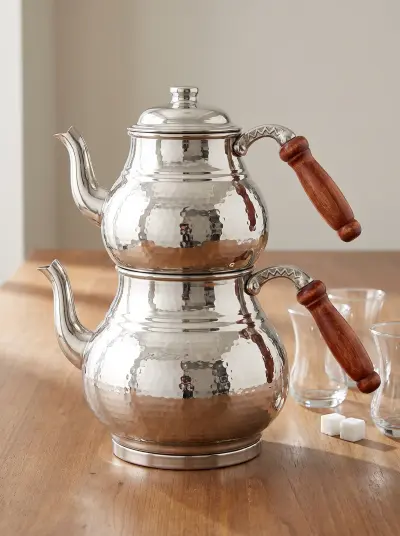
Klasik Copper Turkish Double Teapot — No. 3, light gauge, hand-hammered, nickel-plated
TC10060-2
How copper cookware pricing is built, what sets a minimum order quantity, and which stages make up a lead time. A transparent sourcing guide for importers.

Browse the range, add the pieces you need to your quote list and ask for prices in one message. No account, no online prices.
Copper cookware pricing rests on three variables: the copper weight of the piece, the forming method, and the interior lining. Because copper trades as a commodity, quotes carry short validity windows. MOQ is low on stock shapes and materially higher on custom tooling. Lead time is the sum of several stages, not a single production figure.
Most buyers open their first sourcing conversation expecting a price list. In copper cookware there is no such list, and its absence is honesty rather than evasion. Copper trades on global exchanges, its price moves daily, and in a finished piece the metal is normally the largest single cost line. When the input moves, the output moves with it.
The practical consequence is simple: a quote is valid for a stated period, and that period is short. A workshop that prints a validity date is pricing honestly against the metal. A supplier offering an open-ended fixed price is doing one of two things: selling goods already in finished stock, or converting metal risk into a safety margin inside the unit price. In the second case you fund that margin whether or not the market moves.
So the useful opening question is not "what is your price" but three questions: what metal reference date is this price built on, how many days is it valid, and what mechanism updates it on repeat orders. A supplier who answers all three is worth more to your planning than one who is merely cheaper, because a repeatable mechanism is what makes a landed cost forecastable.
A copper pot, stockpot or serving tray does not have one price. It has a stack of cost lines, each responding to a different decision in your specification.
| Cost line | Driven by | What you control |
|---|---|---|
| Copper raw material | Piece weight and current metal price | Wall thickness, diameter, depth |
| Labour | Hand hammering versus pressing, ornament | Surface pattern, level of handwork |
| Tin lining | Interior surface area and tin cost | Shape, lining specification |
| Tooling and setup | One-off cost for a custom form | Staying on a stock shape |
| Finishing and polishing | Target lustre and finish type | Raw, matte or mirror finish |
| Packaging | Protection level and export requirements | Packaging grade you specify |
Raw material scales directly with weight: double the copper in a piece and this line roughly doubles. That single fact explains why most price negotiations are, underneath, arguments about wall thickness.
Labour depends on method. A hand-hammered stockpot consumes far more skilled hours than a pressed pan of the same diameter. The hammered surface common in Gaziantep and Kahramanmaraş workshops is not decoration applied afterwards; it is the visible trace of a forming method, and it carries cost. Engraving, repoussé and pierced work push the labour line up quickly. Each product page in the catalogue lists the piece's specification, which is where to start reading the labour line.
Tin lining scales with interior surface area, so a deep wide pot costs more to line than a shallow tray of similar weight. Tin melts at 232 °C, so the lining is a consumable layer needing periodic renewal under professional use, not a permanent coating. See tin lining care.
One detail worth asking about: copper offcuts and turnings are not waste. Copper remelts without losing quality and the scrap is usually recovered. How that shows up in a quote varies from workshop to workshop, so on complex shapes it is worth asking whether the material line is calculated on gross or net consumption. The labour line rises on those shapes either way.
Tooling and setup is a one-off investment and sits at the centre of the MOQ conversation. Finishing and packaging are the two lines buyers most often overlook, and the gap between domestic and export-grade packaging shows up directly in breakage on arrival. See export packing and container loading for the detail.
Take two pots of identical diameter, one at 1,5 mm and one at 2,5 mm. Most of the price gap between them is copper weight: at the same diameter and form, metal used grows roughly in proportion to thickness. The saving on the thinner model is not clever engineering; it is metal you did not buy.
That does not make thinning always wrong. It is a reasonable choice for:
It is clearly wrong on cookware used over direct heat and on anything cycled through heating and cooling several times a day in a professional kitchen. Thin walls introduce three failure modes: base warping, uneven heat distribution producing hot spots, and fatigue at handle attachment points. The 2-3 mm range in professional use is a durability requirement, not a comfort preference. When you request quotes in cookware, put wall thickness on the first line of the specification.
A working rule for cost reduction: simplify the product mix first, review packaging grade second, touch wall thickness last. The first two do not damage the product; the third can.
Minimum order quantity is not an arbitrary barrier. It is the threshold at which one-off costs spread to a reasonable amount per piece: tooling or templates for a custom form, setup and calibration, the maker's learning curve on an unfamiliar shape, and scrap from the first pieces off the line.
MOQ therefore tracks how custom the item is:
Exact figures vary by workshop, product group and season, which is why no supplier can honestly publish one number for the sector. The levers that lower MOQ are the same everywhere:
Branded and private-label production runs on different rules; in contract and OEM manufacturing, how tooling cost is shared becomes a negotiation item in its own right.
Asking "what is your lead time" and accepting one figure is misleading: the answer is a sum of stages that wait on each other. The table shows each stage and its typical weight in the total. Absolute durations vary with workshop, quantity and season.
| Stage | What happens | Weight in the total |
|---|---|---|
| Confirmation | Specification, dimensions and drawings are fixed | Short, but the most common source of delay |
| Sampling | One piece is produced and sent for approval | Moderate, courier time included |
| Production | The run itself, scaling with quantity | The largest share |
| Tinning | Interiors are lined, batch by batch | Moderate |
| Quality control | Dimensions, lining and surface inspection | Short |
| Packing | Packaging, labelling, palletising | Short |
| Shipping | Road, sea or air | Route dependent, sea the longest |
Two stages sit on the buyer's side, and most slippage originates there. Confirmation: a request opened with an incomplete specification stalls while the workshop asks questions and waits. Sample approval: a buyer slow to respond moves their own delivery date.
Skipping the sample buys a few weeks and transfers the entire risk to you. The sample is the only physical proof that wall thickness, handle attachment, lining appearance, tolerance and finish match what was written down. On food-contact goods the sample is also the article against which compliance documentation is verified; see the food-contact copper compliance guide.
Copper workshops are bounded by the number of skilled makers on the floor, so capacity does not scale on demand. The same quantity placed in a peak period leaves later than one placed in a quiet month. Buyers who share an annual plan get slotted into the production calendar in advance and see steadier results on both dates and price.
The common pattern is a deposit on order confirmation with the balance before shipment. The deposit is not purely commercial security: the workshop buys copper before production starts, so it finances raw material. Reading a deposit request as a red flag by default is a mistake.
A letter of credit earns its cost when the order value is high, when there is no transaction history, when your bank is financing the trade, or when transfer conditions call for extra assurance. Against that it carries bank charges and strict document discipline, and on a small first order the cost can exceed the benefit. Keeping the first order deliberately small to test the relationship is often cheaper risk management.
Currency is a separate line. State the currency, the payment date and any exchange adjustment clause explicitly, along with which side carries bank charges. It looks minor on one order and becomes visible across a year of repeats.
Whatever instrument you use, tie payment milestones to physical milestones: sample approval, completion notice, pre-shipment inspection. Payments tied to delivered work rather than to dates protect both sides.
The most common error is straightforward: a buyer lines up three quotes, compares unit prices and takes the lowest. The three quotes are usually not pricing the same product.
These are the items that must be fixed to one specification before any comparison means anything:
The correct frame is total cost of ownership. A base that deforms early, a lining needing renewal within months, a share of the consignment broken in transit, or a container held at customs for missing food-contact documentation will each erase a unit price gap several times over. For verifying material and quality on arrival, see how to identify genuine copper.
A buyer who understands how the price is built asks the right question. A request carrying the information below returns comparable quotes in hours rather than days:
Supply all of this at once and the workshop does not have to assume, which matters because a workshop that assumes prices defensively. Add the products to the quote list, write these fields into your message and send it by WhatsApp, e-mail or the form; The Coppery replies with the wholesale price, minimum quantity, lead time and shipping terms for that order. For the wider supplier landscape and the documentation to ask any workshop for, start with the Turkish copper cookware manufacturers guide.
TC10060-2

TC10055-4

TC10055-6
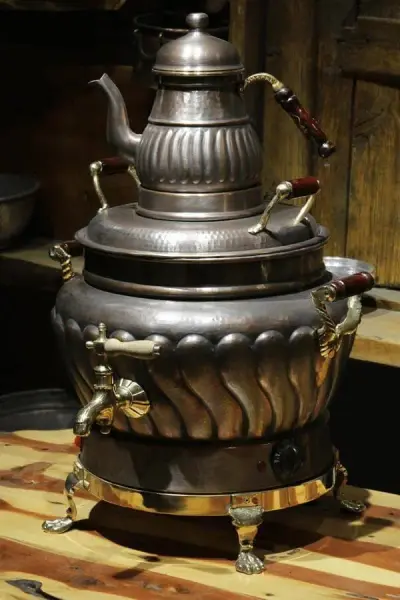
TC10076-3
Because copper is an exchange-traded commodity and metal is the largest single cost line in most pieces. When the metal moves, the piece moves with it. Serious workshops therefore quote with a validity window, commonly a few days to a few weeks. A supplier offering an open-ended fixed price is either selling from finished stock or has buried a risk premium in the number you are paying.
MOQ is the point where one-off setup costs spread thin enough per piece to make sense. On a shape the workshop already produces, that threshold is low. On a custom diameter, a new form or a branded run, tooling, templates and first-run calibration create real up-front cost, so the threshold rises noticeably. Concentrating volume on fewer models is the single most effective way to negotiate it down.
The material line scales roughly with copper weight, so a thinner wall lowers raw material cost almost proportionally. That is a legitimate saving on serving pieces, trays and decorative items. It is a false saving on cookware used over direct heat, where 2-3 mm is a durability requirement rather than a comfort preference. Thin bases warp over repeated heat cycles and develop hot spots.
You can, but the risk transfers entirely to you. The sample is the only physical evidence that wall thickness, handle attachment, tin finish, dimensional tolerance and surface treatment match the written specification. If a full production run turns out wrong, the dispute reduces to how each side reads an email thread, and the cost of correction almost always exceeds the weeks you saved.
No. The workshop buys copper before production begins, so the deposit finances raw material rather than simply securing the order. A deposit on order confirmation with the balance before shipment is the standard pattern in this trade. A letter of credit makes sense on high-value orders or a first relationship with no history, but bank charges and document discipline can outweigh the benefit on small volumes.
Usually because they are not quoting the same item. The gap typically hides in wall thickness, the quality and application of the tin lining, whether handles are riveted or spot welded, whether packaging is export grade, and which Incoterm the price includes. Fix all of those in one specification before you place quotes side by side, otherwise you are comparing different products.
Product type, diameter or capacity, wall thickness, lining preference, quantity and target delivery date. Add packaging expectation, Incoterm and destination port and the quotes become directly comparable. Without these, each workshop fills the gaps with its own assumptions, and assumptions are always priced conservatively, which means priced against you.
Other guides covering the same stage of the buying process - continue reading here.

How to set payment terms with a small Turkish workshop: deposit and balance logic, when a letter of credit is proportionate, the EXW trap, and FOB vs DAP.
A supplier verification method for copper cookware: three layers of proof, factory audit checklist, sample measurements, red flags and the document chain.

How OEM and private label copper production works: three levels of customisation, tooling cost and ownership, sample sign-off, branding methods and packaging.
Add the products you need to your quote list with quantities and send it by WhatsApp, e-mail or the form. We reply with unit prices and delivery terms.