
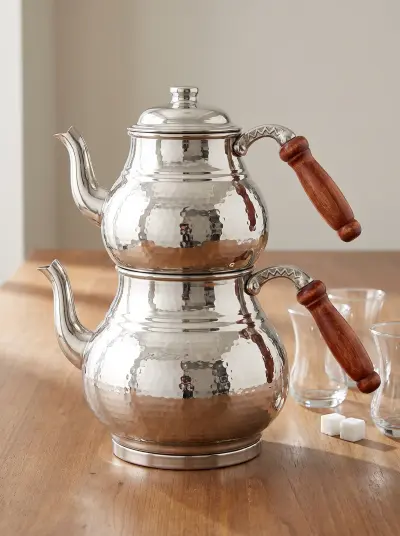
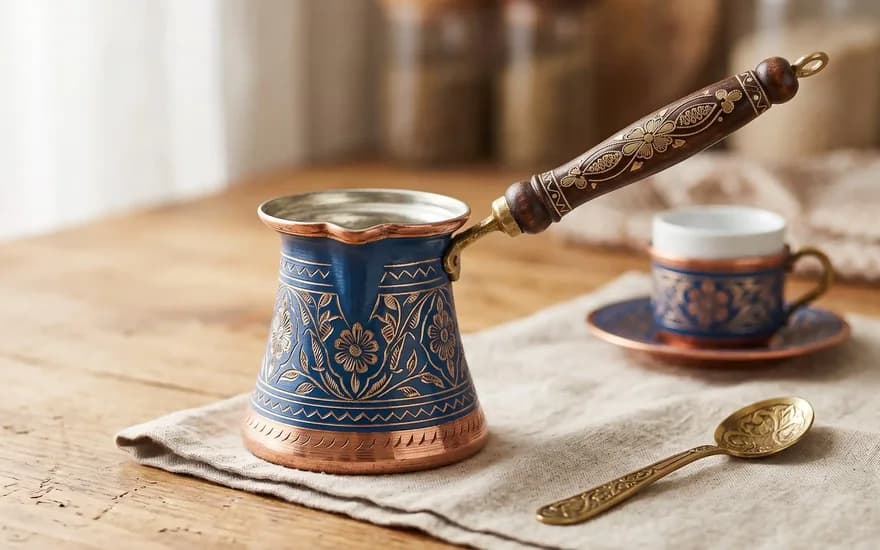
Klasik Copper Turkish Double Teapot — No. 3, light gauge, hand-hammered, nickel-plated
TC10060-2
How OEM and private label copper production works: three levels of customisation, tooling cost and ownership, sample sign-off, branding methods and packaging.

Browse the range, add the pieces you need to your quote list and ask for prices in one message. No account, no online prices.
OEM and private label copper production runs at three levels: branding a catalogue form, altering the dimensions of a catalogue form, and developing an original form from scratch. What separates them is not price but the tooling and setup investment, which is also what sets the minimum order. The process starts with a brief and locks on an approved sample.
Contract manufacturing is not one service but three distinct jobs that differ in cost, lead time and risk. Knowing which one you are asking for is what makes competing quotations comparable.
Level one is branding on a catalogue form. The workshop takes a body it already produces and applies your mark by engraving, stamping, embossing or laser. Packaging becomes your box, the product card is printed in your language, and the tooling is never touched, so setup cost is low and the sample cycle is short. For a retailer launching an own brand this is usually the right entry point, and workshops in the logo-marked production group handle it as routine work.
Level two is a dimensional change on a catalogue form. The shape stays recognisable but diameter, depth, wall thickness, handle type or rim profile changes. Sometimes an existing tool takes an insert, sometimes a new tool is unavoidable, and only a dimensioned drawing tells you which. Hotel groups sit here most often, resizing a service piece to a portion standard or fitting a tray to their own trolley. The custom size requests group describes this middle band.
Level three is an original form. The product is designed from nothing: technical drawing, tooling, more than one sample round and a longer calendar, and in return you hold a piece nobody else sells. Custom collection work runs at this level, and here the detail of the contract matters more than the unit price.
Tooling is the most misread line in an OEM quotation. It is not a unit cost but a one-off investment: made once, then used by every piece produced in that form, which is why its share of total cost falls sharply as the run grows.
It also drives the minimum order quantity. A workshop will not open a job at a quantity where setup cannot be spread down to a sensible per-unit share. Where no tooling is needed the threshold is noticeably lower, since there is nothing to amortise. Ask for pricing at two quantities rather than one: the gap between the numbers shows how heavy the setup share is. The wider relationship between quantity, price and lead time sits in the MOQ, pricing and lead time guide.
A second setup line is rarely asked about: jigs, gauges and the marking punch. A logo stamp, an engraving template or the laser vector file are one-off preparations, small next to tooling but equally important at reorder.
Paying for a tool and owning a tool are different things, and when they are not written separately each side assumes something different. The contract should answer at least five questions: who pays, who owns, where the tool is stored, whether part of the cost is credited against production, and what happens to it when the programme ends.
A sixth question costs most in practice: may the same tool run for another buyer. If that sentence is missing, your own form can appear on someone else's shelf by the time you place a second order.
Contract manufacturing is a chain in which every step has a named approver. It breaks in the same place every time: an approval never written down, or one with no physical reference behind it.
| Step | Output | Approved by |
|---|---|---|
| Brief and reference | Written product definition, visual reference | Workshop confirms feasibility |
| Technical drawing | Dimensioned drawing, gauge, tolerances | Buyer signs off in writing |
| Tooling and setup | Tool, jigs, marking punch | Workshop |
| Sample | First physical piece | Buyer approves by measurement |
| Revision | Updated sample | Buyer |
| Pre-production approval | Images of the first pieces off the line | Buyer |
| Production run | The batch | Workshop |
| Quality control | Inspection record, sampled measurements | Buyer or third party |
| Shipment | Palletised batch, packing list | Buyer |
The two decisive steps are the sample and the pre-production approval. A sample tests whether the brief was understood the same way at the bench, so it is measured rather than admired: take wall thickness with callipers at several points between rim and base and compare it against the specification. Professional service pieces are typically specified between 2 and 3 mm, and how to write that number is covered in the gauge specification guide.
Pre-production approval happens after the run has started. The workshop stops the line, sends measurements or images of the first pieces, and continues only once you confirm. It costs a day and prevents an entire batch from being wrong.
A mark reaches copper in five ways, and the difference between them is permanence and unit economics rather than looks. One rule applies to all: the mark goes on the outside, on the side wall or the base. Nothing is marked into a tinned interior, because engraving and stamping cut the lining and laser damages it with heat.
| Method | How it is applied | Permanence | When it makes sense |
|---|---|---|---|
| Engraving | Hand graver or machine cutting | Stays with the surface, survives polishing | Small to medium runs, gift and premium lines |
| Embossing | Formed from the inside by tool or hammer | Part of the form itself, permanent | Where tooling is already being made |
| Stamping | Cold-struck punch | Permanent, depth depends on the strike | High volume, simple and small marks |
| Laser marking | Controlled surface colour change | Permanent, weakens under heavy polishing | Fine detail, small type, batch numbers |
| Screen printing | Applied ink on the surface | The least wear-resistant option | Decorative pieces, non food contact surfaces |
The choice follows use as much as budget: printed ink on a pan in daily service wears off quickly, while the same print on a wall tray lasts for years. Embossing is a special case: if a tool is being made anyway, sinking the brand into the form adds little setup, whereas adding it later becomes a separate investment.
On a private label product the packaging is part of the product. A retail-facing item needs the box, label, barcode and care instructions designed together, while a bulk HORECA shipment prioritises protection and often carries no retail box at all.
Barcodes are a frequent misunderstanding: the trade item number comes from the number range of the brand owner placing the goods on the market, not from the workshop. Care instructions are the brand owner's text, printed in the language of the destination market. For tin-lined copper one technical warning is not optional: tin melts at roughly 232 degrees Celsius, so an empty pan left over high heat damages the lining directly.
Settle where the workshop's responsibility ends before the order. A workshop may box the item, case-pack the boxes and palletise them, and which of those sits inside the quoted price defines the job. Copper is heavy and soft, so weak palletising shows up as dented goods at the destination port. Export packing detail sits in the export packing and container loading guide.
Who owns a design depends on who drew it, and that is a contract question rather than an assumption. If you arrive with a finished drawing, ownership staying with you is the normal expectation. If the form emerges at the bench from the workshop's own suggestion, the position is genuinely arguable, and what is not settled in writing is not settled later.
A confidentiality agreement is signed before discussions start on an unreleased product, and its scope can cover quantities, price structure and launch timing as well as the drawing. The clause that earns its place most often limits the workshop's use of your product in its own catalogue and marketing images.
Exclusivity is a normal request and a chargeable one, since it asks a workshop to withhold capacity from other buyers, so in practice it is paired with a volume commitment or a fixed term. Keep the scope narrow and written: which item, which markets, for how long and above what annual quantity. This guide is a map rather than legal advice, and the final wording belongs with your own adviser.
The real test of contract manufacturing is not the first batch but the second. Quality on a first run is usually good because everybody is watching; getting the same product six months later is a systems question.
The only reliable instrument is a retained counter sample: two are set aside, one at the workshop and one with you, both dated and labelled. The contract also names the acceptable deviation band, meaning dimensional tolerance, a weight range and a reference for surface tone.
The second element is who does the work: on hand-hammered pieces the density and depth of the hammer marks vary with the craftsman, so ask whether the same bench continues on the reorder. The third is surface and lining, where polish level, patina and the tinning method all drive colour difference between batches. Copper darkens with air exposure, so part of any tone difference is the material behaving normally rather than a defect. In dense clusters such as Gaziantep the supporting trades sit close together, which makes it easier to keep the same tinning shop across runs.
When goods carry your brand and no one else's name, you are the party placing them on the market in your destination, so the labelling, instruction and food contact declaration are generally built in your name.
What the workshop can supply is well defined: material description, lining method, process information and any test reports it holds. A test report covers the sample tested, not a whole catalogue, so if your item runs with a different lining or finish, ask about the scope of that report separately.
Which document must be issued in whose name depends on the destination market, so confirm the final list with your own customs broker. The general structure of the document chain for food contact copper is set out in the food contact compliance guide.
What makes OEM quotations impossible to compare is almost always an incomplete brief: leave any of the nine headings below out and every workshop prices its own assumption.
To put the brief to The Coppery, start from the OEM and contract production group rather than a broad catalogue category, add the base pieces to the quote list and send the brief with it by WhatsApp, e-mail or the form. When you compare suppliers, keep in mind that a workshop that sells stock lines and one that runs branded programmes are not the same kind of business.
TC10060-2

TC10055-4
TC10055-6
TC10076-3
Not if you stay on a catalogue form. Marking, packaging and finish can all be changed without touching the tooling, which is why entry-level private label work carries a low setup cost. Tooling becomes necessary only when the shape itself changes, meaning a new diameter, a new wall profile or an original body. That single distinction drives both your setup cost and your minimum order.
Not automatically. Paying for tooling and owning tooling are two separate questions and both belong in the contract in writing: who pays, who owns, where it is stored, whether the cost is amortised against production runs, and what happens to it if the programme ends. Add one more clause that is often missed, namely whether the same tool may run for any other buyer.
On the outside only, typically the side wall or the base. Marking is not applied to a tinned interior: engraving and stamping cut through the lining and laser marking degrades it with heat. Keeping the food contact surface continuous matters for both hygiene and lining life, so agree the position, size and method before the sample is made rather than after.
On hand-worked copper an exact match is not a realistic specification. What is realistic is an agreed tolerance band written into the contract: dimensional tolerance, a weight range and a reference for surface tone. Keep two counter samples, one at the workshop and one with you, both dated and labelled, because a verbal understanding is worthless against a pallet that lands eight weeks later.
The party that places the goods on the market under its own brand generally carries the labelling and documentation duty, because the product carries no other name. The workshop supplies material, lining and process information plus any test reports it holds. Which documents must be issued in your name depends on the destination market, so confirm the final list with your own customs broker or regulatory adviser.
You can, and the request is normal, but it is not free. Exclusivity asks the workshop not to sell that form to anyone else, which ties up capacity, so in practice it is paired with a volume commitment or a fixed term. Define the scope narrowly in writing: which item, which markets, for how long and above which annual quantity it holds.
Where tooling is involved, the quantity is set by the point at which setup cost falls to an acceptable share per unit, and that point varies by item, method and workshop. Where you stay on a catalogue form and only add branding, the threshold is noticeably lower. Rather than guessing, ask for pricing at two different quantities. The gap between them exposes the setup share directly.
Other guides covering the same stage of the buying process - continue reading here.
How to set payment terms with a small Turkish workshop: deposit and balance logic, when a letter of credit is proportionate, the EXW trap, and FOB vs DAP.
A supplier verification method for copper cookware: three layers of proof, factory audit checklist, sample measurements, red flags and the document chain.
Compare Turkish copper cookware manufacturers by region, gauge, tinning and capacity. How to shortlist suppliers and request a wholesale quote.
Add the products you need to your quote list with quantities and send it by WhatsApp, e-mail or the form. We reply with unit prices and delivery terms.