

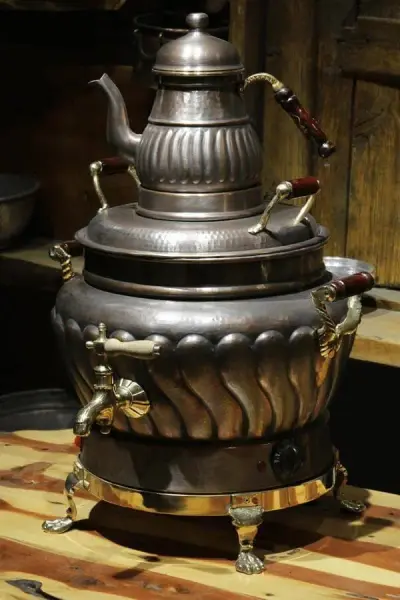
Klasik Copper Turkish Double Teapot — No. 3, light gauge, hand-hammered, nickel-plated
TC10060-2
How to set payment terms with a small Turkish workshop: deposit and balance logic, when a letter of credit is proportionate, the EXW trap, and FOB vs DAP.

Browse the range, add the pieces you need to your quote list and ask for prices in one message. No account, no online prices.
Payment terms with a small Turkish workshop rest on three things: keeping the first order small enough to function as a trial, balancing a deposit that funds raw material against a balance that secures delivery, and tying each payment step to a verifiable milestone. The delivery rule you choose changes that balance and belongs in its own clause.
Almost every guide to international payment terms assumes a factory on the other side, running container volumes and staffing a dedicated export desk. The Turkish copper clusters do not look like that. A large share of production in Gaziantep, Kahramanmaraş, Trabzon and Erzincan happens in workshops of ten to fifteen people, with no finance department and no deep working capital. At that scale a payment term is not a preference. It decides whether production starts at all.
Two consequences follow. First, the workshop buys copper up front. The metal is exchange-traded and merchants do not extend long credit to a craft workshop, so the raw material leaves the maker's account the day your order is confirmed, months before there is anything to ship. Second, the workshop's banking relationship is not that of a trading company. Opening, tracking and papering a complex payment instrument is a real administrative load for a business of that size, and the load falls on the same person who runs the shop floor.
None of this obliges you to accept whatever is proposed. It does mean that a term which reads as standard in a Far East sourcing playbook can be the reason a good maker declines your enquiry. The pricing logic behind those numbers is set out separately in the MOQ, pricing and lead time guide.
Most arguments about payment terms are arguments about trust conducted in another vocabulary. Neither side knows the other, so both try to push risk across the table: you do not want to pay for goods you have not seen, and the maker does not want to buy metal against a promise. The cheapest way out is not to renegotiate the term. It is to shrink the amount at stake.
A trial order is a deliberately small first purchase whose purpose is to test the relationship rather than the product. Testing the product is what a sample does. A trial order tests the process: whether the quoted lead time holds, whether the packing survives transit, whether the documents arrive complete and correct, and how the workshop behaves when something goes wrong. Those answers only exist at the end of a real shipment.
Small batches carry an honest penalty. Customs clearance, terminal handling and documentation are charged per shipment, not per piece, so the unit cost of a trial batch will look poor. That figure is not the price of a production run; it is the cost of verification. The complementary supplier-side checks are covered in how to verify a copper supplier.
The split between deposit and balance is not a haggling position. The two payments do different jobs. The deposit unlocks production: metal purchase, tooling where a custom form requires it, first-run setup and the scrap that comes with it. The balance secures delivery: as long as the maker has not been paid in full before the goods move, it retains a commercial reason to finish the job properly.
A deposit on order confirmation with the balance due before shipment is the common pattern in this trade. The proportions vary with the size of the workshop, whether the item is a stock form or a custom one, and whether there is any history between you. Publishing a fixed percentage would be misleading, and any supplier quoting one as an industry rule is describing its own policy, not a standard.
Make the deposit answer to a document. It should be paid against a signed contract or a mutually accepted proforma invoice, never against a message thread. If that document does not carry the product specification, the quantity, the delivery date and the delivery rule, the deposit has financed an intention rather than an order, and you have no reference point when the first dispute arrives.
A documentary credit is your bank's undertaking to pay against a compliant presentation of specified documents. International practice follows the ICC's UCP 600 rules, and the protection is genuine on both sides: you do not pay before the documents exist, and the seller collects from a bank rather than chasing you.
That protection has a price. Charges arise at issuance, advising, confirmation and presentation, and the document discipline is unforgiving. A date that does not line up, a goods description that differs by a word, a missing packing list — any of these makes the presentation discrepant and stops payment until it is resolved. Most of that burden is fixed rather than proportional to the order.
The conclusion is a matter of proportion, not principle. On a small first order a credit is usually disproportionate, and the same money is better spent on a smaller batch and an independent inspection. It becomes sensible when the value is high, when there is no history between the parties, or when your own bank is financing the purchase and requires it. Where the balance tips is a judgement call that depends on your bank, the corridor and the goods, so ask your bank for the actual figures before deciding.
A delivery rule fixes the point where cost and risk change hands. The Incoterms 2020 rules define those points, and a contract should name the rule, the named place and the year of the rule set together. The most common mistake is choosing the rule that looks simplest.
Under EXW the seller merely places the goods at your disposal at its own premises. It has no obligation to load them, and export clearance is your responsibility. On paper that is the least demanding rule for the maker. In practice it creates two problems. A small workshop may have no loading dock and no forklift, so loading your vehicle falls to the workshop anyway with no contractual basis. More seriously, the export declaration is in practice filed in the name of a party established in Turkey, which a buyer abroad should confirm with its own customs broker. The obligation is written to you and performed by nobody.
| Delivery rule | Seller's cost ends | Risk passes | Suits |
|---|---|---|---|
| EXW workshop | Goods placed at disposal on the premises | At placing at disposal | A buyer or agent established in Turkey |
| FCA workshop or terminal | Delivery at the named place, export clearance on the seller | On completion of delivery | Containerised and groupage cargo |
| FOB Mersin or İskenderun | Loading on board the vessel | When goods are on board | Conventional and bulk sea cargo |
| DAP buyer's address | On the vehicle at the named destination | When placed ready for unloading | Road groupage into Europe |
FCA is the clean answer. With the workshop named as the delivery place, the seller loads your vehicle and handles export clearance, and risk passes to you at loading. The International Chamber of Commerce makes the same point about containers: a box leaves the seller's control days before it is loaded on board, so FOB describes the wrong moment for it.
Sourcing content written around Far East supply chains misses one structural fact. Regular road and groupage services run between Turkey and Europe, which gives a buyer working in small quantities a route that does not require filling a sea container first. The nearest sea ports to the southern clusters are İskenderun and Mersin; in the north, Trabzon has its own port.
That geography feeds straight into the delivery rule. If you are moving by sea and hold your own freight contract, FOB İskenderun or FOB Mersin lets you use it, which is the usual reason buyers ask for it rather than CIF. For a small consignment going to Europe by road, DAP is often more practical: the seller organises carriage, you see a single figure, and you deal only with import formalities at your end.
Do not confuse DAP with DDP. Under DAP, import clearance, duties and unloading are yours. Under DDP the seller absorbs import duties and clearance too, which is rarely realistic for a workshop that has no presence in your tax jurisdiction. How to convert any of these prices into a comparable warehouse-door figure is covered in the tariff code and landed cost guide, and how the goods should be stowed in the export packing and container guide.
Tying instalments to calendar dates is weak, because a date says nothing about who caused a delay. The stronger structure ties each instalment to a verifiable output. Three checkpoints are common: mutual acceptance of the approved sample, a photographed progress report at mid-production, and a pre-shipment inspection.
Sample approval is the first link and makes a natural trigger for the second instalment; the approval chain itself is covered in sample orders and pre-production approval. The mid-production checkpoint shows you the run is genuinely moving and gives the workshop the cash flow it needs to finish. The pre-shipment inspection is the natural counterpart of the balance: goods finished, counted, defect list closed.
For every checkpoint the contract needs two lines: who signs it off, and against which document. A photograph, a countersigned sample, an independent inspection report. Without those lines a milestone reduces to one party's assertion, which is exactly what you were trying to avoid. Settle both lines while the quote is still open, before the order is confirmed.
The list below is a checklist, not a template. We do not offer a downloadable contract, and the wording should be drafted with your own legal adviser. This guide is a map of what must not be left open, not legal advice.
Add packing and marking to the same list. Carton quantity, pallet dimensions and label content are cheap to agree in advance and expensive to renegotiate once the goods are ready to move.
A product listing is not a payment guarantee, and a supplier's catalogue does not replace the contract terms above. Treating a listing as security is a mistake worth naming explicitly, because it is the assumption that leads buyers to skip the checks above.
The catalogue's job sits earlier in the process. The Coppery's catalogue lists pieces and specifications without prices, covering contract and OEM production alongside cookware. You add the pieces to the quote list, send it by WhatsApp, e-mail or the form, and The Coppery replies with the wholesale price, minimum quantity, lead time and shipping terms for that order. The payment schedule and the delivery rule are then settled against that quote, using the checklist above.
TC10060-2

TC10055-4

TC10055-6
TC10076-3
Because it buys the metal before it starts. Copper is an exchange-traded commodity and metal merchants do not extend long credit to a fifteen-person workshop. The deposit funds raw material, tooling and first-run setup rather than the maker's profit. Asking for the material line to be shown separately on the proforma invoice turns that claim into a number you can check.
Usually not. Bank charges, the opening and presentation cycle and the strict document discipline of a credit do not scale down with order value; most of that burden is fixed. On a small trial batch the cost can exceed the protection gained. Where the balance tips depends on the banks, the countries and the goods, so confirm the numbers with your own bank.
Under EXW the seller only places the goods at your disposal at its own premises. Loading is not the seller's obligation and export clearance is yours. In practice the export declaration is filed in the name of a party established in Turkey, and a small workshop may have no loading dock or forklift. The duty sits with you on paper and with nobody in practice.
FCA, with the workshop named as the delivery place. The seller then loads the goods onto the vehicle you send and handles export clearance, and risk passes to you at loading. The International Chamber of Commerce recommends FCA over FOB for containerised cargo, because a container leaves the seller's control long before it is loaded on board.
Under both, the seller carries the goods to a named place in your country. The difference is at the border: with DAP, import clearance, duties and unloading are yours. With DDP the seller also takes on import duties and clearance. DDP is rarely suitable for a small workshop, because it requires the seller to predict a tax regime it does not operate in.
Only milestones with a verifiable output. Three are common, in this order: mutual acceptance of the approved sample, a photographed progress report at mid-production, and a pre-shipment inspection. For each one the contract should name who signs it off and against which document. Without those two lines a milestone rests on one party's word.
Not until both quotes sit on the same delivery rule. A price quoted at the workshop gate and a price quoted at your warehouse door contain entirely different cost blocks, so the gap between them tells you nothing about manufacturing cost. Fix the rule and the named place first, then compare, and compare on landed cost rather than unit price.
No. There is no online payment on the site: it has no checkout, holds no funds, operates no escrow and does not open letters of credit, which run through banks. You pick products in the catalogue, send your quote list, and receive a wholesale quote; the payment schedule and delivery rule for that order are then agreed between you and The Coppery and written into the contract.
Other guides covering the same stage of the buying process - continue reading here.
A supplier verification method for copper cookware: three layers of proof, factory audit checklist, sample measurements, red flags and the document chain.

How OEM and private label copper production works: three levels of customisation, tooling cost and ownership, sample sign-off, branding methods and packaging.

Compare Turkish copper cookware manufacturers by region, gauge, tinning and capacity. How to shortlist suppliers and request a wholesale quote.
Add the products you need to your quote list with quantities and send it by WhatsApp, e-mail or the form. We reply with unit prices and delivery terms.