
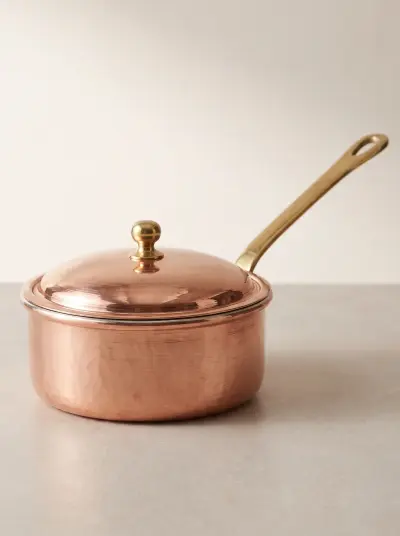
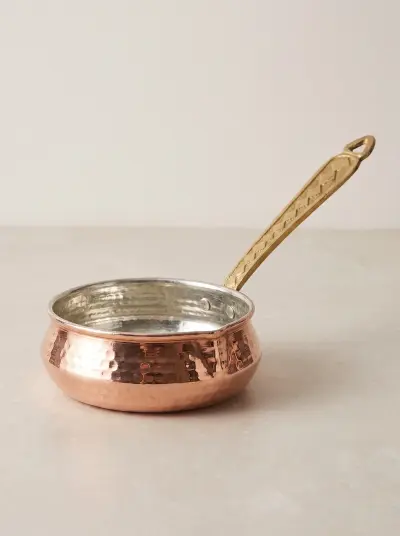
Dalyan Copper Sauce Dish — 14 cm, hand-hammered, polished copper
TC10169-1
A station-by-station copper checklist for Middle Eastern restaurants: mezze dish sizes, kebab platters, cook-and-serve pans, tea, coffee, linings, quote lists.
Browse the range, add the pieces you need to your quote list and ask for prices in one message. No account, no online prices.
A Middle Eastern restaurant copper checklist, the copper part of the equipment list, starts at the table, not the stove: mezze and sauce dishes, grill platters, cook-and-serve casseroles, sharing trays, tea and coffee service, and dessert. For each item specify diameter or capacity, finish, the food-contact lining and quantity, then send them from the quote list as one quote request.
The checklist has six stations, and each station has one governing requirement that decides the specification. Copper earns its place where guests see it and where heat retention or presentation does a job. Behind the pass, stainless steel usually does the same work for less.
Turkish, Lebanese, Levantine, Persian and Gulf menus look different on paper, but they share the same service structure: many small cold and hot starters, a grilled or slow-cooked main brought to the table, bread in volume, and a long tea or coffee finish. That structure is what drives the copper list, more than the cuisine label.
| Station | Copper item | What to specify | Catalogue category |
|---|---|---|---|
| Cold and hot mezze | sauce dishes, small bowls, mini casseroles | diameter or ml, lining, handle | Copper sauce dishes |
| Grill and kebab | boat plates, round platters, lidded platters | length or diameter, lid, finish | Copper serving plates |
| Cook-and-serve | mini casseroles, casseroles, frying pans | gauge, lining, heat source | pots and frying pans |
| Bread and sharing | round trays, large platters | diameter, rim height, finish | Copper serving trays |
| Tea and coffee | cezves (Turkish coffee pots), double teapots, saucers | capacity, lining, handle joint | Turkish coffee pots |
| Dessert and last course | sugar bowls, small plates | diameter, finish, lid | sugar bowls and serving plates |
Read the table as a draft order form. Every row becomes one or more quote lines, each with a stock code, a quantity and a note on the food-contact surface. The rest of this guide goes deep on the first row, because mezze is where most of a Middle Eastern restaurant's copper lives and where most specification mistakes are made. The other stations get a short section and a link to the guide that covers them in full.
Size every mezze dish to one real, plated portion of the dish it will carry, and leave a visible rim. A dish that is too large makes a standard portion look mean; a dish that is too small spills dressing onto the table and slows the runner.
The catalogue gives you concrete sizes to test against. The Alebat sauce dish comes in three sizes: 9 cm (TC10174-1), 11 cm (TC10175-1) and 12 cm (TC10182-1). The Dalyan sauce dish (TC10169-1) is 14 cm with a brass handle. The Salsa sauce dish is offered in three numbered sizes with a choice of brass or wooden handle. For hot mezze, the mini casseroles are listed at 60 ml (TC10176-1), 90 ml (TC10177-1) and 140 ml (TC10178-1), all at 1.85 mm, and the three sizes are also offered together as a set (TC10179-1).
| Dish size | Typical mezze use | Catalogue example | Note |
|---|---|---|---|
| 9 cm, shallow | single dip, olives, pickles, chilli paste | Alebat No. 1, TC10174-1 | quick turnover, many needed |
| 11 to 12 cm | standard cold mezze for one or two | Alebat, TC10175-1 and TC10182-1 | the workhorse size |
| 14 cm | sharing portion, salad, tabbouleh | Dalyan, TC10169-1 | handle helps the runner |
| 90 to 140 ml, deep | hot mezze, baked cheese, shrimp, eggs | mini casseroles | goes from oven to table |
Take a Levantine menu with eight cold mezze and four hot ones, served to a 60-seat room. Hummus, moutabal and muhammara are dips that sit well in an 11 or 12 cm dish. Tabbouleh and fattoush need more surface and suit the 14 cm dish. Olives, pickled turnip and chilli go in the 9 cm size. The four hot mezze, such as halloumi, sujuk (spiced beef sausage) or baked eggs, go into the 90 or 140 ml mini casseroles depending on portion weight.
That gives you four sizes rather than twelve different dishes, which simplifies stock, washing and replacement. It is a common mistake to buy one dish design per menu item. A small set of sizes, used consistently, makes reordering predictable and keeps the table looking like one collection.
Before you fix the sizes, plate each dish once. Weigh the portion, put it in the candidate size, and check three things: the rim stays clean, the spoon or bread has room to work, and the dish does not tip when a guest scoops from one side. Handled dishes solve the last point for wet dips.
Any surface that touches acidic food must be lined. The US FDA Food Code (section 4-101.14) does not allow copper to contact food below pH 6, and unlined copper reacts with acids, and Middle Eastern mezze is full of them: lemon juice, vinegar, sumac dressings, pomegranate molasses, yogurt, labneh and tomato. The interior of every mezze dish that carries a wet or acidic dish needs a tin or stainless lining.
The catalogue lists the outer finish of each product, polished copper, nickel-plated, oxidised or brushed matt, but the finish name does not tell you what the food-contact interior is. Nickel-plated means a silver-coloured outer surface; it is not a statement about the inside of the dish. Put the interior surface as a separate line in your request for every SKU and get it confirmed in the written quote.
Tin is the traditional lining for Turkish copper. It is soft, renewable and melts at 232 °C, which is not a concern for a cold dip but matters for anything that goes into a hot oven or onto a burner empty. Stainless lining tolerates more heat and abrasion but cannot be renewed in the same way. The trade-off is set out in the guide comparing tin and stainless linings for copper.
Unlined copper still has a legitimate place on a mezze table: holding dry items such as nuts or bread, or acting as an outer holder for a glass or ceramic liner. Write that use into the specification so nobody later fills the dish with lemon dressing. What the FDA clause means for an American kitchen is explained in the guide to the US Food Code rule on tin-lined copper. If you import into the European Union, the United States or the Gulf, the documentation question is a separate one; each market asks for its own food-contact documents, so ask in the quote request which documents are available for each item.
Lay out mezze by building the tray from your chosen dish sizes, not by choosing the tray first. Fix the dish diameters, then measure the tray's inner flat area, and arrange one dish in the centre with the others in a ring. A round tray carries a mezze spread better than a rectangle, because the ring keeps every dish within reach.
As a geometry check, the Çaldıran round serving tray (TC30043-2) is listed at 34 cm in diameter with a 1.5 cm rim height. With 9 cm dishes, a ring of six around one central dish fits within that circle on paper; with 11 or 12 cm dishes, plan for fewer. Rims and handles eat into the usable area, so confirm with a sample before you fix the layout in a menu photograph.
Three layouts cover most service styles:
Your layout choice changes the order quantity. A sharing ring uses one tray per table; individual trays need one per guest at peak. Decide the service style before you count, and the tray line in the quote list follows from it.
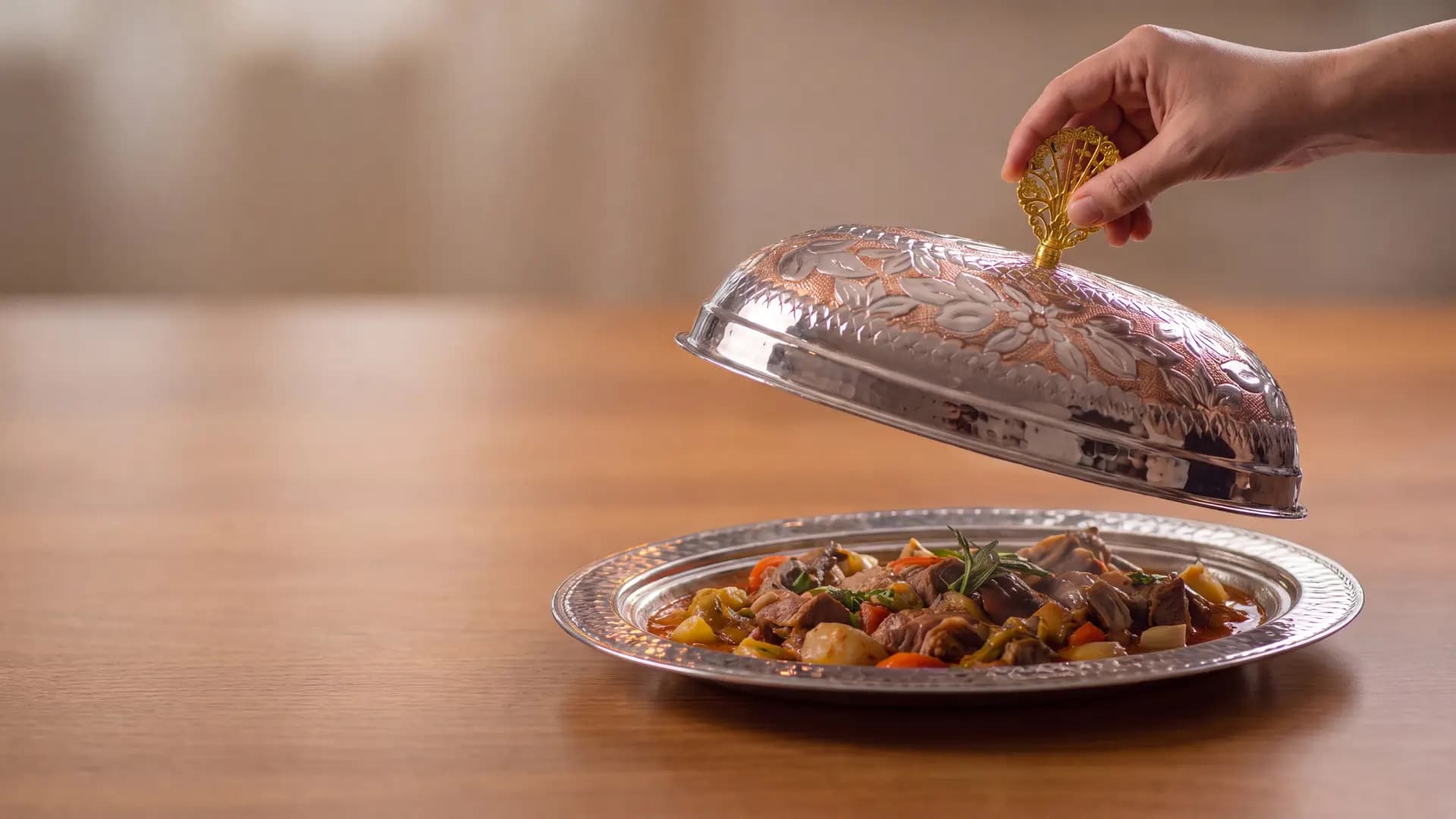
Grill and kebab platters are specified by length or diameter, whether they carry a lid, and how the finish will be kept consistent across a dining room. The copper kebab boat plate (TC30013-1) is a 35 cm hand-hammered, polished piece at 1.00 mm and about 700 g, and the catalogue also lists the Saltanat lidded boat-shaped plates from 25 cm (TC30003-1) to 47 cm (TC30007-1) for dishes that need to arrive covered.
Match platter length to the longest skewer or the full mixed-grill portion, and leave space for bread, salad and grilled vegetables on the same plate. A platter that leaves meat hanging over the rim looks generous in a photograph and causes problems at the table.
Charcoal-heated footed platters, lidded fish platters and the question of how platters survive the pot wash are covered in the dedicated guide to copper kebab and grill serving platters. Use it when grills are a major part of your menu rather than one section of it.
Cook-and-serve copper covers mini casseroles, casseroles and frying pans that cook a dish and then carry it to the guest. Unlike a serving dish, these pieces go on heat, so gauge and lining matter more than size. A cook-and-serve piece is judged twice: once by the cook for heat behaviour, once by the guest for how it looks on the table.
Typical Middle Eastern uses are eggs cooked sahan-style (a sahan is a shallow two-handled Turkish pan) with sujuk or menemen (Turkish eggs with tomato and pepper), served in a mini casserole or a small frying pan, baked dishes such as güveç (a baked stew), and sizzling shrimp or halloumi in a small pan. The catalogue lists copper casseroles in several diameters alongside rondeaus and saucepans in the cooking pots category, and the Soylu and Acemli frying pans in numbered sizes. Gauges vary by model and are shown on each product page.
The main risk with tin-lined cook-and-serve pieces is dry heating: a pan left empty on a strong flame or under a salamander can exceed the 232 °C melting point of tin. Train the line on this before opening. Gauge, heat source compatibility, induction and how many pans a service line needs are worked through in the guide to cook-and-serve copper pans, sahan and sac.
Bread and shared trays are specified by diameter, rim height and finish, and they are bought in larger numbers than most operators expect. Bread arrives in volume with every course in Levantine and Turkish service, and a tray that clears plates is in use all evening. Count trays by function: bread, mezze sharing, clearing and coffee.
Gulf-style restaurants add forms that do not appear on a Turkish menu: the dallah coffee pot, large trays for kabsa and mandi served to a group, and incense burners for the dining room. These need their own capacity and lining notes, and some, such as the dallah, are often custom work rather than catalogue items. The guide to Gulf copper serveware: dallah, trays and sets covers those forms in detail.
If the restaurant is in the United Arab Emirates, the import side has its own rules for food-contact items. The country page on importing copper cookware into the UAE sets out duty, VAT and the conformity certificate question, so the landed cost of your list can be estimated before you commit.
Tea and coffee service is specified by capacity, lining and handle joint, and it is where a Middle Eastern restaurant is remembered. A Turkish coffee served in a copper cezve, or tea poured from a double teapot, is a ritual performed in full view of the table at the end of the meal.
The Kervan Turkish coffee pot (TC10011-1) is listed at 150 ml, two Turkish coffee cups, with a brass handle. A restaurant usually needs two or three cezve sizes: a single for one guest, a two-cup size for couples and a larger pot for tables. The catalogue also lists Turkish double teapots in light and heavy gauge, copper tea saucers, teapot warmers and electric copper samovars for high-volume tea service. Coffee is acidic, so the interior of the cezve needs a lining; sizing, handle joints and heat sources are covered in the Turkish copper coffee pot sourcing guide.
Dessert is the smallest station but easy to forget. Baklava, künefe portions and Turkish delight need small plates and lidded sugar bowls or candy dishes, and those pieces sit on the table alongside the coffee. Specify them in the same finish as the coffee set, so the last course reads as one collection.
Turn the checklist into a quote list by giving every row a stock code, a quantity and a note on the interior surface, then sending all lines together. A complete list gets a comparable written quote in one round; a list with open questions about lining or size gets questions back, and the opening date moves.
Work through it in this order:
Browse the full Turkish copper catalogue by category, add each product with its quantity, and send it from your wholesale quote list by WhatsApp, e-mail or the form. The wholesale price, minimum quantity, lead time and shipping are then given in writing for that order. If this is your first order from Turkey, the first wholesale copper order guide walks through choosing a trial range, reading stock codes and setting quantities. A restaurant inside a hotel follows the purchasing route set out in the guide to hotel OS&E copper procurement, and the page on HORECA copper equipment supply gives the wider property view.
TC10169-1
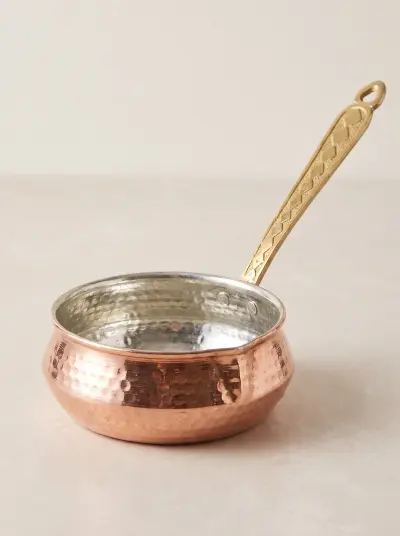
TC10170-1
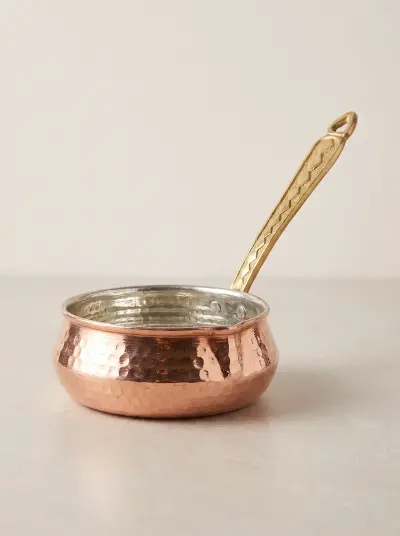
TC10171-1
TC10172-1
Only pieces made for heat. Sauce dishes and serving bowls are built for the table, while mini casseroles and frying pans are made to go from oven or hob to table. Never heat a tin-lined piece empty, because tin melts at 232 °C. Check the lining for each stock code in the written quote before any piece goes into the oven.
Only when the food-contact surface is lined. Unlined copper reacts with acidic food such as lemon, vinegar, pomegranate molasses, yogurt and tomato, so dips and dressings need a tin or stainless interior. Copper with no lining is suitable for dry items or as an outer holder for a liner. Confirm the interior surface of every SKU in the written quote.
As a rule, no. Alkaline machine detergents and long hot cycles dull the copper surface and wear tin linings. The usual practice is a short soak, hand washing with a mild detergent and immediate drying. Agree this with your kitchen porters before opening, because it decides how many spare dishes you need in circulation during service.
Count the dishes in use at peak, then add the dishes moving through the wash-up and an allowance for loss and damage. Small dishes and coffee saucers go missing fastest, so give them the larger allowance. Size the opening order from the menu and seat count, then size the reorder from what you actually lose in the first months.
Oxidised and brushed matt finishes need the least work, because they are meant to darken and they hide fingerprints and handling marks. Nickel-plated pieces keep a silver colour with less tarnish showing. Polished copper looks brightest but needs regular polishing to stay that way, so budget the staff time before choosing it for a whole dining room.
Order early enough to plate test dishes with real food before the opening menu is fixed. Stock items usually move faster than anything custom, while engraved pieces, non-catalogue sizes and Gulf forms such as the dallah take noticeably longer. The lead time for your exact list is stated in the written quote, so send the quote request as soon as the menu is drafted.
Yes. Logo engraving is quoted as a separate line from stock dishes and takes noticeably longer, because placement and method are approved on a sample before production. Small mezze dishes offer little flat area, so trays, platters and coffee pots usually carry a logo better. Keep the artwork and position on record so later reorders match.
Other guides covering the same stage of the buying process - continue reading here.
How to specify copper serving trays, chafing dish sets and mezze bowls for hospitality: telling solid copper from copper-plated stainless, lining and packing.
How restaurants choose copper cook-and-serve casseroles: mini and sharing sizes, capacity per portion, gauge, heat sources, linings, lids, handles, quantities.
How to choose copper serving platters with lids for banquets and room service: boat, round and fish shapes, 23-60 cm sizes, lid styles, lining and quantities.
Add the products you need to your quote list with quantities and send it by WhatsApp, e-mail or the form. We reply with unit prices and delivery terms.