
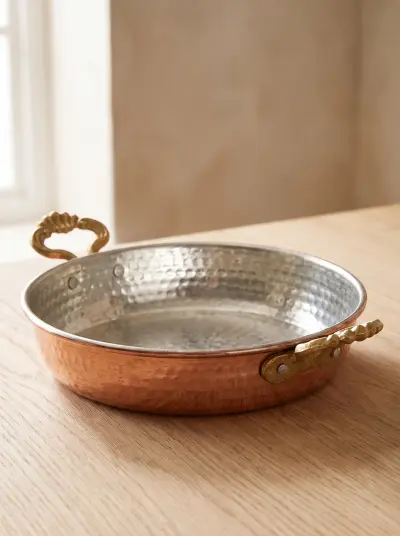
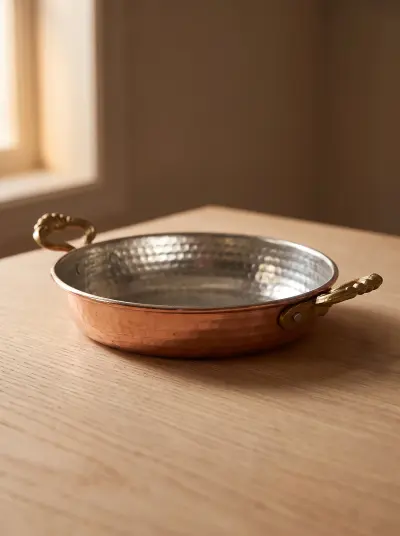
Soylu Copper Frying Pan — No. 2, 16 cm, heavy gauge, polished copper
TC10120-1
Which copper pan goes from stove to table: frying pan, lidded sahan, sac and wok pan or round gratin tray. Gauge, heat sources, tin limits and stock planning.
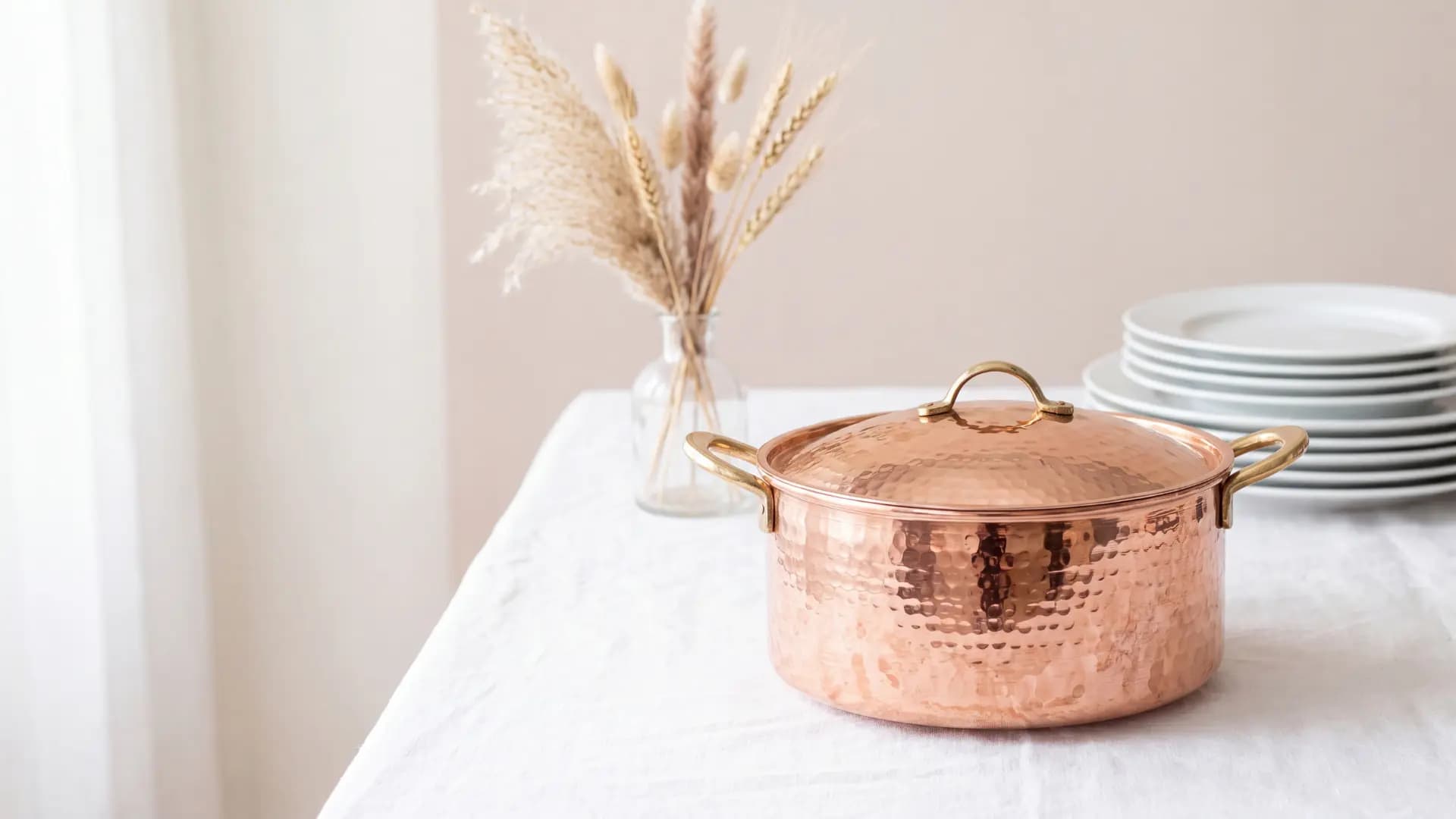
Browse the range, add the pieces you need to your quote list and ask for prices in one message. No account, no online prices.
A cook-and-serve copper pan cooks the dish and then becomes the plate, so the choice starts from the menu. Eggs want a small open pan, braised dishes a lidded pan, fast sautés a wide sac pan or wok, baked desserts a shallow round tray. Gauge and lining decide which pieces can stay on the stove.
Two Turkish names run through this guide. A sahan is the small, shallow, handled pan in which eggs and hot starters are cooked and served; on an English menu it is usually just a copper serving pan. A sac is a wide, shallow Turkish sauté pan, and sac kavurma is diced meat seared fast in it and brought to the table still sizzling.
A cook-and-serve pan is seen, carried and used as a plate, and those three facts separate it from everything else on the line. A stockpot stays in the kitchen, where only the cook sees it; a pan that goes to the table is part of how the dining room looks.
That changes the buying questions. For a stockpot you ask about capacity and cover count. For a serving pan you ask which portion it carries, how much table it takes up, how staff hold it hot and how often it is washed in one evening. You also buy far more of them, because every table needs its own. Most of these pans see a few minutes of strong heat and then cool on the table; long simmering belongs to the stockpot line, not to them.
The four forms differ in depth, diameter and whether they take a lid. The figures below come from the recorded attributes of products in The Coppery's catalogue, which at the time of this update lists 50 frying pans, 13 sac and wok pans and 22 baking trays; current stock is shown on each product page.
| Form | Diameter and gauge | Weight | Job on the menu |
|---|---|---|---|
| Open frying pan | 14–27 cm, 0.50–1.30 mm | 264–1070 g range | Eggs, shakshuka-style dishes, hot starters |
| Lidded frying pan | Beyoğlu 18–27 cm, Emirgan 14–22 cm | 406–1250 g range | Braised, steamed or covered dishes |
| Sac and wok pan | 16–36 cm, 0.50–1.00 mm | 321–1322 g range | Sac kavurma, sautés, wok dishes |
| Round baking tray | 16–36 cm, 0.50–0.70 mm | 275–1350 g range | Gratins, baked desserts, sharing bakes |
Frying pan heights, where recorded, run from 4.3 to 5.8 cm, so every pan in the group is shallow enough to work as a serving dish. Of the pans whose type is recorded, 40 are open and 9 are lidded; the lidded ones are the five sizes of the Beyoğlu Kapaklı series and four sizes of the Emirgan series. By construction, 26 recorded pans are hand-hammered, 9 machine-hammered and 5 smooth machine-made.
The sac group is led by the Ziyafet series, eleven diameters stepping up by 2 cm from 16 to 36 cm. Its 16 to 22 cm sizes are recorded at 0.80 mm and the 24 to 36 cm sizes at 1.00 mm. The other two items are 25 cm woks: the lidless version is 0.50 mm and 600 g, the lidded one 0.70 mm and 1322 g, the heaviest piece in the group.
The trays are round and come in two series. Sultani is recorded at 0.50 mm; Yanyana mostly at 0.55 mm, with its 30 and 32 cm sizes at 0.70 mm. Tray height runs from 4.0 to 5.5 cm.
Match the form to how the dish cooks and how it arrives at the table; there is no single best copper serving pan. Diameters below are a working guide, not a product specification.
| Menu item | Form | Typical diameter | Watch for |
|---|---|---|---|
| Fried eggs, menemen, shakshuka | Open frying pan | 14–16 cm | Single portion, fast turnover |
| Garlic prawns, baked cheese, hot meze | Open pan or sauce dish and mini casserole | 9–16 cm | Many small pieces per table |
| Chicken or vegetable casserole | Lidded frying pan | 18–24 cm | Lid lifted at the table |
| Sac kavurma, sauté, stir-fry | Sac or wok pan | 22–30 cm | High heat, wide surface |
| Sharing sauté for the centre | Sac or wok pan | 30–36 cm | Weight and carrying |
| Gratin, baked dessert, sharing bake | Round baking tray | 20–28 cm | Oven heat and tin |
Using one form for two items simplifies stock: a 16 cm open pan can carry eggs at breakfast and a hot starter at dinner. Shared pans across services, though, mean planning the pot wash around the busier of the two peaks. When a dish starts in the oven and is browned at the end, the choice between tray and pan comes down to rim height: the tray gives a wider surface and a low rim, the pan a deeper well that is easier to lift.
Light gauge leans toward service and heavy gauge toward the stove, because sheet thickness sets how heat spreads, how much the pan weighs and how well it takes knocks. For heavy cookware that spends long periods over a direct flame, the figure most often cited is 2 to 3 mm; the reasoning behind it and how to measure it are in the specification guide linked below. Every frying pan, sac pan and tray in the catalogue sits between 0.50 and 1.30 mm.
That is a definition of use, not a defect. Plan these pans for short cooking and table service, not for hours on the line. Within the range there is still an order:
Weight is a decision of its own. A 1250 g lidded pan with food in it pushes what a server can comfortably carry in one hand, and several pans on one tray add up quickly. How to write gauge into a specification, where to measure it and what tolerance to accept is covered in our wall thickness specification guide.
Copper pans work directly on gas, over a grill and on radiant glass ceramic tops, but not on induction. An induction range needs a magnetic base, plain copper is not magnetic, and the range simply does not detect the pan.
| Heat source | Open and lidded pan | Sac and wok pan | Baking tray |
|---|---|---|---|
| Gas burner | Yes, medium flame | Yes, flame within the base | Rarely needed |
| Oven | After confirming handle and lid | Occasionally | Main use |
| Salamander or top grill | Short browning only | Short only | Short browning only |
| Induction | Not on its own | Not on its own | Not used |
On gas, keep the flame inside the base. Copper conducts heat quickly, so medium heat does the work of high heat in other metals; flame licking up the sides heats the handle joint and marks the exterior.
Under the salamander, keep browning short, because intense top heat lands directly on any part of the lining not covered by food.
Kitchens on induction have two practical routes: an interface disc, or cooking in an induction-ready pan and transferring the food into a warmed copper pan for service. Both are compared in our induction compatibility guide.
The biggest risk to a tin-lined copper pan is heating it empty or nearly empty, because tin melts at about 232 °C and a dry pan reaches that far faster than one holding food. Food and fat absorb heat; an empty pan has no such buffer.
Cook-and-serve kitchens run this risk more often than the stockpot line. Preheating pans on the burner during the rush, leaving a sac pan smoking dry before the meat goes in, and exposing unfilled edges under the salamander are the three usual causes. Melted tin shows as runs and patches of bare copper, and the pan should not be used for acidic food until it has been retinned.
The interior lining is not a separate field in the catalogue data; it is known only where a product name says tinned. When you order cook-and-serve pans, have the lining, tin or stainless, confirmed in writing at quote stage. For US kitchens the lining is also a code question: the FDA Food Code clause on copper and acidic food is explained in our guide to the US food code and tin-lined copper.
Kitchen rules can stay short: never heat a pan empty, keep the flame moderate and time the salamander to the dish. Worn tin is renewed; the signs and the process are in our retinning guide.
A hot copper pan always reaches the table on a wooden board or trivet, and the server carries it with a cloth or handle sleeve, because copper moves heat fast and the handle heats with the body. A sequence that works in practice:
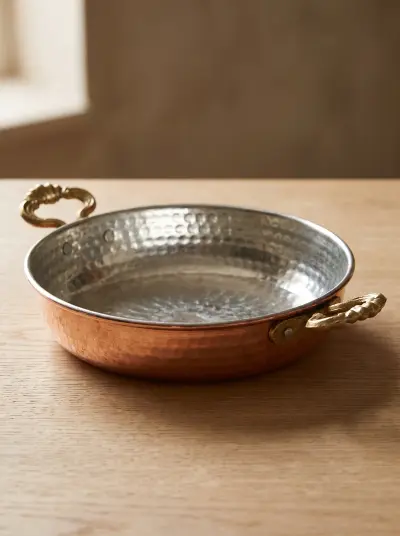
Handle material is not a separate catalogue field for frying pans or sac pans; check it from the product photos and confirm it in the quote. Allow for the board diameter too: a 16 cm pan on its board takes more room than a plate and changes how many dishes fit on a table for four.
Cleaning closes the loop. The pan is washed by hand in warm water with mild detergent and a soft sponge, dried at once and stored dry, with a cloth between stacked pieces; steel wool, abrasive powder and the dishwasher wear both the exterior and the tin. The darkening exterior is natural oxidation and can be polished with a copper cleaner, never on the lining. Budget for periodic retinning and polishing labour as well as the purchase price; care routines are set out in our copper care and lifespan guide.
The number of pans per menu item comes from the portions sold in the busiest hour multiplied by the full cycle time of one pan; there is no fixed ratio, and each kitchen has to measure its own figures. Time on the table, clearing, hand washing and drying are all part of that cycle.
A method you can apply:
The pot wash is the step most often left out: every minute a hand-washed pan waits at the sink is a pan out of circulation.
A quote request for cook-and-serve pans should state, for every model, the diameter and form, the gauge, whether it has a lid, the interior lining, the heat sources it will meet and the quantity. Without them, one product name can mean two different pans.
| Line | What to write | Why |
|---|---|---|
| Diameter and form | For example open frying pan, 16 cm | Portion and table layout |
| Gauge | Catalogue value in mm | Stove time, weight, durability |
| Interior lining | Tin or other, confirmed in writing | Dry-heat and acidic-food limits |
| Heat source and quantity | Gas, oven, salamander; units per model | Conditions of use and production plan |
The heat source line is the one most often skipped. If the supplier knows a pan will go into the oven or under the salamander, the answer on handle fixing and lining can reflect that; if the kitchen runs on induction, say so plainly.
For quantity, use your cycle figure with spares. Ordering several sizes of one series together, such as 14, 16 and 18 cm, keeps the look consistent and reorders simple. When you add models by diameter and quantity to the quote list, the wholesale price, minimum quantity, lead time and shipping terms for that order come back in writing; no fixed prices are published on the site.
TC10120-1
TC10121-1
TC10122-1
TC10123-1
Not on its own. Induction needs a magnetic base and plain copper is not magnetic, so the range does not detect the pan. Kitchens on induction either use an interface disc or cook in an induction-ready pan and transfer the food into a warmed copper pan for service. On gas, a grill or a radiant glass ceramic top, copper works directly.
When the dish steams, braises gently or has to stay hot on its way to the table. Covered egg dishes, casserole-style chicken or vegetables and anything revealed at the table are the usual cases. The lid buys a few minutes of heat between pass and table and turns lifting it into part of the service.
Yes, a shallow round tray is a natural oven-to-table dish for gratins, baked desserts and sharing plates. The trays in the catalogue are 0.50 to 0.70 mm sheet, which suits short oven work and presentation. Check handle details from the product photos, and confirm the interior surface in writing if your oven runs close to the 232 °C melting point of tin.
There is no fixed interval. Tin wears with heat, volume and cleaning habits, so a pan on a busy egg station wears faster than one used twice a week. Retin when bare copper shows across a wide area of the cooking surface or when the tin has blistered or run. Busy kitchens tie this to a maintenance schedule and hold spare pans to cover the ones away for retinning.
For food contact, the FDA Food Code bars copper and brass from contact with food below pH 6, naming vinegar, fruit juice and wine. In practice that means the food-contact surface of a cook-and-serve pan must be lined. Local health departments adopt and enforce the code, so check the version your jurisdiction uses before you specify.
For a single egg dish or small hot starter, 14 to 16 cm is the usual choice; 18 to 22 cm suits portions for two or sharing plates. The catalogue range runs from 14 to 27 cm. Plan with the board or trivet included, because the footprint on the table, not the pan alone, decides how many dishes fit.
They should not. Commercial dishwasher detergents are alkaline; they dull and mark the exterior and wear the tin lining. Copper is washed by hand in warm water with a soft sponge and dried straight away. If your pot wash cannot guarantee that, keep copper on dishes that come back lightly soiled rather than on the heaviest cooking.
Other guides covering the same stage of the buying process - continue reading here.
Copper, brass and cupronickel share one tariff heading but are three materials. Alloy definitions, the lead question and the spec lines that separate them.

How hand hammered copper differs from pressed and spun copper, how to spot an applied hammered finish, and which forming method suits your order volume.

Copper alone is not a specification. How to write solid copper, tin-lined and hammered into an RFQ, tell copper from copper-coloured metal, and read quotes.
Add the products you need to your quote list with quantities and send it by WhatsApp, e-mail or the form. We reply with unit prices and delivery terms.