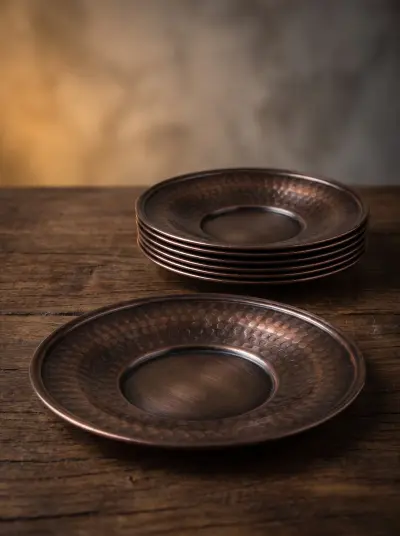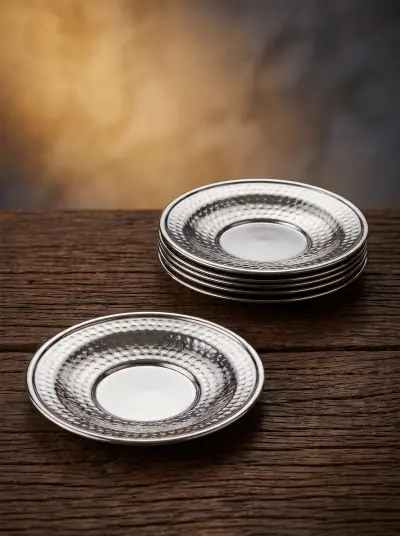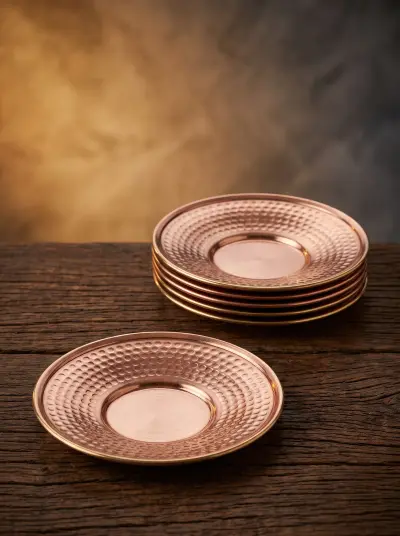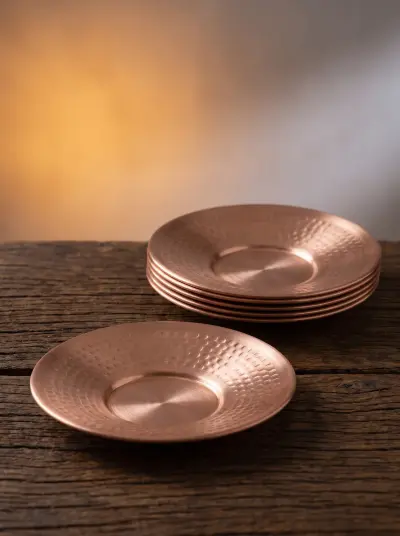
Otağ Copper Tea Saucer, Set of 6 — hand-hammered, brushed matt
TC30042-4
Copper, brass and cupronickel share one tariff heading but are three materials. Alloy definitions, the lead question and the spec lines that separate them.

Browse the range, add the pieces you need to your quote list and ask for prices in one message. No account, no online prices.
Copper, brass and cupronickel share a single tariff heading but they are three different materials. Refined copper is one metal; brass is a copper-zinc alloy and cupronickel a copper-nickel alloy. The difference appears in colour, heat transfer, tin lining behaviour and cost. If your specification does not say which one you want, the quotations you receive are not comparable.
In sourcing conversations a single word carries three materials at once. A line item described as a copper tray may genuinely be refined copper. It may be brass, a copper-zinc alloy. It may be a copper-nickel alloy sold in several markets under the name melchior. All three belong to the copper family, all three are classified as copper articles at the border, and all three are priced and used differently.
The ambiguity is partly linguistic. Trade Arabic uses one expression for both brass and yellow-toned copper. Russian treats melchior tableware as a product category of its own with a tradition independent of copper. German catalogues carry an additional trap in the other direction, where items listed under the word copper turn out to be copper-toned steel. Buyer and seller can use the same noun and picture two different metals, and the gap usually surfaces when the container is opened.
This is also where the boundary of this article sits. Choosing the body alloy is one decision; choosing the interior lining is another, and the tin against stainless question is covered in the lining comparison. Telling solid copper apart from copper-plated or merely copper-coloured goods is a third question, handled in the solid copper specification guide. The question here is narrower and comes earlier: what is the body itself made of.
Alloy names are too consequential to leave to marketing copy, which is why the international tariff text defines them numerically. The World Customs Organization nomenclature sets out refined copper and the copper alloy families in the notes to Chapter 74. The table below is the part of those definitions a buyer actually uses.
| Distinguishing question | Refined copper | Brass | Cupronickel and nickel silver |
|---|---|---|---|
| Definition | At least 99.85 percent copper by weight | Copper-zinc base; zinc predominates over other additions | Copper-nickel base, or copper-nickel-zinc base |
| Threshold that separates | Other elements below the note limits | Nickel under 5 percent, tin under 3 percent | Copper-nickel holds no more than 1 percent zinc; nickel silver carries 5 percent nickel or more |
| Colour | Reddish orange | Yellow, paler as zinc rises | Silver |
| Heat conduction | Around 400 W per metre kelvin | Roughly a quarter of that | An order of magnitude lower |
The first row alone produces a usable specification sentence. Writing refined copper instead of copper narrows the material to a group defined as at least 99.85 percent copper by weight, and every alloy falls outside it. The second row shows that family membership is decided by ratio rather than by appearance: once nickel passes 5 percent, a copper-zinc alloy is no longer brass but nickel silver.
Nickel silver is sold as alpacca in parts of Europe and turns up mostly in flatware. Because melchior is used loosely for both copper-nickel and copper-nickel-zinc goods, a contract is safer describing the family than repeating the trade name: copper-nickel base, or copper-nickel-zinc base.
This is where importers are most often caught out. Heading 74.18 reads table, kitchen or other household articles and parts thereof, of copper, and Chapter 74 counts copper alloys as copper. A brass serving tray, a cupronickel banquet set and a refined copper pan can all land in the same heading. The tariff line tells you nothing about the metal.
Two practical consequences follow. First, an HS code on a customs declaration is not evidence of material; it classifies, it does not verify. Second, if your landed cost model is built on the heading, an alloy substitution will not disturb the model but will change the product you receive. For the duty and cost side, the HS code and landed cost guide covers the calculation; the subject here is what actually arrives under that code.
The only document that can draw the line is your own. The body alloy belongs on the proforma invoice, on the purchase order and on the inspection acceptance sheet as a separate line. Without that line, a dispute has no text to refer back to.
Copper earns its place in a commercial kitchen because it moves heat quickly and evenly. Conductivity of roughly 400 watts per metre kelvin is what makes the difference in work that needs control. In brass that figure falls to roughly a quarter, and in copper-nickel alloys by about an order of magnitude. A brass pan looks like copper but does not behave like copper: it spreads heat more slowly and produces more pronounced hot spots over a burner.
Lining behaviour is the second difference. Tinning is the traditional answer in copper work, and because tin melts at about 232 degrees Celsius the operating rules of a tinned vessel are well understood. A tin lining does not behave identically on brass or copper-nickel bodies, and the same retinning cycle cannot be assumed. Plan the lining cycle against the body alloy rather than against the product name.
Surface behaviour is the third. Copper darkens over time and, in the right conditions, develops a greenish patina. Brass tarnishes differently, towards deep brown and black. On a service floor these two are not managed by the same cleaning routine, and a mixed inventory needs two protocols rather than one. For the food contact surface itself, the health and safety guide goes into more detail.
Lead is the most sensitive item in any alloy discussion, and the honest way to handle it is to point at the source rather than to generalise. In August 2025 the US Food and Drug Administration issued a warning about imported cookware that may leach lead. According to that warning, certain imported products made from aluminium, brass and the aluminium alloys known as Hindalium or Hindolium and Indalium or Indolium were tested by the agency and state partners, and demonstrated the potential to leach lead under conditions designed to mimic their use in contact with food. The named products were of Indian and Pakistani origin, and the agency states that affected products are not limited to the published list.
Two things need saying together. First, solid copper and tin-lined copper are not among the materials named, so this is not an advisory about copper cookware. Second, the notice does not condemn brass as a class either; it reports on specific tested products. The same agency had already written to retailers and distributors in December 2024 asking them to confirm that such products do not leach lead, and pointing to available leach testing methods.
The lesson for a buyer is that the material name is not the evidence, the document is. If a brass body is wanted, ask for the alloy grade and the lead content in writing, and for an independent migration test report on anything that touches food. Some brass grades carry lead deliberately as a machining aid, so the word brass on its own is not a composition statement. The document set your destination market expects is mapped in the food contact compliance guide.
The point is not to rule brass or cupronickel out, but to know which job goes to which metal. The table below is a rough map.
| Product form | Natural choice | Why |
|---|---|---|
| Pans, stockpots, saute dishes | Tin-lined refined copper | Heat transfer drives the decision |
| Trays, cloches, lidded service dishes | Refined copper or brass | Appearance and weight lead, heat is secondary |
| Handles, knobs, cast trim | Brass | Suits machining and cast detail |
| Flatware and fine table accessories | Nickel silver or stainless | Copper is not the usual choice in this form |
The common Turkish workshop combination is a refined copper body with brass handles and knobs. That is not a defect, but it has to be written as two lines rather than one: body alloy on one line, hardware alloy on another. A specification that says copper once will technically be satisfied by a quotation whose body is brass.
Alloy also drives cost, and understanding the build-up is more useful than memorising a number. Raw material cost is the weight of the body multiplied by the exchange price of the metals inside it, so part of a brass calculation runs on zinc and part of a copper-nickel calculation runs on nickel. Gauge, scrap rate, labour and tinning sit on top. When two vessels of the same size carry different alloys, compare weight, wall thickness and alloy together rather than unit price alone. The total cost of ownership guide gives a line by line template.
The checks available on a physical sample are limited, and knowing their limits matters. A magnet does not separate these three materials: copper, brass and copper-nickel alloys are all non-ferromagnetic, so none of them holds a magnet. The test screens in one direction only. If a magnet holds, the body is not one of the three.
Colour is more useful but not conclusive on its own, because surface treatment changes it. A reddish orange body points to copper, a yellow body to brass, a silver body either to the copper-nickel family or to a tin lining. A tinned copper vessel is silver inside and red outside, which is normal and does not indicate a different alloy. A cut or machined edge showing a body colour different from the surface points to plating instead.
Weight is the third clue and is available while the sample is in your hand. Two vessels of the same size and wall thickness weigh differently when the body alloys differ, because the densities are not equal. The gap between copper and brass is narrow, so weight alone decides nothing, but read against a declared wall thickness it exposes inconsistency. Record weight, diameter and wall thickness on the acceptance sheet; in serial production that record is the only measurable reference you hold.
A definitive answer is instrument work. X-ray fluorescence is non-destructive and returns the composition; when order size justifies it, an independent inspection company can run it. To verify the workshop rather than the batch, follow the supplier verification guide.
The text that carries an alloy decision into a contract is short. State that the body material is refined copper, and that copper-zinc alloys, copper-nickel alloys and copper-coloured finishes are outside the scope. The second line separates hardware: if handles, knobs or trim are a different alloy, name that alloy.
The third line is the declaration clause. It states that the body alloy will appear as a distinct item in the quotation and the proforma, and that a composition report will be provided on request before shipment. The fourth line addresses the food contact surface and names the document your destination market requires.
Judge every line by one test: can it separate two incoming quotations from each other. If it cannot, the line is decoration. The alloy line passes that test, because three different cost structures can hide behind one product name and this line makes them visible. To see the product groups, browse serveware and presentation or cookware, then add the pieces to the quote list and send it with the specification you have written.
Copper is a single metal. Brass is an alloy of copper and zinc. The Harmonized System defines brass as a copper-zinc base alloy in which zinc predominates by weight over each other added element. The practical consequences show up in colour, heat transfer and cost build-up: brass is yellow, conducts heat substantially more slowly, and its raw material cost is calculated on a different metal mix.
Brass is common in serveware and decorative pieces and is treated more carefully as a hot cooking surface. What matters is the specific alloy grade and the condition of the food contact surface, not the word brass. Ask your supplier in writing for the alloy grade, the lead content and whether the interior is lined, then match those answers to the food contact rules of your destination market.
The US Food and Drug Administration issued a warning in August 2025 about certain imported cookware. It states that products made from aluminium, brass and the aluminium alloys known as Hindalium or Indalium were tested and showed the potential to leach lead under conditions designed to mimic food contact. The named products were of Indian and Pakistani origin and the list is not exhaustive. Solid copper and tin-lined copper are not among the materials named.
No. Copper, brass and copper-nickel alloys are all non-ferromagnetic, so a magnet sticks to none of them. The magnet test screens for one thing only: if a magnet holds, the body is not any of these three and is most likely steel. Separating the alloys from one another requires colour, weight and documentation read together, or an instrument.
Not for tableware and kitchenware. Heading 74.18 covers table, kitchen and other household articles of copper, and Chapter 74 treats copper alloys as copper. A tray made of brass, bronze, cupronickel or nickel silver lands in the same heading as one made of refined copper. The tariff line does not separate them; your contract has to.
Cupronickel, known as melchior in several markets, is a copper-nickel base alloy. The Harmonized System defines that family as alloys of copper and nickel containing no more than 1 percent zinc by weight. For classification purposes it sits in the copper chapter, so customs paperwork reads as a copper article. As a material it is not refined copper: it is silver in colour and conducts heat far more slowly.
One inclusion and one exclusion are enough. State that the body material is refined copper, and that copper-zinc alloys, copper-nickel alloys and copper-coloured finishes are outside the scope of the request. Add a clause requiring the body alloy to be declared as a separate line in the quotation. The word copper in a product name is not a declaration.
Other guides covering the same stage of the buying process - continue reading here.

Copper alone is not a specification. How to write solid copper, tin-lined and hammered into an RFQ, tell copper from copper-coloured metal, and read quotes.
Exterior finishes on copper cookware compared: hammered, mirror, brushed, antique patina and lacquer, with the spec lines and batch tolerances buyers leave out.
A procurement framework for commercial kitchens: cost lines behind copper, stainless steel and cast iron, scrap value, mixed inventory and a blank TCO model.
Add the products you need to your quote list with quantities and send it by WhatsApp, e-mail or the form. We reply with unit prices and delivery terms.