

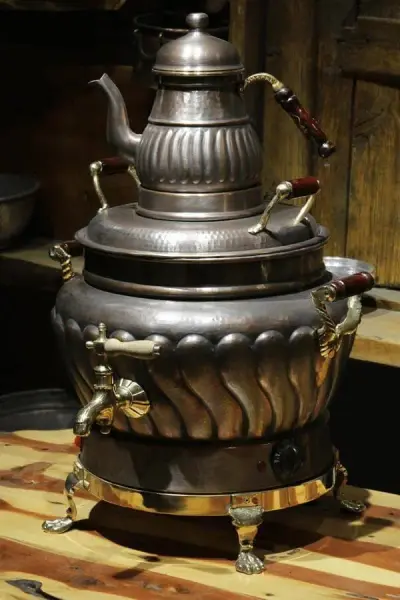
Klasik Copper Turkish Double Teapot — No. 3, light gauge, hand-hammered, nickel-plated
TC10060-2
A procurement framework for commercial kitchens: cost lines behind copper, stainless steel and cast iron, scrap value, mixed inventory and a blank TCO model.

Browse the range, add the pieces you need to your quote list and ask for prices in one message. No account, no online prices.
The choice between copper, stainless steel and cast iron is not settled by unit price. It is settled line by line in a total cost of ownership model that costs purchase price, daily maintenance labour, re-lining, loss and damage, service life and scrap value together. The output is usually not one material but a mixed inventory allocated by job.
A quotation comparison sheet normally has one decisive column, and that column is unit price. Decide on that column alone and every cost the item will generate over its working life sits outside the model. Purchase price is only the first line, and the one most easily negotiated; the recurring lines never enter the negotiation at all, because nobody wrote them down at the quotation stage.
The consequence shows up in two opposite ways on the same desk. In one, a copper item is judged expensive and its cheaper replacement is bought again a few seasons later, while the kitchen pays an unrecorded labour cost at every service. In the other, copper is specified everywhere, its weight and surface care become a standing complaint back of house, and part of the inventory stops being used. Both errors compress the decision into a single number.
Total cost of ownership prevents both by taking the decision off one number and spreading it across a list of lines. In a finance review, this one is better quality does not carry the meeting; these lines, in these periods, at this size does. This guide builds the list; you supply the figures, because a number printed on a guide page is only waiting to be wrong.
Purchase price. The quoted amount plus freight. In a heavy material the freight share of landed cost is not a rounding error, which is why item weight belongs in the quotation.
Installation and opening inventory. An item is never bought alone. Buffer units, lids, handle protection, storage and, where relevant, a hob compatibility solution belong to the same decision. On an induction line that last point is a line item rather than a surprise; see the induction compatibility guide.
Daily maintenance labour. The most underestimated line, because no invoice ever arrives for it. How long an item takes at each service, whether it is washed by hand, dried immediately or polished on a schedule are all staff hours. Copper and cast iron take more of this line than stainless steel; the protocol is covered in caring for copper and its service life.
Periodic re-lining. On tin-lined copper the lining is a consumable layer, renewed in three parts: labour, freight both ways, and days out of service. The process is described in the tin re-lining guide. Stainless lining has no recurring line, but when damaged the cost lands at once and equals the whole item.
Energy behaviour. No figure goes here, only behaviour. Copper follows a burner adjustment quickly; cast iron takes time to come up but holds temperature and recovers predictably when cold product goes in; with stainless steel the base construction largely sets the behaviour. What that is worth must be measured on your own line, not copied from a supplier claim.
Loss and damage. Deformed rims, detached handles, dropped items, lost lids. This line follows operating culture more than material, and grows in kitchens with high staff turnover.
Service life. How many years the item stays in service. Body and lining separate: the copper body is long-lived, the lining is consumed.
Disposal and scrap value. The closing line and the only credit in the model, treated in its own section below, because it is where copper separates most clearly from the other two.
The table below carries no numerical claims; it describes each material as it reaches the purchasing decision. No column beats the others across the board, and the three answer different jobs.
| Criterion | Copper | Stainless steel | Cast iron |
|---|---|---|---|
| Heat behaviour | Fast, responsive control at the burner | Set by base construction; multi-ply distributes better | Stores heat, slow to come up, holds temperature |
| Weight | Heavy, especially at professional wall gauge | Comparatively light, easy to move and rack | Heavy; large volumes are a two-person lift |
| Surface care | Needs a routine; exterior polishing is a separate decision | Low maintenance, tolerates a hard wash regime | Needs care, must not be left wet |
| Repairability | Tin lining is renewable, the body stays in service | Lining is not repairable; damage retires the item | Durable body, surface can be re-established |
| Supply chain | Workshop-led, planned line by line | Very wide supply and replacement availability | Wide, product forms comparatively limited |
| End of life | Retains scrap value to a high degree | Has scrap value, not to the same degree | Has scrap value, not to the same degree |
Each row connects to a cost line, and that is what makes the table a procurement tool: weight feeds freight and handling, surface care feeds staff hours, repairability decides whether you renew a layer or replace an item, and end of life feeds the only credit in the model.
One variable is absent from the table and outranks material choice in practice: wall gauge. Professional use typically expects a wall in the 2-3 mm range, and a thin-walled pan produces hot spots whatever it is made of. Gauge is specified before the material debate starts; the detail sits in the wall gauge specification guide.
Copper is not the best material for every job, and assuming otherwise leaves part of the inventory unused. The allocation is made by job, not by product group.
Delicate sauces and sugar work. Emulsified sauces, dairy-based preparations and sugar work all want a base that answers a burner adjustment immediately, and this is where copper is clearly strongest. One constraint has to be stated: tin melts at 232 °C, so on high-temperature sugar work the lining type is agreed before the order. The full comparison is in tin versus stainless lining.
Long braising, oven work and high-heat searing. Where a preparation runs for hours, or where surface temperature must not collapse as product goes in, a body that stores heat has the advantage. This is cast iron territory; tin-lined copper is not the first choice here, because of the lining temperature limit rather than the copper itself.
High-turnover lines and hard wash regimes. For items that cycle fast, pass through many hands and are washed aggressively, stainless steel produces the fewest surprises, and in operations with high staff turnover it cuts the maintenance labour line directly. The wider sourcing picture is in HORECA copper sourcing.
Service, presentation and the buffet line. Here the decision is not made on kitchen performance alone, and it gets its own section below. Open serving and presentation and cookware as separate RFQ lines, with separate justifications.
Part of copper's commercial value never appears in a back of house cost sheet, because it is not created in the kitchen. A copper chafing dish on a buffet line, a pan that goes to the table, a row of copper visible from an open kitchen all do two jobs: they cook or serve, and they carry the visual language of the operation.
That second function is real, and it is not measurable. We cannot show defensibly what a copper buffet line contributes to menu positioning or guest perception, and a model that pretends otherwise is not honest. The response is not an invented figure but a different budget heading: front of house pieces are defended from a presentation and brand budget, not from the equipment budget.
The effect is clean. A pan working back of house justifies copper on performance and cost alone. A chafing dish the guest sees is justified differently, and legitimately so. Mixing the two headings is how a front of house preference spreads into back of house and the budget grows without a stated reason.
Most equipment cost models stop at the end of service life. With copper that means dropping the most distinctive line in the model.
Copper largely retains its value as scrap and has an established secondary market: a body that has finished its working life is weighed out, and the amount that comes back reduces the total cost of ownership. Stainless steel and cast iron also have scrap markets, but not of the same order. This is the only credit in the model.
Two cautions belong here. No rate or amount can be printed on this page: copper is an exchange-traded commodity and such a figure becomes wrong quickly, so the line enters the model as a row, not as a percentage, set by the market on the day. And scrap value is the value of the body: handles, rivets and lining are assessed separately, so the closer an item is to one clean material, the simpler the transaction.
The consequence is direct: a long-lived copper body may generate re-lining costs across its life and still return part of its value at the end, while a short-lived, low-priced item returns nothing. On purchase price alone, that difference is invisible.
Well-run commercial kitchens are rarely single-material. The inventory is allocated by job, and that allocation is the decision rather than an avoidance of one.
In practice, hard-used line items are specified in stainless steel; long braising and searing go to cast iron; delicate heat control, sauce and sugar work, together with the service and buffet pieces the guest sees, go to copper. Copper is a small share of the unit count and produces value in two places at once: performance in the kitchen, presentation in the room.
The split also divides risk. An inventory tied to one material pays for that weakness wherever it shows: maintenance concentrates in one place, a supply delay touches the whole line, staff learn a single handling culture. In a mixed inventory each item follows the care regime its own job requires, and those regimes differing is no problem as long as they are written down.
The one real cost of a mixed inventory is training. Three materials mean three sets of cleaning and storage rules, and where they are not written and visible, staff treat everything alike and the most sensitive material pays. Put that in the model: a training session and a rule sheet cost less than a damage line repeating every year.
The last column below is deliberately empty. Fill it with your own figures: some lines are one-off, several repeat, the closing line is a credit. Build the model item by item, because one kitchen will land on different materials for different items.
| Cost line | How to measure it | Period | Your figure |
|---|---|---|---|
| Purchase price | Quoted amount plus freight, multiplied by quantity | One-off | |
| Opening inventory and buffer | Buffer units, lids, racking, hob compatibility | One-off | |
| Daily maintenance labour | Staff minutes per service multiplied by hourly cost | Recurring | |
| Re-lining | Labour plus freight plus days out of service | Recurring | |
| Energy behaviour | Measured on your own line; no assumption goes here | Recurring | |
| Loss and damage | Units replaced per year plus repair spend | Recurring | |
| Service life | Years the item is expected to stay in service | Life | |
| Scrap value | Body weight against the market on the day | End of life, credit |
Four things are requested from the supplier line by line at the quotation stage: wall gauge, interior lining type, whether a re-lining service is offered on tin-lined items, and item weight. Without them no row holds a real number and the quotations are not comparable. Writing all four into the message that goes with your quote list makes the comparison possible from the start; the pieces themselves are picked in the catalogue.
TC10060-2

TC10055-4

TC10055-6
TC10076-3
The question cannot be answered in that form, because cheap depends on which lines you count. Once purchase price, daily maintenance labour, replacement cycle, loss and damage, service life and scrap value are costed separately, the ranking changes from operation to operation. The useful question is which job the item will do, at what intensity, for how many years.
Eight lines are the minimum: purchase price, installation and opening inventory, daily maintenance labour, periodic re-lining, energy behaviour, loss and damage, service life, and disposal or scrap value. Some are one-off, several repeat every year, and the last one is a credit rather than a cost. Missing lines are where equipment budgets overrun.
It changes the closing line. Copper largely retains its value as scrap and has an established secondary market, so a body that reaches end of life is weighed out and returns something to the operation. The same expectation does not hold to the same degree for stainless steel or cast iron. The figure is set by the market on the day, so it enters the model as a line, never as a fixed rate.
No, and a supplier who proposes it is not working in your interest. Copper is strongest where responsive heat control matters and on surfaces the guest sees. On a high-turnover line, under an aggressive wash regime and for high-heat searing, stainless steel and cast iron produce fewer surprises. The working answer is a mixed inventory allocated by job.
As a recurring line with three components: the re-lining labour, freight in both directions, and the days the item is out of service. The third is the one buyers forget, and it requires a buffer stock. Do not write a fixed re-lining interval into the model; the interval depends on usage intensity, the acidity of what is cooked and wash discipline.
Honestly, no. On buffet lines, open kitchens and tabletop service, copper works as a presentation and brand asset, and that value does not appear in a back of house cost sheet. Putting an invented figure into the model would be misleading. The sound approach is to defend front of house items under a separate budget heading from back of house equipment.
Wherever heat storage matters more than heat response. Cast iron takes time to come up but holds temperature, so the surface recovers more predictably when cold product goes in. That helps in long braising, oven work and high-heat searing. In exchange it is heavy, it needs surface care, and it does not follow a burner adjustment the way copper does.
Four things, line by line, at the quotation stage: wall gauge, interior lining type, whether a re-lining service is offered on tin-lined items, and the weight of each item. Without those four, no row of the model holds a real number and the quotations you receive are not comparable with each other.
Other guides covering the same stage of the buying process - continue reading here.

Copper, brass and cupronickel share one tariff heading but are three materials. Alloy definitions, the lead question and the spec lines that separate them.

Copper alone is not a specification. How to write solid copper, tin-lined and hammered into an RFQ, tell copper from copper-coloured metal, and read quotes.

Tin lined copper vs stainless lining: melting point, cooking behaviour, retinning, cleaning rules and total cost of ownership, for buyers drafting a spec.
Add the products you need to your quote list with quantities and send it by WhatsApp, e-mail or the form. We reply with unit prices and delivery terms.