
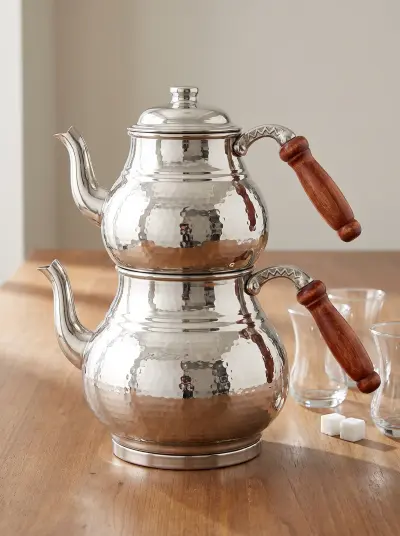
Klasik Copper Turkish Double Teapot — No. 3, light gauge, hand-hammered, nickel-plated
TC10060-2
Can you use copper cookware on induction? The physics, the magnet test, bonded magnetic bases, adapter discs, and what to write into a wholesale specification.
Browse the range, add the pieces you need to your quote list and ask for prices in one message. No account, no online prices.
Can you use copper cookware on induction? Not with a plain copper base. Induction heats through a magnetic field and pure copper is not magnetic, so the hob never sees the pan. Copper works on induction only when a magnetic stainless disc is bonded to the base. Serving and buffet pieces are unaffected entirely.
Moving from gas to induction is not a change of convenience, it is a change of physics. A gas flame heats the underside of a pan from the outside, and the metal the pan is made from does not obstruct that transfer. An induction hob works the other way round: a coil under the glass generates an alternating magnetic field, and the heat is created inside the base of the pan rather than under it.
For that to happen, the base has to be made of a material that responds to a magnetic field. Ferromagnetic metal, the kind a magnet sticks to, heats through eddy currents and hysteresis losses. Copper is one of the best electrical conductors a kitchen will ever handle, but it is not ferromagnetic. Placed on an induction hob, a solid copper pan is not detected at all. Most modern units will refuse to start, show an error code, or shut down after a few seconds of searching.
The irony is not lost on chefs. Copper is used in professional kitchens precisely because it spreads and releases heat faster than almost any affordable alternative, which is why saucepans, sugar pans and preserving pans have stayed copper for centuries. Induction, however, does not reward thermal conductivity. It rewards magnetic response, and copper fails that specific test while passing every other one.
The fastest and most reliable way to answer the compatibility question for a specific item is an ordinary fridge magnet held against the centre of the outside base.
Run this test at sample approval rather than trusting a line in a product sheet, and run it across items, not just once. A supplier's saucepan range may be built on a bonded base while the same supplier's sauté pans and serving skillets are plain copper. General methods for verifying what a piece is actually made of are covered in the how to identify real copper module.
There are three ways to keep copper in a kitchen that has moved to induction. They differ in where the cost lands.
The direct answer is to bond a magnetic stainless steel disc, or a full sandwich layer, to the base of the copper body during manufacture. The pan then works on induction without qualification, and it keeps its copper body and appearance.
Two costs follow. The first is thermal behaviour. Heat now enters the steel layer first and reaches the copper through it, so part of the sharp responsiveness that made copper worth buying is softened at that interface. If your reason for specifying copper is precise control over a reduction or a sugar stage, price that loss into the decision. The second is manufacturing cost: base bonding is a separate process step with its own tooling, its own material and its own inspection point. Not every workshop has that capability on the bench, so writing the requirement into the RFQ has a useful side effect. It screens out suppliers who cannot do it before you spend a week on samples.
An adapter disc is a magnetic plate that sits between hob and pan. The hob heats the disc, the disc heats the pan, and the cookware itself needs no modification. On paper it looks like the cheap answer.
In a commercial kitchen it is not. The extra layer measurably slows heat-up and lowers efficiency, and the response you feel from the power dial is now the disc's response rather than the pan's, so fine control disappears. The disc itself retains a lot of heat and sits on the hob as a hot metal plate through service, which is a safety line item. Practically, you also need one per burner, and they get washed, stored and lost. It is a fair way to rescue a favourite pan at home, not a way to run a twelve burner line.
This is what most commercial kitchens actually do, and it is the least discussed of the three. A kitchen does not have to run on one heat source. A gas section is retained, or a single gas burner is left in the layout, and copper is used there. The induction line runs magnetic base cookware.
Decided during the design of a new kitchen, this costs one line on a drawing. Retrofitted later, it becomes a building works item. That is exactly why it belongs in the specification stage of a refit: defining the copper station up front is cheaper than replacing the cookware afterwards. The second benefit is that it protects existing assets. Your current copper inventory is not written off, it changes station.
| Approach | What you gain | What it costs |
|---|---|---|
| Bonded magnetic base | Full induction compatibility, copper body retained | Some thermal responsiveness, higher unit cost |
| Adapter disc | Existing pans keep working, no product change | Slow heat-up, poor efficiency, control and safety |
| Mixed heat source plan | Copper used at full capacity, inventory retained | Building works, two heat sources to manage |
| Non-hob product groups | The question never arises | Solves service, not cooking |
The most useful thing an induction discussion gives a buyer is this: only some copper items are ever placed on a hob. The problem exists only in that subset.
The hob-side group is cookware: lined saucepans and stockpots, cauldrons, frying and sauté pans, shallow serving pans, and the cezve used for Turkish coffee. For these, base construction is a specification line.
The service and presentation group never touches a hob. Serving trays, mezze and sauce bowls, bread baskets, wine coolers, jugs and carafes, beverage equipment and decorative pieces are chosen for appearance, weight in the hand and how they hold temperature at the table, not for conduction into a burner. No magnetic base, no adapter, no compatibility question at all.
Chafing dishes deserve a separate note because they sit in between. A chafing system takes its heat from a fuel canister or an electric element underneath the water pan, not from a hob. The chafer body is never placed on an induction surface and is not expected to be. Specifying copper chafing bodies for a buffet line is entirely unaffected by an induction conversion.
The practical conclusion is straightforward. A hotel or restaurant group moving to induction does not remove copper from the buying list. It moves copper out of the cooking line and into the dining room, keeps a limited magnetic base set on the hobs, and uses copper at full capacity on the buffet, the breakfast service and the table.
Other heat sources behave differently, and conflating them is a common error.
Radiant glass ceramic hobs are not induction. An element under the glass heats and conducts through the surface, so no magnetic base is required and copper works. The condition here is flatness. A hand-hammered base can be slightly convex, and where contact area drops, heat-up slows. Glass surfaces also scratch, so pans are lifted rather than slid into place.
Gas remains the most forgiving heat source for copper, which is why it anchors the mixed kitchen plan. The flame heats the base directly and imposes no constraint on base construction. The one point of care is keeping the flame under the base rather than letting it climb the side wall, since on a tin-lined vessel that fatigues the lining from the rim inward.
Oven use depends on the lining. Tin melts at 232 °C, which does not mean a tin-lined pan cannot go in an oven, but it does set a ceiling: high temperature roasting and heating an empty vessel both threaten the lining directly. Stainless lined bodies are not bound by that limit. Handle material matters as well, since wooden and some cast handles are not oven rated. How linings are protected and when they are renewed is set out in the tin lining care module, and that content is also the backbone of the use instructions that should ship with the goods.
Dishwashers are not suitable for copper. Machine detergents are alkaline, they dull and stain the surface and they wear tin. Copper is washed by hand. For an importer it is a real operating cost to disclose to the end customer.
Induction compatibility is a manufacturing requirement, not a marketing label. Four lines cover it in an RFQ.
Hob type. State what the kitchen runs on: induction, radiant glass ceramic, gas or mixed. That single sentence lets the producer quote the right body instead of guessing.
Base construction. Ask for a bonded magnetic stainless disc base or a magnetic stainless sandwich base by name. The phrase induction compatible on its own is not enough, because it can be read to include a pan that works only with an adapter disc.
Base diameter. The coil responds to the base, not the rim. A base significantly smaller than the coil may not be detected, or will run at reduced power. If the catalogue lists rim diameter, ask for base diameter separately.
Interior lining. State tin or stainless, since that determines both oven behaviour and the cleaning instruction. Specify wall thickness in the same block, because a magnetic base does not substitute for gauge: 2 to 3 mm is the usual range for heavy duty professional use.
Pair those four lines with sample acceptance criteria, so that the magnet test, the base diameter measurement and the visual lining check are written into the terms rather than assumed. Specification work runs alongside quantity and lead time planning, which is covered in the MOQ, pricing and lead time guide. To see which production clusters carry which capability, read the guide to copper cookware manufacturers in Turkey; to pick pieces and ask about their base, start from the catalogue.
The table below summarises the base construction to request where hob type and product group intersect.
| Hob type | Product group | Base to request |
|---|---|---|
| Induction | Saucepans, stockpots, sauté pans, skillets | Bonded magnetic stainless disc or sandwich base |
| Induction | Cezve and small diameter vessels | Bonded base plus detection test, or a gas burner |
| Induction | Service, presentation, chafing, decorative | No requirement, plain copper base is used |
| Radiant glass ceramic | All cookware | No magnetic requirement, fully flat base required |
| Gas | All cookware | No constraint, gauge and lining govern the choice |
| Mixed kitchen | Copper cookware on the gas station | No constraint, station defined in the specification |
The cezve line is worth reading twice. A cezve has a narrow, tapered base that can fall below an induction hob's detection threshold, so even with a bonded base a small vessel may not register on some units. That has to be tested on samples rather than assumed. For a hotel running Turkish coffee service at breakfast, it is on its own a sufficient reason to keep one gas burner in the layout.
Writing hob type and base construction as separate lines in your request for quotation also keeps the responses comparable. When one quote comes back with a bonded base and another with plain copper, the price gap reflects a manufacturing difference rather than a negotiating position.
TC10060-2
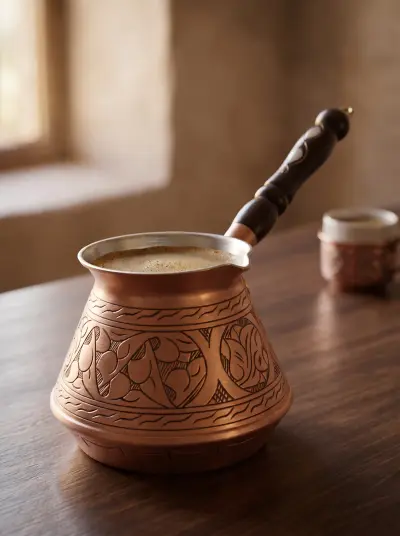
TC10055-4
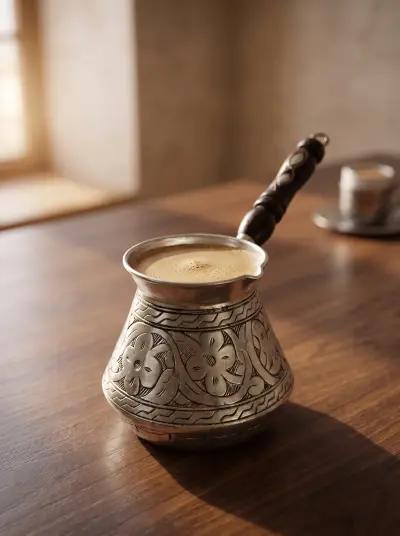
TC10055-6
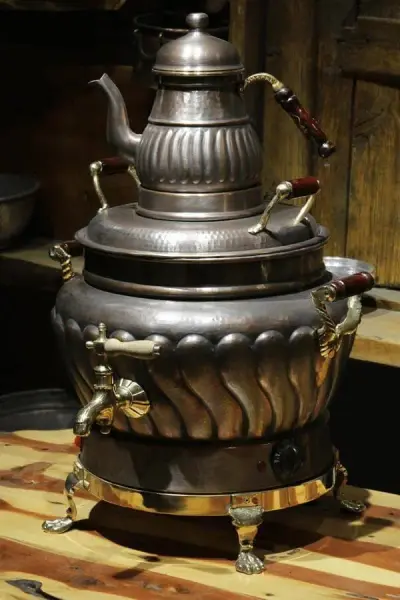
TC10076-3
Not if the base is plain copper. An induction hob heats through a magnetic field and pure copper is not magnetic, so the hob never detects the pan and most units simply refuse to start. Copper cookware works on induction only when a magnetic stainless steel disc or sandwich layer has been bonded to the base during manufacture.
Hold an ordinary fridge magnet against the outside of the base. If it grips firmly and holds the pan up, the base is magnetic and the hob will detect it. A weak grip means a thin or partial magnetic layer and unstable heating. No grip at all means the pan will not work. The test takes half a minute and belongs in your sample approval routine.
It works technically and fails operationally. The disc sits between the hob and the pan, so the hob heats the disc and the disc heats the pan. That extra layer slows heat-up, reduces efficiency and blunts the response you get from the power setting. The disc also stays dangerously hot after service. It is a reasonable domestic workaround, not a line solution.
No. Trays, mezze bowls, bread baskets, wine coolers, jugs and chafing dish bodies are never placed on a hob, so the compatibility question never arises for them. Copper can be used at full capacity in that group. Kitchens moving to induction typically shift copper from the cooking line to the service and buffet line rather than dropping it.
It depends on the lining. Tin melts at 232 °C, which puts a ceiling on any tin-lined piece: high temperature roasting and heating an empty vessel both threaten the lining. Stainless lined copper bodies are not bound by that limit. Handle material matters too, since wooden and some cast handles are not oven rated.
It should not go in. Machine detergents are alkaline, they dull and stain the copper surface and they wear tin lining. Copper is washed by hand in warm water with a soft sponge. Treat this as an operating cost line before you order, because a kitchen that cannot enforce hand washing should place copper on the service side rather than the cooking line.
A radiant glass ceramic hob is not induction. The element under the glass heats up and transfers heat by conduction, so no magnetic base is required and copper works. The base must be genuinely flat, since a slightly convex hand-hammered base reduces contact area. Lift pans on and off rather than sliding them, because the glass scratches.
Four lines cover it: hob type, base construction, base diameter and interior lining. Ask for a bonded magnetic stainless base by name rather than the phrase induction compatible, give base diameter instead of rim diameter because the coil responds to the base, and state whether the lining is tin or stainless. Add that samples will be magnet tested on arrival.
Other guides covering the same stage of the buying process - continue reading here.
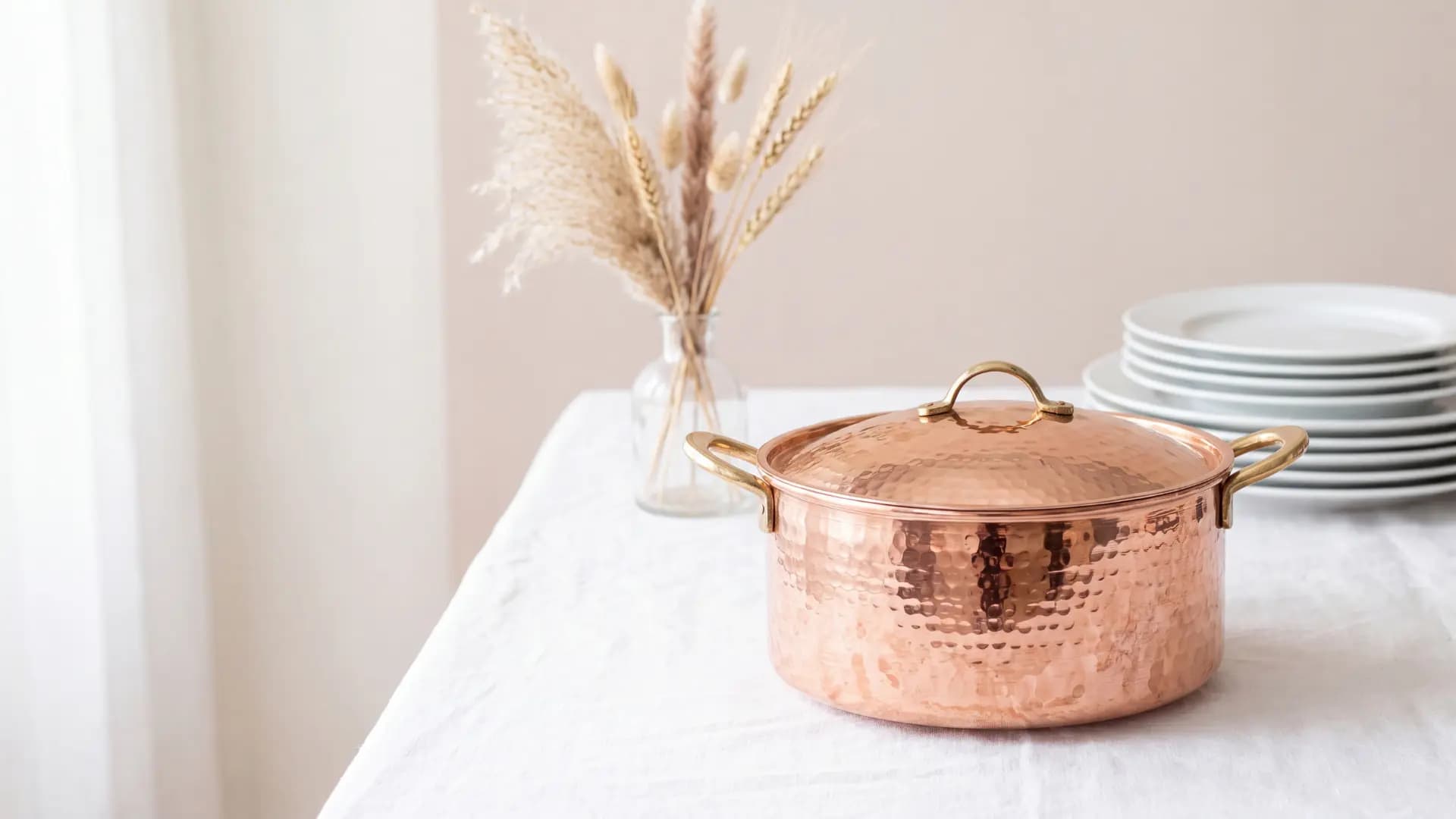
Which copper pan goes from stove to table: frying pan, lidded sahan, sac and wok pan or round gratin tray. Gauge, heat sources, tin limits and stock planning.
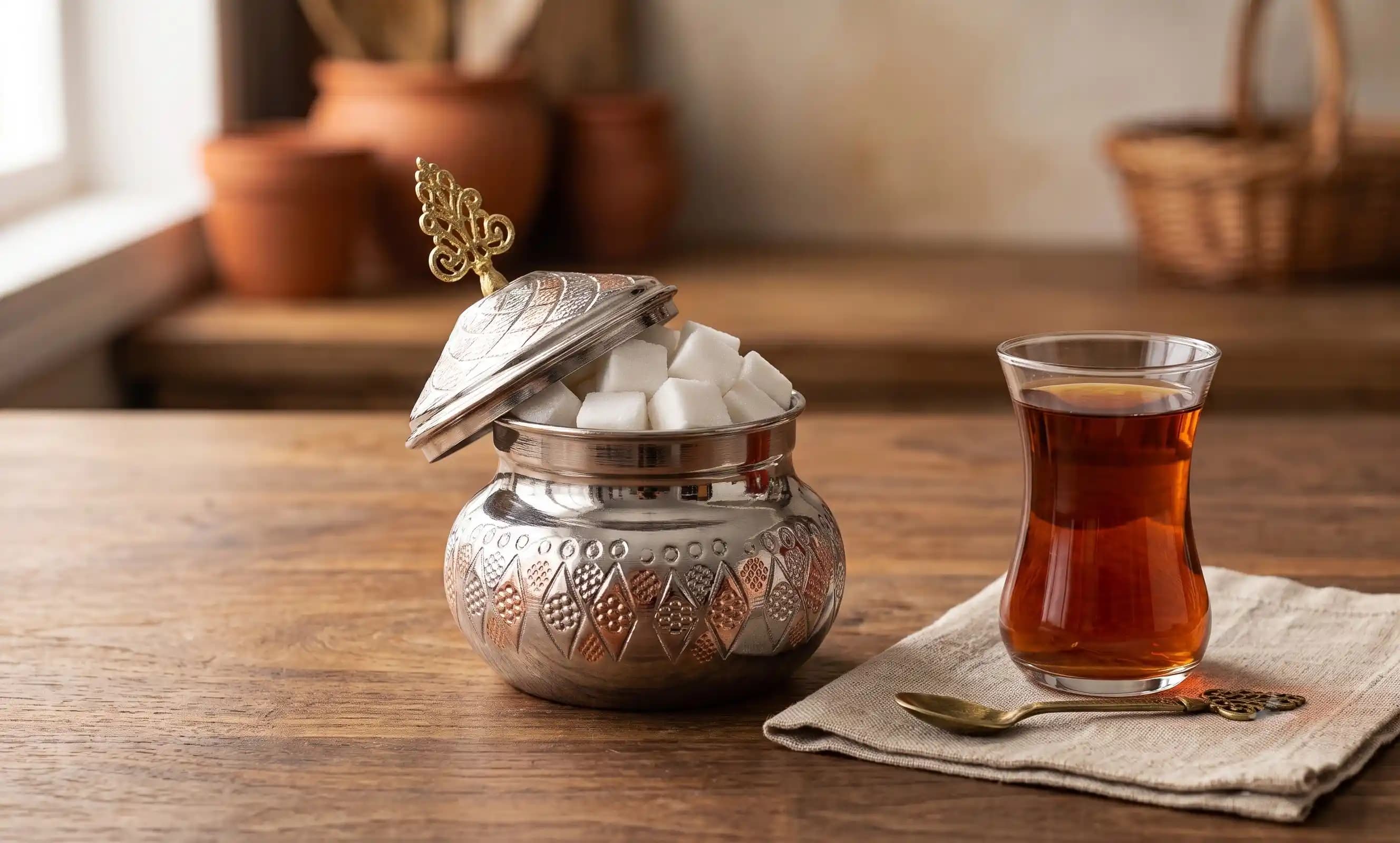
Copper, brass and cupronickel share one tariff heading but are three materials. Alloy definitions, the lead question and the spec lines that separate them.

How hand hammered copper differs from pressed and spun copper, how to spot an applied hammered finish, and which forming method suits your order volume.
Add the products you need to your quote list with quantities and send it by WhatsApp, e-mail or the form. We reply with unit prices and delivery terms.