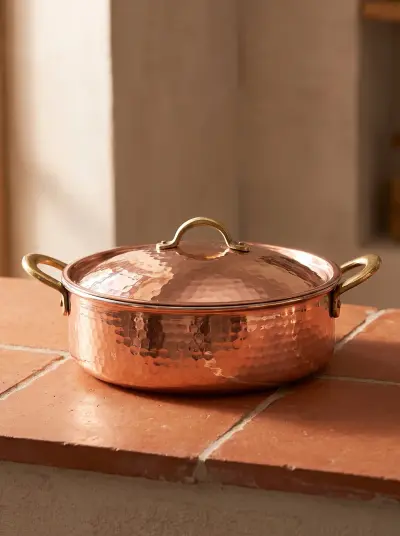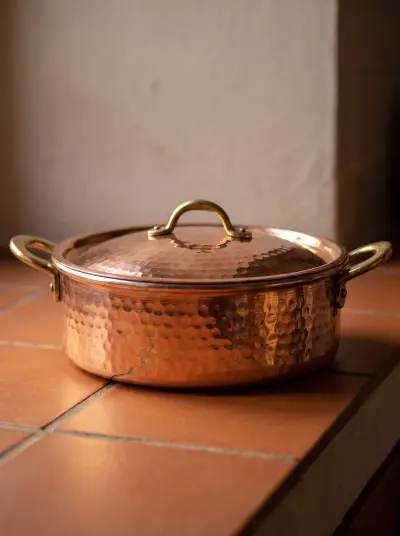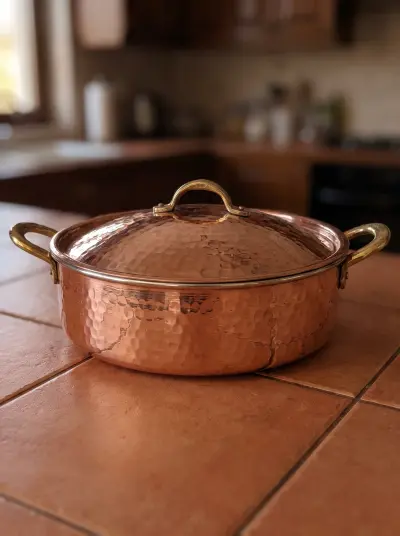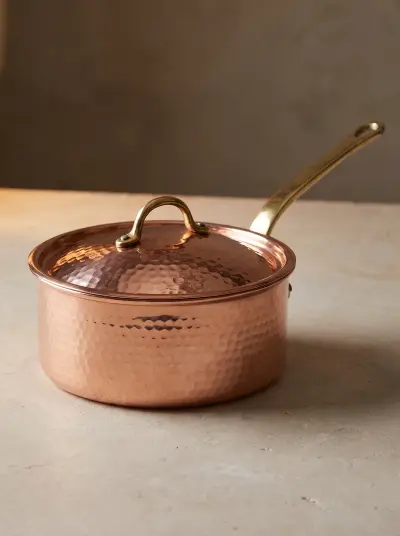
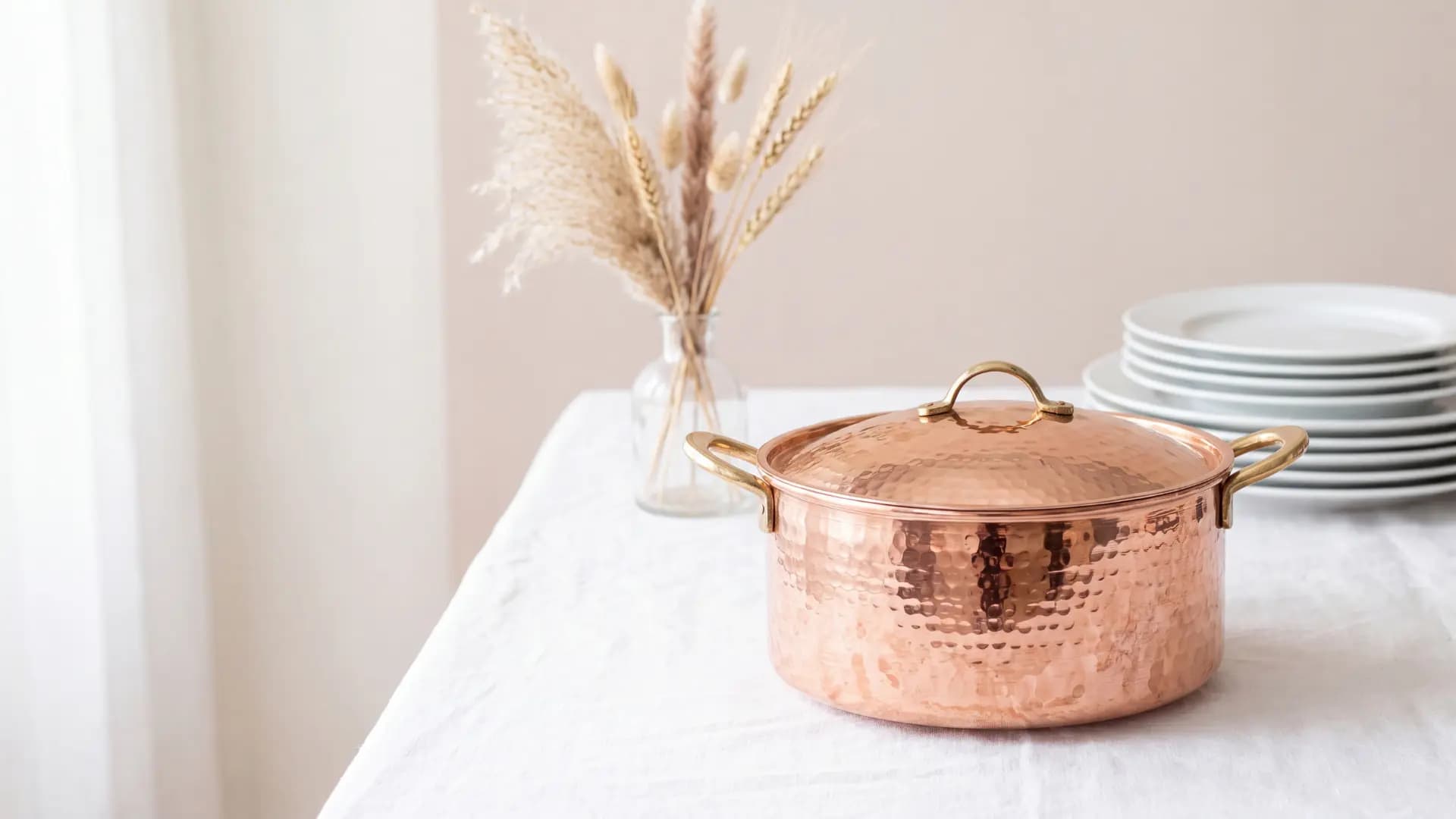
Copper Saucepan — No. 5, 26 cm, hand-hammered, polished copper
TC10083-1
How restaurants choose copper cook-and-serve casseroles: mini and sharing sizes, capacity per portion, gauge, heat sources, linings, lids, handles, quantities.
Browse the range, add the pieces you need to your quote list and ask for prices in one message. No account, no online prices.
Copper cook-and-serve casseroles are small and medium copper pots that go from oven, hob or salamander straight to the guest's table. For a restaurant order, choose them by capacity per portion, wall thickness, food-contact lining, handle type and lid, then list each size by stock code with a quantity on one quote list.
Three groups in the catalogue are built for cook-and-serve work: tiny smooth mini casseroles for sauces and single bites, hand-hammered Mini casseroles for individual portions, and Maraş casseroles for sharing. Larger casserole pots and rondeaus can go to the table too, but they are mainly kitchen pots.
The table below lists the lines a dining room is most likely to use, with the figures as they appear in the catalogue. Maraş refers to Kahramanmaraş, a copper-working city in southern Turkey and the home of The Coppery.
| Line and stock code | Size | Capacity | Sheet and weight |
|---|---|---|---|
| Mini casserole No. 1, smooth, TC10176-1 | 3.5 cm high | 60 ml | 1.85 mm, 98 g |
| Mini casserole No. 2, smooth, TC10177-1 | 4.5 cm high | 90 ml | 1.85 mm, 108 g |
| Mini casserole No. 3, smooth, TC10178-1 | 4.0 cm high | 140 ml | 1.85 mm, 150 g |
| Mini Casserole No. 1, hand-hammered, TC10096-1 | 12 cm | 450 ml | 0.50 mm, 260 g |
| Mini Casserole No. 2, hand-hammered, TC10097-1 | 13 cm | 650 ml | 0.50 mm, 290 g |
| Mini Casserole No. 3, hand-hammered, TC10098-1 | 14 cm | 850 ml | listed 1.00 mm, 390 g |
| Maraş Casserole No. 1, TC10093-1 | 18 cm | 2200 ml | 0.50 mm, 870 g |
| Maraş Casserole No. 2, TC10094-1 | 20 cm | 2800 ml | 0.50 mm, 1048 g |
| Maraş Casserole No. 3, TC10095-1 | 22 cm | 3400 ml | 0.50 mm, 1250 g |
The Mini and Maraş casseroles are also listed nickel-plated, with stock codes ending in -2 (for example TC10096-2 and TC10093-2). The hand-hammered Mini Casserole comes as a set of three (TC10099-1, nickel-plated TC10099-2), and the smooth mini casseroles as a set (TC10179-1). The smooth pieces sit in the copper sauce dishes category, the others with the copper pots and casseroles.
One figure deserves a check before you order. The polished No. 3 Mini Casserole (TC10098-1) is listed at 1.00 mm while its nickel-plated twin (TC10098-2) is listed at 0.50 mm, at the same weight of 390 g. Same-weight pieces of the same size are unlikely to differ that much in sheet, so ask in the quote request for the gauge of both codes to be confirmed.
If you need the pan side of cook-and-serve, frying pans, lidded pans and sac pans (saç, the shallow Turkish griddle pan), our guide on choosing copper pans for table service covers them; this guide stays with the deeper, round-sided casserole.
Choose the casserole by the portion you plate, then check that the dish fills it to a sensible level. A casserole that is half empty looks mean on the table and lets the exposed wall overheat in the oven; one filled to the brim spills on the way out of the kitchen.
Catalogue capacity figures describe the vessel. Ask in the quote request whether the figure is measured brim-full, and plate test portions with real food before you fix the order. As a working rule, plan a hot dish at roughly two-thirds to three-quarters of the stated capacity, leaving room for bubbling sauce, a lid and a garnish.
| Menu role | Typical dishes | Suggested piece | Capacity to start from |
|---|---|---|---|
| Sauce, dip or butter | garlic butter, aioli, chilli oil | smooth mini casserole | 60 or 90 ml |
| Single tapas or hot mezze bite | garlic prawns, baked feta, mushrooms | smooth mini casserole No. 3 | 140 ml |
| Individual starter or side | gratin, dal, baked beans, rice | Mini Casserole No. 1 or No. 2 | 450 or 650 ml |
| Individual main | stew, curry, cocotte of braised meat | Mini Casserole No. 3 | 850 ml |
| Sharing dish for two to four | braise, pilaf, family-style curry | Maraş Casserole No. 1 or No. 2 | 2200 or 2800 ml |
| Table centrepiece or buffet | large stew, rice, baked pasta | Maraş No. 3 or a casserole pot | 3400 ml and up |
Two kitchen details change the choice. First, the footprint on the table includes the underplate or board, so a 14 cm casserole takes more room than its diameter suggests. Second, sauces reduce in the oven: a dish that fits a 450 ml casserole cold may need the 650 ml size once it bubbles. Test both before committing to one size for the whole menu.
Most restaurants standardise on two or three sizes rather than one per dish. Fewer sizes mean simpler storage, quicker sorting at the wash-up and easier reorders, and the nested Mini set shows how the three diameters stack.
Yes, but in a different way from line cookware. A serving casserole spends a few minutes in heat and much longer on the table, so wall thickness decides how long the food stays hot after it leaves the pass, how heavy the dish is in a server's hand and how well it survives knocks at the wash-up.
The catalogue's cook-and-serve pieces span a wide range. The hand-hammered Mini and Maraş casseroles are mostly listed at 0.50 mm, a light sheet suited to short oven work and presentation. The smooth mini casseroles are listed at 1.85 mm, the heaviest gauge in this group, which explains why a 140 ml piece weighs 150 g. The larger casserole pots run from 0.80 to 1.00 mm, and the rondeaus from 0.70 to 1.00 mm.
Copper weighs 8.96 g/cm³, so weight follows thickness closely in a given shape. That makes the listed weight a useful cross-check when you compare two offers: if a piece of the same diameter is noticeably lighter, the sheet is thinner. For serving, a heavier wall holds heat longer and resists denting; a lighter wall heats faster and is easier to carry four at a time. Neither is better in general. A tapas bar that fires small dishes at high speed may prefer the light hammered pieces, while a bistro that sends out a slow braise for twenty minutes on the table gets more from a heavier pot.
Gauge across the whole range, and how to write it into a specification, is covered in our guide to buying copper pots, pans and tea kettles wholesale.
A lined copper casserole takes the oven, gas and the salamander when it holds food. Induction needs a magnetic base or an interface disc, because copper itself does not respond to an induction hob. The real limit in every case is the lining, not the copper body.
Oven. The contents of a casserole full of stew or sauce stay near the boiling point of water, 100 °C, whatever the oven dial says. The risk sits in the part of the wall above the food line and in any piece that goes in empty. Tin melts at 232 °C, so a tin-lined casserole should never preheat empty and should never go into a wood-fired or pizza oven, which runs far hotter than that.
Gas. Open flame suits copper well, because the metal spreads heat quickly across the base. Keep the flame inside the base diameter; flame licking up the side scorches the exterior finish and heats the wall above the food.
Salamander. Gratins and baked cheese dishes often finish under top heat. Fill the casserole so the food covers the lining up to the rim area, keep browning short, and watch the exposed rim, where top heat lands on bare lining.
Induction. A plain copper casserole will not register on an induction hob. The options are a bonded magnetic base, which the catalogue does not list, so ask in the quote request whether any form can be supplied with one, or a steel interface disc used in the kitchen. Our copper on induction guide explains the magnet test and the trade-offs. For a piece that only serves, induction does not matter at all.
Write the heat sources into the quote request. A supplier that knows a casserole will go under the salamander every evening can answer the handle and lining questions with that use in mind.
Any casserole that cooks food or holds wet or acidic dishes needs a lined interior, tin-lined or stainless-lined, because the dishes that go into casseroles are often acidic. Unlined copper is suitable only for non-acidic contents or as an outer holder for a separate liner.
Look at a typical cook-and-serve menu. Tomato sauces, wine braises such as coq au vin, curries built on tomato, lemon and vinegar dressings, and most cooked fruit sit below pH 6. The US FDA Food Code, section 4-101.14, does not allow copper to contact food below pH 6. Many other markets apply their own food-contact rules, but a lined interior is the safe default for any restaurant. Our guide to the US Food Code rule on tin-lined copper explains what the clause covers and how to write it into a specification.
The catalogue has no lining field, so do not assume the interior of any stock code. Ask in the quote request for the interior surface of each line to be stated. Nickel plating and lacquer are exterior finishes and are not food-contact linings: a nickel-plated casserole still needs its interior confirmed.
Tin lining is the traditional choice. It conducts heat well and can be renewed when it wears, but it melts at 232 °C and wears faster under metal spoons and scouring. In a busy restaurant, cook-and-serve casseroles see more abrasion than kitchen pots, because servers and guests scrape them at the table. Plan retinning into the life of the dish; the signs and the process are in our retinning guide.
Stainless lining tolerates heat well above the working kitchen range and never needs renewing, but it cannot be re-lined or repaired if it is damaged. If you want stainless-lined casseroles, ask whether a given form is available that way rather than assuming it; the comparison is set out in tin-lined vs stainless-lined copper.
Unlined copper has a role at the table as a holder. A cold dessert in a glass or ceramic cup can sit inside a copper casserole, and dry items such as bread or nuts can go in directly.
A hot copper casserole is carried by its handles with a cloth or glove, lid on, and set down on an underplate or board, never straight on wood or linen. Before ordering, check three things per stock code: the handle material, whether a lid is included and what the dish stands on, because the casserole listings state neither lid nor handle material.
The catalogue lists the handle material for sauce dishes: brass on most pieces, wood on some Salsa sauce dishes. Brass handles are a copper alloy and conduct heat, so they get hot in the oven and need a cloth or glove; they are fine under the salamander and on gas. Wooden handles stay cooler in the hand but should be kept out of the oven and away from the salamander, because dry heat cracks and chars wood. For the casseroles, check the handle form in the product photos: two small side handles suit oven work and stacking, while a single long handle suits hob work and a pan-style service. If handle material matters for your kitchen, ask in the quote request for it per code.
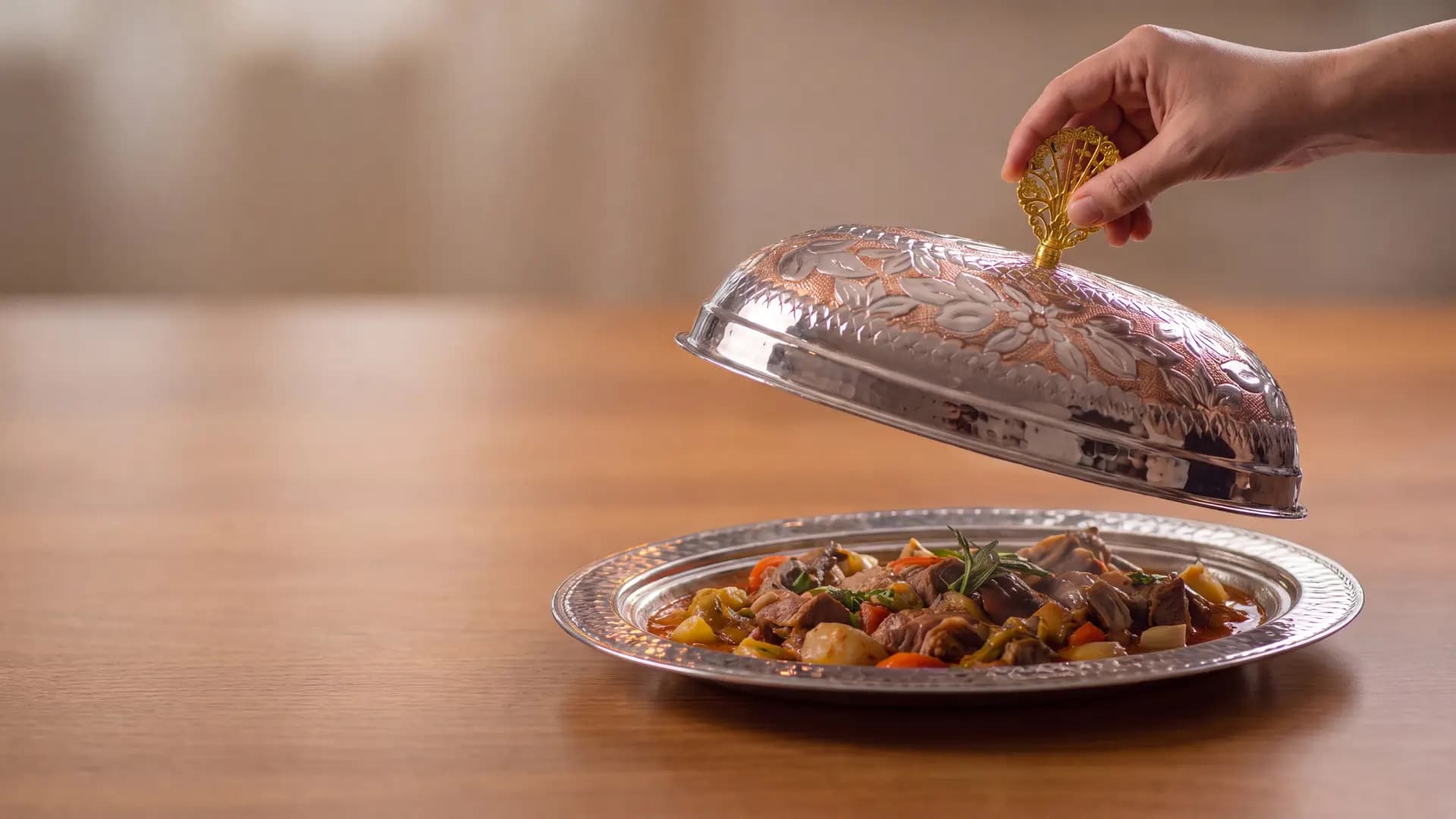
A lid changes how a casserole works. It keeps a braise moist in the oven, holds heat on the way to the table and gives the server a moment of presentation when it comes off in front of the guest. The casserole listings do not state whether a lid is included, so ask in the quote request for it to be confirmed for each stock code, and price lids as their own line if you need spares. Lids go missing faster than bodies, so count them separately at stocktake.
Hot copper marks wooden tables and burns linen. Every casserole that leaves the kitchen needs something under it: a wooden board, a heat-resistant mat, a copper plate or a small tray. Choose the underplate at the same time as the casserole, because it sets the table footprint. The copper serving plates range gives underplates that match the casserole finish. For banquets, lidded platters carry several portions at once; our guide to copper lidded serving platters for banquets covers that format.
Order enough casseroles to cover the busiest service with every piece in its cycle: in the oven, on the table, at the wash-up and drying. Then add spares for loss, damage and pieces away for polishing or retinning. There is no fixed ratio; each kitchen measures its own turnover.
Casseroles behave differently from serving pans in one way that changes the count. They stay on the table longer, because a guest eats a stew or curry slowly from the dish, and because the casserole often doubles as the serving bowl for a table to share. A sharing casserole may be out of the kitchen for most of a meal. Count table time from your own service, not from the cooking time.
A simple method:
Order the opening quantity from this count, then size the reorder from what you lose in the first months. Copper casseroles go in the dishwasher only at the cost of their finish and lining, which is why hand-washing time belongs in the cycle. A kitchen that hand-washes needs more pieces in circulation than one that could run them through a machine.
For menus built around many small hot dishes, our Middle Eastern restaurant copper checklist lists the other stations, and the guide to copper handi, kadai and thali sourcing covers the forms an Indian restaurant serves in alongside casseroles.
A casserole quote request should name each stock code with its quantity, finish and heat sources, and ask the supplier to confirm the lining, lid, handle and gauge in writing. That turns a list of dishes into a written quote you can compare and reorder from.
| Field | Example | Why it matters |
|---|---|---|
| Stock code and size | TC10097-1, Mini Casserole No. 2, 13 cm | fixes the exact form and capacity |
| Finish | polished copper or nickel-plated | separate codes, separate lines |
| Interior surface | ask in the quote request | the catalogue has no lining field |
| Lid | included or separate, spares needed | listings do not state it |
| Handle material | brass, wood, form | decides oven and salamander use |
| Heat sources | oven, gas, salamander, induction | sets the base and lining answer |
| Quantity per size | opening count plus spares | from your cycle count |
| Logo or marking | engraving position, if any | adds a sample stage and time |
Add the casseroles to the quote list from their product pages, then send the list by WhatsApp, e-mail or the form. Fill the list from the whole kitchen rather than casseroles alone: the same written quote can cover copper frying pans for egg and pan dishes, the wider copper cookware range for the line, and anything else in the full catalogue. Wholesale price, minimum quantity, lead time and shipping are confirmed in the written quote for your exact list.
Hotels and restaurant groups equipping several outlets can find the broader supply picture on our page for HORECA copper equipment supply, which covers kitchen, buffet and table service in one order.
Yes, but engraving is quoted as its own line and adds time, because position, size and method are approved on a sample first. On a 12 cm mini casserole the flat area is small, so many restaurants mark the lid or the underplate instead. Keep the approved artwork and position on file so that a reorder two years later matches the first batch.
Cocotte is the French name for a small lidded casserole, usually sized for one portion and sent to the table in the dish it was cooked in. In this catalogue the closest pieces are the hand-hammered Mini Casseroles No. 1 to No. 3 (TC10096-1 to TC10098-1, 450 to 850 ml). The listings do not state whether a lid is included, so confirm it per stock code.
Yes. Copper does not crack from a sudden temperature change the way glazed earthenware can, so a dish prepared ahead and chilled can go into a hot oven in its casserole. A tin-lined piece should go in with its food, never empty, and condensation should be wiped off first so it does not spot the exterior finish. A thin casserole heats faster than a heavy one, so test timings on a sample.
For many tapas, yes. The smooth mini casseroles hold 60, 90 and 140 ml in 1.85 mm sheet, sized for garlic prawns, sauces or a single bite, and the hand-hammered Mini Casseroles hold 450 to 850 ml for larger raciones. Copper heats faster than terracotta and will not crack. Tomato or wine-based tapas need a lined interior, so confirm the interior surface per stock code in the written quote.
No. Polished copper darkens with heat and handling, and most restaurants polish the exterior on a fixed routine set by how the dining room should look, not before every service. Nickel-plated pieces show less tarnish. The interior is never polished with abrasive copper cleaner, because that wears the lining. Schedule polishing on a quiet day and keep enough spare casseroles to cover pieces out of circulation.
Yes. The catalogue lists the Mini casserole as a set of three in polished copper and nickel-plated, and the smooth 60, 90 and 140 ml mini casseroles as a set as well. Sets suit retail because the buyer sees a nested run in one box. Ask for retail packaging and any carton marking in the quote request, since export cartons for restaurants are packed differently.
Other guides covering the same stage of the buying process - continue reading here.
Wholesale copper spice jars and lidded canisters from Turkey: the Safran and Tabbal lines, what dry goods unlined copper can hold, salt, sets and quote lists.
How to plan a first mixed wholesale copper order from Turkey: choosing a trial range, reading stock codes, setting quantities and writing a quote request.
A station-by-station copper checklist for Middle Eastern restaurants: mezze dish sizes, kebab platters, cook-and-serve pans, tea, coffee, linings, quote lists.
Add the products you need to your quote list with quantities and send it by WhatsApp, e-mail or the form. We reply with unit prices and delivery terms.