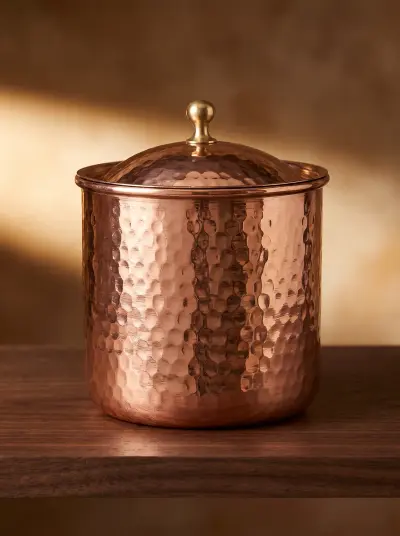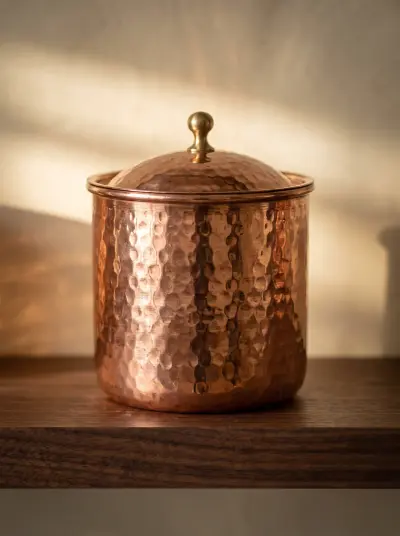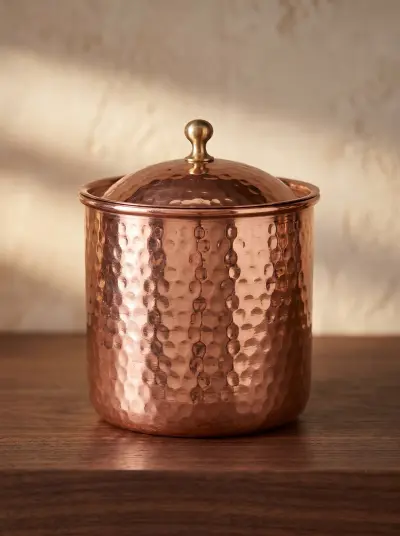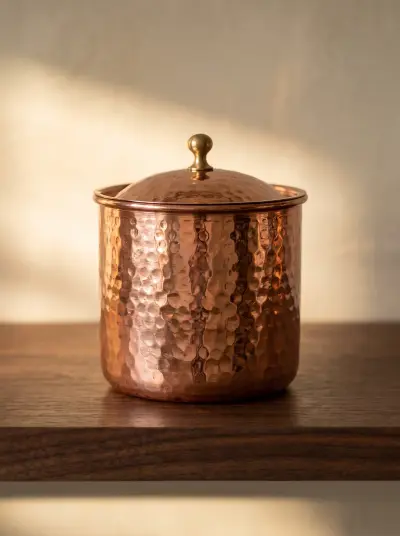
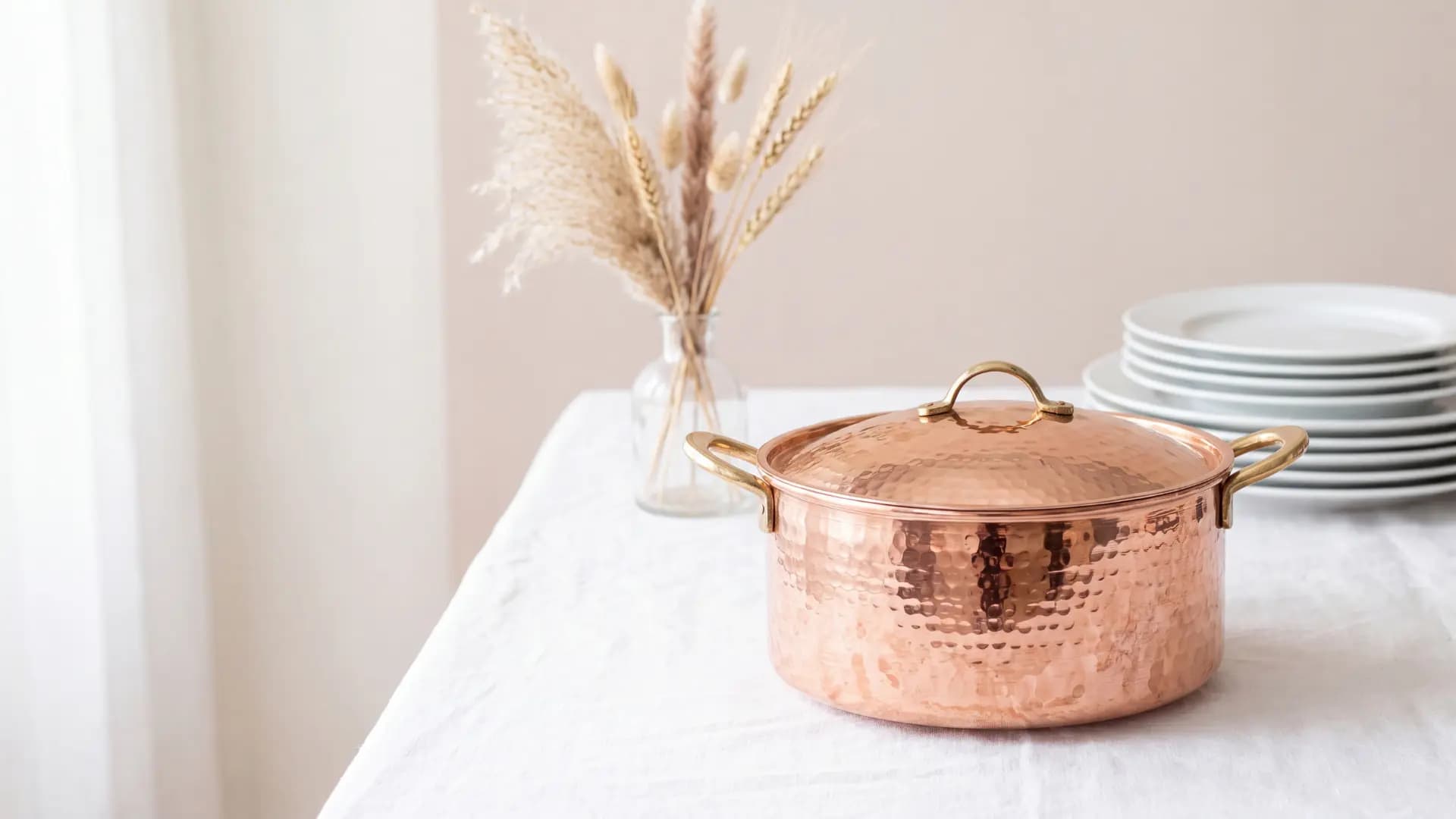
Safran Copper Spice Jar — No. 1, hand-hammered, polished copper
TC40001-1
Wholesale copper spice jars and lidded canisters from Turkey: the Safran and Tabbal lines, what dry goods unlined copper can hold, salt, sets and quote lists.
Browse the range, add the pieces you need to your quote list and ask for prices in one message. No account, no online prices.
Unlined copper spice jars and canisters suit dry, non-acidic goods such as whole spices, loose tea, coffee beans, sugar and rice, but salt, pastes and anything moist or acidic need a glass or porcelain insert. The Coppery's Safran and Tabbal jars are lidded, not airtight, so confirm each stock code's interior in the written quote.
The spice jar category holds 24 stock codes in two model lines, and every one was listed as in stock as of November 2026. The data below comes from the catalogue listings: gauge, weight and, where given, height and diameter.
The Safran line is a straight-sided canister with a fitted lid and a knob finial. It comes in four numbered sizes plus a set of four, and in two surfaces: hand-hammered and hand-engraved. The engraved version carries a floral relief around the body and a fluted lid. The Tabbal line is a round, pot-bellied jar on a short foot, with a pointed dome lid. One version comes with a spoon that rests in a notch in the lid.
| Line and stock codes | Gauge and weight | Surfaces | Finishes |
|---|---|---|---|
| Safran No. 1 and No. 2: TC40001-1, TC40002-1, TC40006-1, TC40007-1 and the -3 versions | 0.60 mm, 210 g and 230 g | hand-hammered or hand-engraved | polished copper, oxidised |
| Safran No. 3 and No. 4: TC40003-1, TC40004-1, TC40008-1, TC40009-1 and the -3 versions | 0.70 mm, 290 g and 350 g (TC40004-3 listed at 360 g) | hand-hammered or hand-engraved | polished copper, oxidised |
| Safran set of four: TC40005-1, TC40005-3 hammered; TC40010-1, TC40010-3 engraved | 0.70 mm, 1090 g | hand-hammered or hand-engraved | polished copper, oxidised |
| Tabbal domed jar: TC40011-1, TC40011-2 | 0.80 mm, 130 g, 11.2 cm high, 8.0 cm across | hand-hammered | polished copper, nickel-plated |
| Tabbal jar with spoon: TC40012-1, TC40012-2 | 0.70 mm, 120 g | hand-hammered | polished copper, nickel-plated |
Two gaps in the data matter for a buyer. The Safran listings give no height, diameter or capacity, only gauge and weight, so the size steps from No. 1 to No. 4 have to be read from the weights and the photographs. And two oxidised listings, TC40003-3 and TC40008-3, give a weight but no gauge. Where size or volume decides the order, for example a spice shop that sells 100 g portions, ask for dimensions and capacity on the quote line.
Every code is on the copper spice jars page with photographs. The parent copper storage category has 38 listings: the 24 spice jars, nine Elit pails and five ice buckets. The ice buckets belong to bar and table service, not dry storage, so leave them out of a pantry range.
Unlined copper is generally fine for dry, non-acidic contents such as whole spices, loose tea, coffee beans, sugar, rice and pulses. Salt, moist pastes, oily mixes and acidic foods need a glass or porcelain insert, a lined interior or another container. Confirm the interior of each stock code in the written quote, because the catalogue does not record a lining.
The reason is chemical: copper reacts with acids, and the US FDA Food Code (section 4-101.14) does not allow copper to touch food with a pH below 6. The FDA Food Code copper rule explains what the clause covers. The clause is written around acidic food, and dry, non-acidic goods are what unlined copper is normally used for, as long as they stay dry. Moisture changes the picture: a damp spice blend, a paste or a jar left open over a steaming stove gives copper and acid a way to meet.
Salt is a separate case. It is not acidic, but chloride is corrosive to copper and leaves dull patches and green deposits wherever damp salt rests on the metal. A copper salt jar on a humid counter marks quickly. Keep the copper as the outer piece and put the salt in a small glass or porcelain pot inside it.
| Contents | Unlined copper jar | What to do |
|---|---|---|
| Whole spices, dried herbs, ground spices kept dry | suitable | close the lid, keep away from steam |
| Loose tea, coffee beans, ground coffee | suitable when dry | use the bag or an insert for oily dark roasts |
| Sugar, sugar cubes, rice, lentils, flour, bulgur | suitable | keep in the original bag if refilled often |
| Salt, salt blends, seasoned salts | not recommended | glass or porcelain insert inside the jar |
| Pastes, chutneys, pickles, oily or wet blends | not suitable | lined container or another material |
| Brewed tea or coffee, any liquid | not suitable | brewed tea and coffee are mildly acidic, commonly around pH 5 |
Spice blends deserve a note. Some contain citric acid, dried lime or souring agents, and this guide does not assign a pH to individual spices. If a blend is sold slightly moist or is sticky to the touch, treat it like a moist food and use an insert. The same reasoning appears in the copper sugar bowl and Turkish delight dish guide, which deals with the dry-sweet side of the same shelf. For the regulatory map across the EU, UK and US, read the food contact compliance guide for copper.
No listing in the catalogue describes the Safran or Tabbal jars as airtight or sealed, so they should not be sold as airtight. The lids in the product photographs sit on the rim as a fitted cover, which keeps out dust, light and insects but does not form a gasket seal.
Several features point the same way. The jars are hand-hammered, so the rim and the lid are made to a pattern rather than machined to a tolerance. The Tabbal jar with a spoon has a notch in the lid for the spoon handle, which is an open gap by design. And copper jars carry no rubber or silicone ring.
For most dry spices this is enough in practice: whole spices kept dark and dry in a lidded tin hold up well on a kitchen shelf. For goods that lose aroma fast, such as ground coffee, some green teas or saffron threads, the usual answer is a resealable bag or a small glass jar inside the copper. The copper then does what it is good at, which is display and light protection, and the inner container does the sealing.
Two practical habits follow. Keep each lid with its own base after washing, because a lid from one hand-made jar can sit loosely on another of the same size. And tell retail customers plainly in the care card that the jar is a lidded canister, not a vacuum container, so that nobody returns it for letting coffee go stale.
Yes, for dry leaf tea and coffee beans, but the catalogue has no line sold specifically as a tea or coffee canister. The usual choices are the larger Safran sizes, No. 3 and No. 4, and the lidded Elit pail, which is the only storage piece with a listed volume.
The Elit pail is a hammered bucket with a lid and a swing handle in the photographs. It comes in three sizes and three finishes:
Volumes appear on some codes and not others, so ask for the capacity of each code you order.
Coffee needs a little more thought than tea. Roasted beans release oil, and darker roasts release more. That oil collects on the interior of any canister and turns rancid over time, which then taints the next fill. Keep beans in their valve bag inside the canister, or use a glass insert. Brewed coffee and tea never go into copper storage: both are mildly acidic, commonly around pH 5, and sit below the FDA pH 6 line.
A tea or coffee shelf usually sells canisters next to the brewing pieces. The copper Turkish coffee pots, called cezve in Turkish, sit naturally beside a Safran jar of coffee, and a café gift set of cezve, canister and a sealed pack of coffee is a straightforward bundle.
Buy the Safran set of four for gift retail and the single sizes for kitchens and spice counters, where one size usually dominates. The Tabbal jar is the low-weight entry piece for impulse and amenity use.
The set weight of 1090 g sits within 10 g of the four singles added together (210, 230, 290 and 350 g, or 1080 g), which is consistent with one jar of each size packed as one item. That suits a gift box. A spice shop that refills one size all day has no use for the smallest or largest jar, so it should order singles in the size that fits its portion.
Hammered and engraved jars sell to different eyes. The hand-hammered surface reads as a working kitchen piece and shows fewer fingerprints. The hand-engraved floral relief reads as a decorative or heirloom piece and photographs well for gift retail. Both carry the same gauge and weight per size, so the choice comes down to the customer.
| Buyer | Typical starting codes | Why |
|---|---|---|
| Kitchenware or gift retailer | TC40005-1, TC40010-1, TC40010-3, TC40011-1 | boxed set for gifting, engraved for display, Tabbal as entry price point |
| Spice shop or delicatessen counter | TC40003-1 or TC40004-1 in quantity, TC40012-1 for a tasting spoon | one working size, a spoon jar for samples |
| Indian or Middle Eastern grocer | TC40005-3, TC40011-2, TC40014-1 | oxidised set, nickel-plated Tabbal, pail for rice or tea |
| Restaurant open kitchen or pass | TC40004-1 or TC40004-3 single sizes | matched row of one size reads as a line |
| Hotel room amenity or breakfast | TC40011-2, TC40012-2 | small, light, nickel-plated holds its look |
A grocery that already carries Turkish coffee, tea and sweets has a natural place for these jars, and the copper range guide for Turkish and Middle Eastern grocers shows where they sit in a wider shelf plan. A gift store building a full home range can use the copper home and gift assortment guide to pair spice jars with candle holders and planters from copper home décor.
The same jar does a different job in each setting. A shop uses it to sell, a restaurant uses it to signal, and a hotel uses it to present a small amenity. That job decides the finish, the size and how many spares to order.
On a spice counter, copper jars usually hold the display sample, while the stock for sale sits in sacks, bins or bags behind the counter. A row of the same Safran size with a handwritten or printed tag on each lid gives a uniform line that customers read from left to right. The Tabbal jar with a spoon works as a tasting jar for a robust dry spice; saffron and other fast-fading spices stay in a sealed inner container, because the spoon notch leaves the lid open. Order a few spare lids, because a counter jar is opened far more often than a kitchen jar.
In an open kitchen, copper jars on a shelf behind the pass are part of the room's look as much as storage. Keep them for dry whole spices and dried herbs, away from the steam of the range, and keep wet mise en place in the kitchen's own food containers. An Indian restaurant that already serves in copper handi or kadai can match the shelf to the tableware; the copper handi, kadai and thali sourcing guide covers the service side.
Hotels use small lidded jars for sugar sachets, tea bags or cotton pads, and nickel-plated pieces hold their look between housekeeping rounds. The Tabbal jar, at 120 to 130 g, is light enough to sit on a tea tray. Nickel plating is a decorative finish, not a food-contact lining, so loose sugar or tea goes in sachets or an insert, not straight onto the plating.
For a kitchen or hotel buyer sourcing several product families at once, the wholesale copper kitchenware sourcing page explains how one mixed order from Turkey is put together.
Naming each jar is usually done with a tag or a label on the lid rather than engraving, because the Safran engraved version already carries an all-over floral pattern and the hammered surface leaves little smooth space for lettering. Ask in the quote request whether a name can be added to a specific code before you plan around it.
There are four realistic options:
If a brand name or logo matters more than spice names, the branding guide for copper compares the methods and volumes. For retail, multilingual tags are simple to prepare, since each catalogue listing carries its name in Turkish, English, Arabic, Russian and German.
Copper storage jars need dry cleaning more than washing: empty, brush out, wipe and air-dry before refilling. Polished copper darkens with handling and needs periodic polishing; oxidised and nickel-plated pieces need only a soft cloth.
Fine coloured powders settle into hammer marks and engraved relief. Turn the jar over and tap it, then use a dry soft brush before any washing. If a jar must be washed, use warm water and mild soap, dry it at once inside and out, and leave the lid off until it is fully dry. A jar closed while damp invites spots, and any salt residue left inside makes them worse.
Finish care differs:
The copper care and lifespan guide covers polishing products, what never to put on copper and how finishes age. A short care card in the language of the country of sale saves retail returns.
Choose stock codes, not model names, add them to the quote list with quantities per code, and write the questions the listings cannot answer next to each line. The written quote then comes back with wholesale prices, availability, minimum quantities and lead time for exactly those codes.
| Quote line field | What to write for spice jars |
|---|---|
| Stock code and finish | full code with suffix, for example TC40005-1 or TC40012-2 |
| Quantity | per code, and whether sets may be split |
| Size questions | height, diameter and capacity for Safran sizes you order |
| Interior | confirm the interior per code: tin-lined, stainless-lined or unlined |
| Inserts and spoons | confirm the spoon is included on TC40012-1 and TC40012-2; ask about glass inserts if needed |
| Packing | individual boxes for retail, or bulk for kitchens and hotels |
Browse the full copper catalogue if the order will mix families, for example spice jars with copper sugar bowls or cezves. Then add the codes to the quote list and send it by WhatsApp, e-mail or the form. A buyer placing a first order of this kind can follow the first wholesale copper order guide to set quantities across a trial range.
It is better not to. A cold jar taken into a warm kitchen gathers condensation inside and out, and moisture is what lets copper spot and lets damp spices cake against the metal. If whole spices or coffee must be kept cold, keep them sealed in a bag or glass jar and use the copper jar at room temperature as the outer display piece.
No. A masala dabba, the round Indian spice box with small inner bowls under one lid, is not in The Coppery catalogue as of November 2026. The nearest options are the Safran set of four, which gives four separate lidded jars in graded sizes, or a row of Tabbal domed jars. If a dabba is essential to your range, describe it in the quote request as a custom enquiry.
Yes. Resin incense, bakhoor chips, potpourri, cotton balls in a hotel bathroom or tea lights are dry, non-food uses and copper suits them well. Once a jar has held fragrance it should not go back to food, because oils and scent stay in the hammered surface. Label retail stock for one purpose so that a jar sold as a spice jar is not shown with incense inside.
For dry grains, yes. The pail is listed with volumes of 2300 ml for No. 2 and 3250 ml for No. 3, and the photographs show a lid and a carrying handle. It holds a household quantity rather than a shop sack. Keep grain in its bag inside the pail if the pail will be refilled often, and confirm in the written quote that the lid is included.
Not from stock. As of November 2026 the Safran jars and sets are listed in polished copper and oxidised only, while nickel-plated is listed for the Tabbal jars and the Elit pails. A nickel-plated Safran would be a custom line with its own minimum quantity and lead time. Ask for it in the quote request as a separate line next to the stock codes.
Polished copper in a window darkens unevenly, faster where hands touch it and where the sun warms one side. Oxidised and nickel-plated pieces change less visibly. For a long-running window display, use oxidised Safran jars or nickel-plated Tabbal jars, rotate polished stock from the stockroom, and keep a soft cloth at the counter for fingerprints.
Other guides covering the same stage of the buying process - continue reading here.
How restaurants choose copper cook-and-serve casseroles: mini and sharing sizes, capacity per portion, gauge, heat sources, linings, lids, handles, quantities.
How to plan a first mixed wholesale copper order from Turkey: choosing a trial range, reading stock codes, setting quantities and writing a quote request.
How bakeries choose round copper baking trays (tepsi) for baklava and börek: 16 to 36 cm sizes, rim height, gauge, lining and oven limits, cleaning, quote list.
Add the products you need to your quote list with quantities and send it by WhatsApp, e-mail or the form. We reply with unit prices and delivery terms.