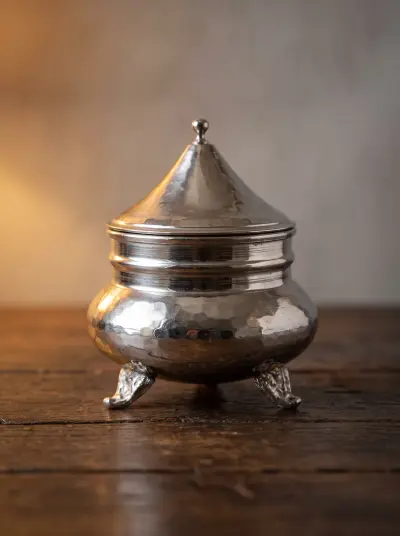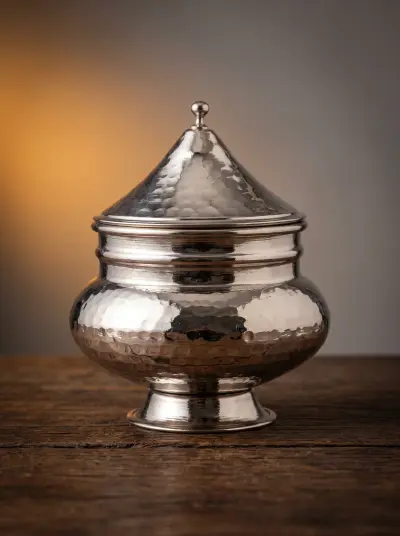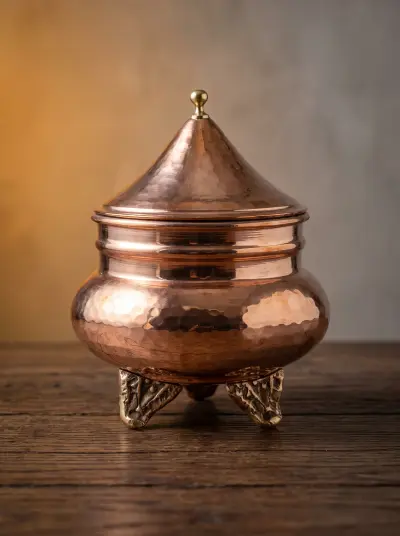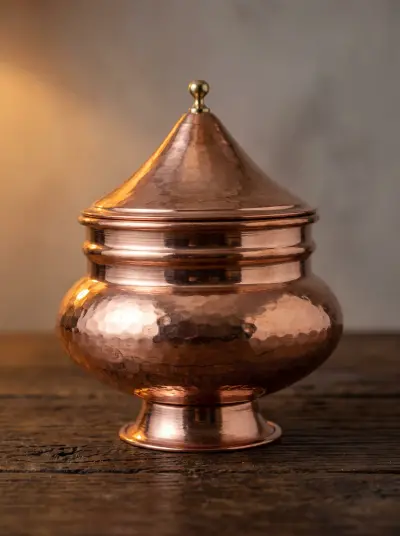
Rumeli Copper Sugar Bowl — hand-hammered, polished copper
TC30048-1
How hotels, confectioners and favour buyers use copper Turkish delight dishes and sugar bowls: size by use, lids, which sweets suit them, engraving and stock.
Browse the range, add the pieces you need to your quote list and ask for prices in one message. No account, no online prices.
Copper Turkish delight (lokum) dishes and sugar bowls hold dry, non-acidic sweets in three settings: a confectioner's counter and gift shelf, hotel tea service and room amenities, and lidded wedding favours. Choose the size by use, from a 7 cm favour dish to a 16 cm table bowl, confirm the interior per stock code and send one quote request.
Pick by use: a 7 to 9 cm lidded dish for favours and room amenities, a footed sugar bowl for tea and coffee service, and the Saka dome dish for serving lokum on a counter. The table maps each use to a line, a size and a starting stock code; the suffix -1 is polished copper and -2 nickel-plated where both exist.
| Use | Line | Size | Stock code to start from |
|---|---|---|---|
| Wedding or event favour | Mini Casserole Sugar Bowl | 7 cm | TC30057-1 |
| Favour or turndown amenity | Saka Turkish delight dish | 9 cm | TC30061-1, TC30061-2 |
| Lokum with coffee, counter tasting | Saka Turkish delight dish | 11 cm | TC30055-1, TC30055-2 |
| Café or tea table sugar | Rumeli sugar bowl | 8.6 cm high | TC30048-1, TC30052-1 smooth |
| Lounge table beside a tea or coffee service | Defne sugar bowl | 13 or 14 cm | TC30049-2, TC30053-2 |
| Buffet line or counter centrepiece | Heybeli sugar bowl | 14 or 16 cm | TC30056-1; 16 cm TC30054-2 |
| Gift shelf, nested set | Mini Casserole Sugar Bowl set | 7, 8 and 10 cm | TC30060-1 |
| Dark, traditional interior | Rumeli smooth, oxidised | 8.6 cm high | TC30052-3 |
Gauges sit between 0.50 and 0.70 mm across the category, which is right for pieces that carry dry food and do not go on heat. The full inventory of 35 listings, with every finish and photograph, is on the category page for copper sugar bowls and Turkish delight dishes; the wider copper serveware section holds the trays, bowls and plates these pieces are usually combined with.
Three reading notes save confusion later. First, on the Defne line the 13 and 14 cm in the name sit on a listed height of only about 8 cm, so the name figure describes a wide, low bowl. Second, on the Heybeli line the name figure tracks the listed height, 14.2 and 15.8 cm. Third, the mini casserole bowls give both measures: the 7 cm size is listed at 7.1 cm across and 7.5 cm high, the 10 cm size at 10.0 cm across and 9.0 cm high, and the set of three, TC30060-1, weighs 366 g, exactly the 7, 8 and 10 cm singles added together.
No listing gives a capacity in millilitres or grams of sugar. If capacity matters, for example for a hotel that fills a fixed number of sugar cubes per room, ask for it on the quote line or measure it on a sample.
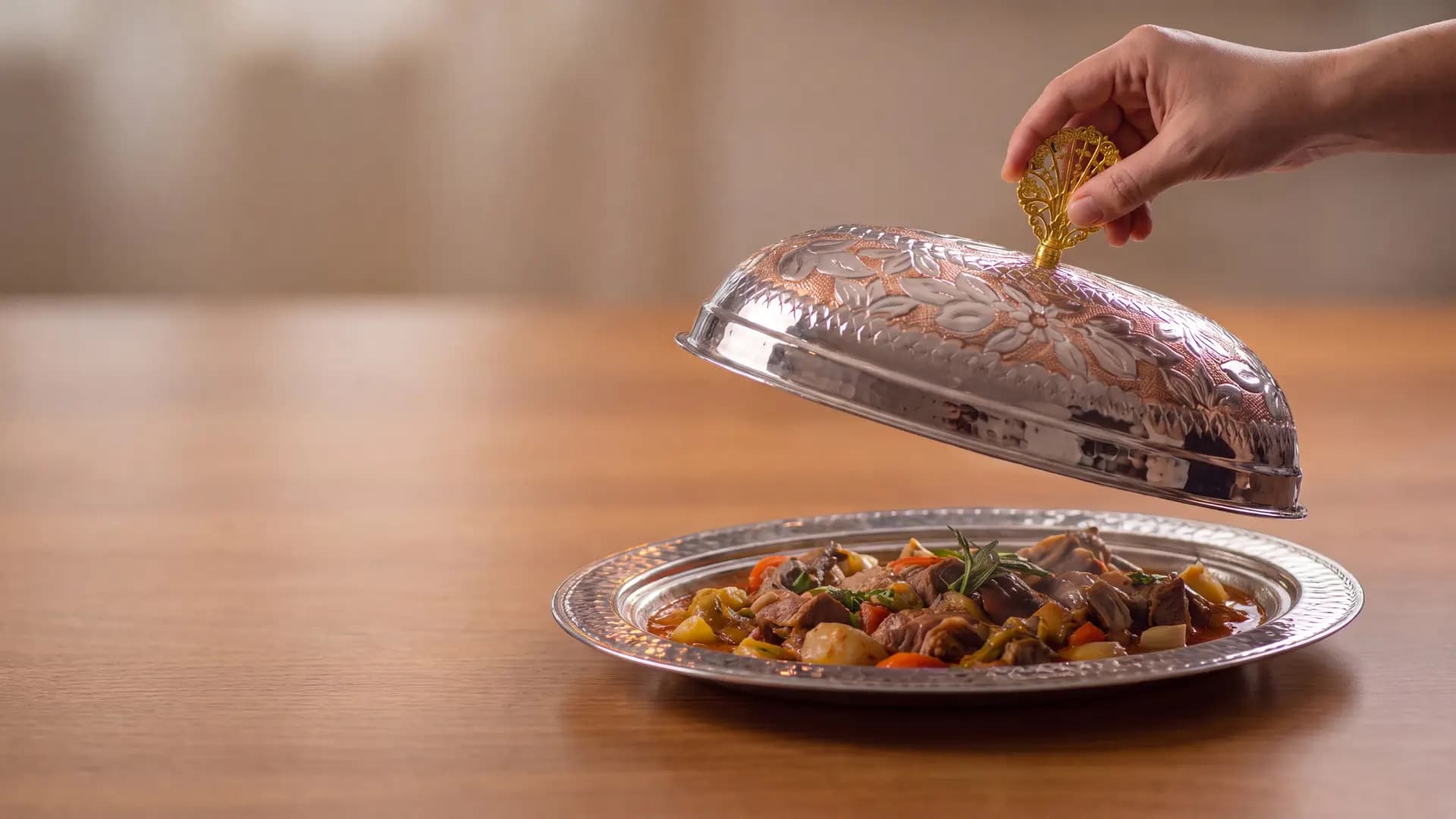
Every line in the category is photographed with a lid, and the lid shape is the clearest way to tell the lines apart. The catalogue has no lid field, so confirm the lid per stock code in the quote request, because a lid that arrives separately or not at all changes how the piece can be used.
The product photographs show five lid types:
Finials and feet appear in a brass colour in the photographs. The listings do not state their material, so if your market or your polishing routine depends on it, ask in the quote request.
A lid earns its place in three situations. It keeps dust and insects off sugar and sweets on a terrace or in an open-front shop. It keeps a hotel amenity looking untouched until the guest lifts it. And it turns a plain dish into a small reveal, which is the point of a Turkish delight dish in coffee service. Where none of these applies, the lid tends to get lost: on a busy café floor, budget extra lids or accept that some dishes will run uncovered.
Hand-hammered lids and bases are made to a pattern but are not machined to a tolerance, so lids are best kept with their own base. When pieces are washed in batches, a lid from one bowl may sit loosely on another.
Sugar, wrapped sweets and nuts are dry and non-acidic, so they suit copper dishes with little risk; plain lokum is dry on the surface but some recipes use citric acid, so serve it on a paper liner. Moist, sticky or acidic contents such as jam, honey, fresh fruit and soft dried fruit need a lined interior or a liner between the food and the metal.
The reason is the US FDA Food Code, section 4-101.14, which does not allow copper to contact food below pH 6. Other markets set their own food contact rules, and the pH 6 line is a useful reference point when you read them. Our guide to the FDA rule on copper and tin lining explains where that line sits and what it means for a commercial buyer. The catalogue has no lining field, so never assume an item is lined: ask in the quote request for the interior to be confirmed per stock code (tin-lined, stainless-lined or unlined) and plan your use around the answer.
| Contents | Acidic or moist? | Fit for an unlined dish | Practical note |
|---|---|---|---|
| Sugar cubes, loose sugar | dry, non-acidic | yes | keep the lid on in humid rooms so sugar does not cake |
| Plain lokum dusted with sugar and starch | dry surface, some recipes contain citric acid | yes, on a paper liner | the liner also keeps powder out of the hammered dimples |
| Lokum with fruit pulp or a sticky coating | moist, may be acidic | only with a liner | change the liner at every refill |
| Roasted nuts, sugared almonds | dry, non-acidic | yes | oily nuts leave a film; wipe the dish daily |
| Wrapped chocolates and candies | no direct contact | yes | the most forgiving use for any finish |
| Unwrapped chocolate | dry, non-acidic | yes | keep away from sunny windows and warm displays |
| Medjool and other soft dates | moist and sticky | only with a liner | a liner stops sugar residue drying onto the metal |
| Dried apricots, figs and other dried fruit | moist, often acidic | only with a liner | treat as acidic unless you have a pH figure |
| Jam, honey, fruit preserves | acidic | no | use a glass or porcelain insert, or a confirmed lined piece |
The practical rule for a confectioner or a hotel is simple: anything you would happily put in a paper bag can sit in a copper dish; anything that would stain the paper needs a liner or a different vessel. Glassine paper, food-grade doilies and small paper cases do the job and also make refilling faster.
For breakfast service, the copper serving bowls category includes a 7.5 cm mini breakfast bowl, TC30047-3 in oxidised finish, which is the open alternative for a portion of butter. Olives, honey and jam are acidic and belong in a glass or porcelain insert there too.
A lokum or baklava shop uses copper dishes in two places: on the counter, where lidded dishes hold tasting samples and present the house speciality, and on the retail shelf, where a dish is sold as a gift alongside a box of sweets. The two uses call for different lines and quantities.
On the counter. Tasting samples are refilled constantly and handled by customers, so a lidded dish that closes between visitors keeps the counter tidy and the sweets clean. The Saka 11 cm dish, TC30055-1 in polished copper, presents four or five pieces; the Heybeli 14 cm bowl, TC30056-1, gives height at the end of a counter and draws the eye. Order more than you display, because sample dishes go to the wash-up during the day and a spare set keeps the counter full.
On the shelf. A gift retailer or confectioner selling copper as an add-on needs pieces that are light, small and recognisably Turkish. The mini casserole set of three, TC30060-1, nests into one footprint and at 366 g is light enough for a parcel. The Saka 9 cm dish at 68 g suits a counter-side impulse purchase next to a box of lokum. Decide whether the sweets ever go inside the dish for sale; the FAQ below covers the packaging point.
Finish choice follows the shop's lighting and staffing. Polished copper glows under warm light but shows fingerprints after a day of handling. Nickel-plated pieces suit a cool, modern counter and need less polishing. The oxidised Rumeli bowl, TC30052-3, is the only oxidised option in the category and suits a shop with a dark, traditional fit-out.
For a shop that also stocks spices, coffee and housewares, the guide to the copper range for ethnic grocery stores shows how sugar bowls sit in a wider shelf assortment, and the copper home and gift assortment guide covers display and reordering for a gift shop.
Hotels use these pieces in three programmes: the lobby or lounge coffee and tea service, the breakfast room, and in-room amenities such as a turndown sweet. Each programme counts pieces differently, and small lidded dishes are easy for guests to take home, so plan a loss allowance alongside the first count.
Lobby and lounge. Turkish coffee is usually sweetened in the pot, so a lounge table needs a lokum dish with each coffee and a sugar bowl only where tea is served or guests sweeten their own cup. The Defne bowl's low profile suits a lounge table; nickel-plated Defne pieces, TC30049-2 and TC30053-2, sit well beside silver-tone coffee equipment. The Turkish coffee shop equipment guide covers the brewing side, and the wholesale Turkish tea sets guide covers the tea service these bowls complete.
Breakfast room. Sugar on a buffet is better served from a few larger lidded bowls than from many small ones. The Heybeli 14 cm bowl has the height to be seen along a buffet line. Keep honey and preserves in inserts, as above.
In-room amenity and turndown. A small lidded dish with two pieces of lokum or wrapped chocolates is a recognisable welcome in a property with a Turkish or Middle Eastern identity. The Saka 9 cm dish is the natural size. Count one dish per room in service plus the dishes in housekeeping circulation, and expect some to be taken home by guests; some hotels accept that as part of the amenity and some prefer a cheaper open dish. Decide which before you count.
Room count, outlet list and replacement planning belong in the hotel's OS&E (operating supplies and equipment) budget. The guide to hotel OS&E copper procurement shows how to count pieces per outlet, and our HORECA copper equipment supply page explains how a hotel or restaurant group sources mixed copper lines in one request.
Yes. A small lidded copper dish filled with sugared almonds or lokum makes a keepsake favour, and the light lines in this category suit the job. The mini casserole 7 cm bowl and the Saka 9 cm dish are the two obvious candidates.
Weight and volume add up quickly. A favour order is counted by guest, so a light single becomes a heavy consignment. A worked example for 150 guests:
Packed weight will be higher, because each piece needs its own wrap to keep the lid from scratching the body. Ask in the quote request for a packed weight and carton count, and see the first wholesale copper order guide for how a first consignment is quoted and shipped.
Names and dates on the lid. Personalised favours usually carry the couple's names and the date. The surface decides what is legible. A hand-hammered dome, like the Saka or mini casserole lid, breaks fine script into facets, so a short monogram or initials read better than full names. The smooth lines, Rumeli TC30052-1 to TC30052-3 and the smooth Copper Sugar Bowl TC30051-2, offer a calmer surface on the body. The flat rim around the Saka base is another place for a short line of text. One artwork repeated on every piece is a single setup; a different guest name on each piece multiplies the work and the lead time. The guide to logo printing and engraving on copper explains the methods; for favours, the question to ask is whether the chosen stock code can take your text at the size you want.
Corporate events follow the same logic with a logo instead of names. A conference welcome gift or a client gift box built around a lidded dish of lokum needs the same weight check and the same lead time margin. For tables, buffets and dessert stations at the same event, the guide to copper serveware for event rental and catering covers the larger pieces.
As of November 2026, 22 of the 35 listings were in stock. The thirteen out-of-stock items were the twelve Saka sets of two, four and six, in both sizes and both finishes, and the Heybeli 16 cm bowl, TC30054-2. The mini casserole set of three, TC30060-1, was in stock.
That snapshot shapes a first order in three ways:
Most buyers pair these pieces with a tray. The copper serving trays category includes the Çaldıran 34 cm round tray, TC30043-1 in polished copper and TC30043-2 nickel-plated, which carries a sugar bowl, a lokum dish and a coffee or tea service for one table. Matching finish across tray, bowl and dish matters more to the guest than matching line.
For restaurants that serve coffee and sweets at the end of a Turkish, Lebanese or Levantine meal, the Middle Eastern restaurant copper checklist places sugar bowls and lokum dishes in the full front-of-house list.
Write each piece as one line with the full stock code, the quantity including your loss allowance, and the intended contents. Then add the notes that change the answer, such as lid, interior, personalisation and packaging, and send the whole list in one quote request.
| Field on each line | Why it matters | Example |
|---|---|---|
| Full stock code with suffix | the suffix is the finish | TC30061-2 is the nickel-plated 9 cm Saka |
| Quantity plus allowance | small lidded pieces go missing | 120 in service plus spares |
| Intended contents | settles the interior question | wrapped chocolates, turndown |
| Lid required | confirms the lid is in the item | lid included per piece |
| Interior confirmation | no lining field in the catalogue | tin-lined, stainless-lined or unlined |
| Personalisation | adds a sample and lead time | initials and date on the rim |
| Packaging | retail box versus export carton | individual wrap, plain carton |
| Destination and use date | drives the dispatch plan | country, event date |
Add items from the full copper catalogue to your quote list, add a note with the points above, and send it by WhatsApp, e-mail or the form. The written quote comes back line by line with wholesale price, minimum quantity, lead time and shipping for that order, so you can drop or swap a line before you confirm.
Lokum is dusted with icing sugar and starch, and the fine powder settles in the dimples of a hand-hammered surface. Tip the dish out, then loosen the powder with a dry soft brush before any water touches it, because wet starch turns to paste in the hollows. Wash with mild soap, rinse and dry at once with a soft cloth. A paper liner under the sweets keeps most of the powder off the metal.
The product photographs show the Saka dishes and the Heybeli bowls with a crescent finial, and no alternative finial is offered as a catalogue option. If a crescent does not suit your market or your brand, say so on the quote line for that stock code and ask whether another finial can be fitted. Treat any change as a custom item with its own sample and a longer lead time.
Work back from the event date rather than forward from today. Allow time for the written quote, any engraving artwork approval, production of out-of-stock items, transit and customs, plus a margin for a late carton. In-stock singles move fastest; sets that are out of stock and anything personalised take noticeably longer. Ask for the expected dispatch date in writing before you confirm the order.
Many confectioners sell the sweets in their own box with the empty copper dish beside them, which keeps the food packaging separate from the metal. If the lokum must travel inside the dish, wrap it in food-grade film or glassine first. Selling food packed in a container makes the container part of your packaging, so check the food contact rules in your market before launch.
Salt is not acidic, but chloride is corrosive to copper and leaves dull spots and green deposits where damp salt sits on the metal. A sugar bowl used as a salt cellar on a humid terrace will mark quickly. If you want copper on the table for salt, put a small glass or porcelain insert inside the bowl and keep the copper as the outer piece.
The set listings repeat the single dish weight, 68 g for the 9 cm size and 120 g for the 11 cm size, so treat that figure as the weight per dish until the written quote confirms it. For a set of six, the copper alone is roughly six times the single weight before box and wrapping. Ask in the quote request for the packed weight per set if you sell by parcel.
A sugar bowl is made for the table and holds sugar for tea or coffee. A bonbonniere is a small decorative lidded container for sweets, often given as a wedding or event favour. In Turkish service the same small lidded copper pieces do both jobs, so a buyer chooses by size and lid style rather than by name. A 7 to 9 cm lidded dish suits a favour; a larger bowl suits a table.
Other guides covering the same stage of the buying process - continue reading here.
How to specify copper serving trays, chafing dish sets and mezze bowls for hospitality: telling solid copper from copper-plated stainless, lining and packing.
How to choose copper serving platters with lids for banquets and room service: boat, round and fish shapes, 23-60 cm sizes, lid styles, lining and quantities.
How event rental firms and caterers buy copper serveware: durable lines, finishes for repeated polishing, turnaround cleaning, damage tracking and crating.
Add the products you need to your quote list with quantities and send it by WhatsApp, e-mail or the form. We reply with unit prices and delivery terms.