
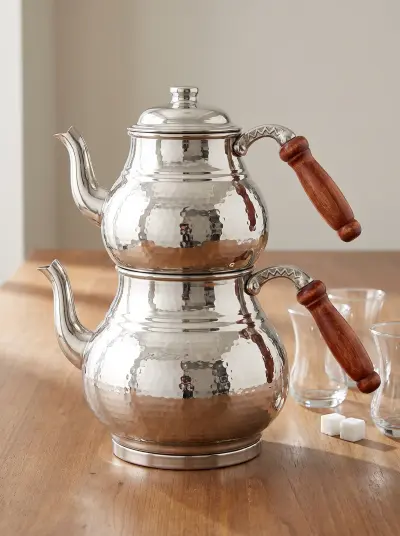
Klasik Copper Turkish Double Teapot — No. 3, light gauge, hand-hammered, nickel-plated
TC10060-2
How cafés, hotels and retailers build a wholesale Turkish tea set: double teapot size and gauge, warmers, trays, tea saucers, sugar bowls and table quantities.

Browse the range, add the pieces you need to your quote list and ask for prices in one message. No account, no online prices.
A wholesale Turkish tea set for commercial service combines a copper double teapot (çaydanlık, often written caydanlik), sized for the venue's volume, with a warmer if tea stands between orders, a serving tray, tea saucers and a sugar bowl. Specify each piece by stock code, finish and quantity, confirm interior lining per code in writing, then send one quote request.
A commercial Turkish tea set has five components: the double teapot that boils and brews, an optional warmer that holds the brewed tea hot, a tray that carries the service, saucers that sit under the tea glasses, and a sugar bowl. Each is a separate line in a quote, with its own stock code, size and finish.
Buyers coming from Western tea service often expect a "tea set" to be one boxed product. In Turkish service it is a system of parts, and venues buy those parts in different quantities. A café may run four double teapots behind the counter but need forty saucers on the floor. A hotel lounge may want one set per table, each on its own tray with its own sugar bowl. A retailer may sell the double teapot alone and the tray and saucers as add-ons.
The table below lists the components, what each one does in service and where it sits in the catalogue.
| Component | Job in service | Catalogue category |
|---|---|---|
| Double teapot (çaydanlık) | boils water below, brews tea concentrate above | Turkish double teapots |
| Teapot warmer | keeps the brewed pot hot between pours | teapot warmers |
| Serving tray | carries the set and glasses to the table | trays |
| Tea saucer | sits under each tea glass | trays (Otağ saucers) |
| Sugar bowl or lokum dish | sugar cubes, or lokum (Turkish delight) on the side | sugar bowls |
The catalogue does not list tea glasses or glass holders. Glasses are sourced separately and are covered in the FAQ below. Everything else in the table can be specified from one supplier in Turkey, in matching finishes, which is the main reason buyers source the tea service as one list.
Turkish tea is brewed in two stages. Water boils in the larger lower kettle, loose black tea steeps in the small upper pot, and the brew is poured into the glass as a strong concentrate and topped up with hot water from the kettle. The guest chooses strong or light tea by that ratio.
The sequence matters to a buyer because it explains the shape of the equipment. In practice it runs like this:
Two consequences follow for specification. First, the lower kettle does all the work on the heat source, so its gauge decides how the set survives a busy counter. Second, brewed tea stands in the upper pot for long periods, sometimes through a whole service, so the interior of the brewing pot is the surface to ask about first when lining comes up.
For the production side of the kettle itself, including how gauge, finish and lining are written on a purchase line next to pots and pans, the guide to wholesale copper pots, pans and Turkish tea kettles goes into the detail. This guide stays with the service set around it.
Match the size to how many glasses are poured from one brew and the gauge to how many hours a day the set sits on heat. The line is numbered No. 1 to No. 3 in rising size; volumes are not listed, so confirm them per stock code. Heavy gauge suits all-day counter brewing; light gauge suits table service, occasional use and retail.
The Turkish double teapot range lists 23 copper sets, 20 of them in stock as of November 2026. They come in the Klasik line, with a plain body, and a fluted line with a ribbed body, in polished copper, nickel-plated and oxidised finishes. Seven are sold as a set with a warmer. The gauge is stated in the product name as light or heavy; where a sheet thickness is listed, it is 0.80 mm. Capacity is not listed for this line, so the kettle and teapot volume of each size is a question for the written quote.
Three listings show how the stock code carries size, gauge and finish:
The table below is a starting point for matching formats to sets. It describes the logic of the choice; the exact glass count per brew depends on the volumes given in the written quote and on how strong the venue pours.
| Service format | Double teapot | Warmer and tray |
|---|---|---|
| Café counter, brewing all day | No. 3 or No. 2 heavy gauge | warmer on the counter, trays for carrying glasses |
| Restaurant, after-meal tea at the table | No. 2 or No. 1 | round tray per table, warmer optional |
| Hotel lobby lounge or tea corner | set with warmer, No. 2 or No. 3 | warmer included, tray under the set |
| Tea garden or family table service | No. 2 or No. 3 per table | tray per table, sugar bowl per table |
| Retail and gifting | No. 1 or No. 2 light gauge | tray and saucers as add-on lines |
Where volume goes beyond what several double teapots can sustain, for example a banquet tea station or a busy breakfast room, the answer is usually a samovar or tea urn rather than more kettles. The guide to wholesale copper samovars and tea urns explains where that line falls and how a samovar order is specified.
Decoration is the last choice. Most sets are hand-hammered; two No. 2 heavy-gauge listings are hand-engraved, a more decorative surface that suits a hotel lounge or a premium retail shelf. The fluted line was not in stock as of November 2026, so ask about timing if a design brief calls for it.
Count double teapots per brewing point, not per guest, and count saucers, trays and sugar bowls per seat or per table. Then add a buffer for pieces in the wash-up and for the occasional set that leaves service for repair. The two counts behave differently and belong on separate lines.
This guide gives no fixed ratios, because tea consumption varies too much between a tea house, a hotel lounge and a restaurant that serves tea only after dinner. A method that holds up is to work through four questions per outlet and write the answers down.
A café with 60 seats that brews at the counter and serves tea in glasses on saucers might specify along these lines: two or three No. 2 or No. 3 heavy-gauge double teapots for the counter, one warmer per set that stands between orders, a number of 34 cm round trays for carrying glasses, saucers to cover peak glasses in use plus those in the wash-up, and a sugar bowl or lokum dish per table. The exact figures come from the venue's peak hour, not from the seat count alone.
If the same café also serves Turkish coffee, the cezve (Turkish coffee pot) and the coffee service form a second section of the same list. The sibling guide on copper equipment for a Turkish coffee shop covers that side, and the Middle Eastern restaurant copper checklist places tea and coffee at the end of a full restaurant list.
A warmer earns its place wherever brewed tea stands between pours: on a café counter, at a hotel tea corner, at a slow table service. It holds the pot at serving temperature without leaving the double teapot on a burner. Venues that brew and pour immediately can leave it out.
The catalogue lists five copper teapot warmers, all in stock as of November 2026, in one smooth design and two sizes:
Choose the warmer size by the base of the pot that will sit on it, which is why ordering the warmer and the double teapot on the same quote list helps: the reply can confirm which warmer fits which set. The seven double teapot sets sold with a warmer remove that question, since the pair is supplied matched.
Ask in the quote request how the warmer is heated and what fuel or insert it takes, and check that against the venue's fire and safety rules before placing the order. On a busy counter the oxidised finish hides heat marks and soot better than polished copper, which shows every mark.
The front-of-house pieces decide how the tea service looks at the table, and they are bought in the largest quantities. Specify the tray by diameter and finish, the saucers by finish and pack size, and the sugar bowls by capacity and lid, all in the same finish as the double teapot where the guest sees them together.
The catalogue's copper serving trays include three 34 cm round trays. The Çaldıran tray is hand-hammered, 0.95 mm, 714 g and 1.5 cm high, listed as TC30043-1 in polished copper and TC30043-2 nickel-plated. A machine-patterned 34 cm round tray, TC30044-2, is nickel-plated and lighter at 410 g; its pattern repeats evenly across a batch, which suits a large matched order, but it was out of stock as of November 2026, so ask about timing in the quote request. A 34 cm tray carries a small double teapot set or a round of glasses for one table; test it on the real counter and stand before ordering in volume.
The Otağ copper tea saucer is hand-hammered at 0.50 mm and listed in four finishes: polished copper, nickel-plated, oxidised and brushed matt. Each finish is sold singly (TC30041-1 to TC30041-4) and as a set of six (TC30042-1 to TC30042-4). Cafés usually order singles in the quantity they need; retailers usually stock the set of six. Brushed matt is worth noting for busy venues, because it shows fingerprints and fine scratches less than a polished surface.
The copper sugar bowls category lists 35 products, from small lidded bowls to lokum dishes. Some options for tea service:
Sugar and lokum are dry, so these pieces carry no acidic-contact concern in normal use. The full range of sizes is covered in the Turkish coffee shop guide linked above.
For venues that also want a simple single-pot service, for example a Western-style teapot on a breakfast buffet, the single copper teapots are listed with capacities: the Kahveevi teapot TC10072-1 at 500 ml, the Tiryaki teapot TC10069-1 at 800 ml and the Maraş teapot TC10068-1 at 1300 ml.
A copper double teapot is safe on gas or an electric plate as long as the lower kettle always holds water, and it does not work on induction without an adapter plate. Never heat it empty: any tin lining melts at 232 °C, and a dry kettle on a ring passes that quickly. Confirm interior lining per stock code in the written quote.
The risk in commercial tea service is the kettle that boils dry at the end of a shift. Copper conducts heat very well, so an empty kettle on a lit burner heats up fast. Where the interior is tin-lined, the tin softens and runs; where it is unlined, the copper discolours and the joints and handles take the strain. Two habits prevent most damage: keep the kettle topped up while the burner is on, and turn the burner down to a low flame once the water has boiled, since the upper pot only needs gentle heat to steep. Keep handles, whatever they are made of, turned away from the flame.
Copper is not magnetic, so an induction hob does not detect a copper kettle. Venues with induction tops either use an induction adapter plate under the kettle or choose a different heat source for the tea station. The copper and induction compatibility guide explains the options and their trade-offs.
Unlined copper should not hold acidic food or drink; the US FDA Food Code (section 4-101.14) does not allow copper to contact food below pH 6, and the guide to the US Food Code and tin-lined copper explains what an inspector checks. The catalogue does not record lining for the double teapot line. Brewed black tea is commonly around pH 5, below that threshold, and it stands in the upper pot for long periods, so ask in the quote request whether the interior is tin-lined, stainless-lined or unlined, and get the answer per stock code in the written quote. A nickel-plated set has a nickel exterior finish; that finish is not a food-contact lining, and the interior question applies to it in the same way.
Where a set turns out to be tin-lined, the tin wears over years of brewing and can be renewed. The retinning guide explains how to tell when a lining is worn and what renewing it involves.
A retail or distribution assortment should cover the sizes that sell, a light and a heavy gauge, two or three finishes of one design, and the add-ons that raise the basket: a tray, saucers in sets of six and a sugar bowl or lokum dish. Keep the first order narrow enough to reorder by stock code.
Retail buyers face a different decision from venues. A café needs the set to work for years on a burner; a shop needs it to sell from a shelf and arrive undamaged. A practical first assortment for an ethnic housewares retailer or a distributor selling to such shops might cover:
| Line | What to stock | Why |
|---|---|---|
| Double teapot | No. 1 and No. 2, light gauge, two finishes | covers home sizes at an accessible weight |
| Premium double teapot | No. 2 heavy gauge or hand-engraved | gives a gift and upgrade option |
| Set with warmer | one size, one finish | answers buyers who want a complete set |
| Tea saucers | set of six, two finishes | an easy add-on at the till |
| Tray and sugar bowl | one tray, one sugar bowl or lokum dish | completes a display set |
Polished copper is the traditional look, nickel-plated reads as silver and fits contemporary kitchens, and oxidised gives an aged tone. Showing the same design in two or three finishes side by side tends to make the display clearer than mixing designs.
The first wholesale copper order guide shows how to size a trial assortment across categories and how stock codes, samples and the first shipment fit together.
Work component by component: double teapots, warmers, trays, saucers and sugar bowls, each with full stock code, finish and quantity. Add notes on lining, heat source and packing, then send the whole list as one quote request so the written quote comes back line by line.
Browse the full copper catalogue category by category, add each item to the quote list with its quantity and send it by WhatsApp, e-mail or the form, with your country and delivery address. A complete tea service request answers these points:
The written quote returns wholesale price per line, minimum quantity, lead time and shipping terms for that order; nothing is priced online. For a hotel, the tea service is one section of a wider OS&E list, and the hotel OS&E copper procurement guide shows how it fits alongside buffet, room service and spa pieces. Tea tables are often laid with water as well, and the guide to copper water pitchers for restaurants covers that service. For restaurant groups and hotel chains combining tea service with other copper equipment, the HORECA copper equipment supply page describes how mixed hospitality orders are consolidated into one shipment.
TC10060-2
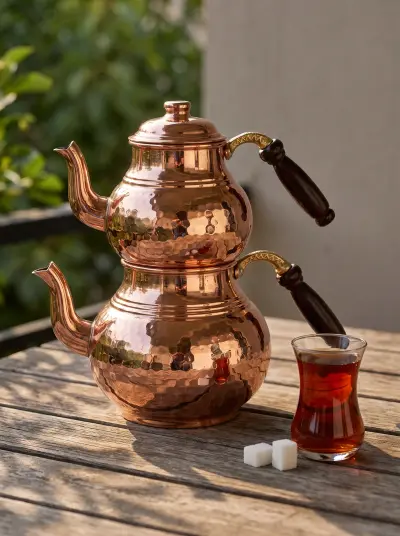
TC10057-1
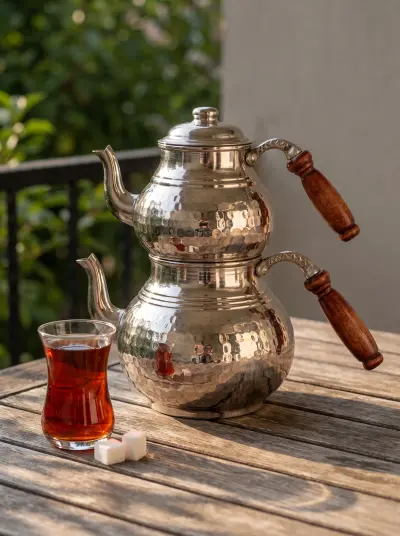
TC10057-2
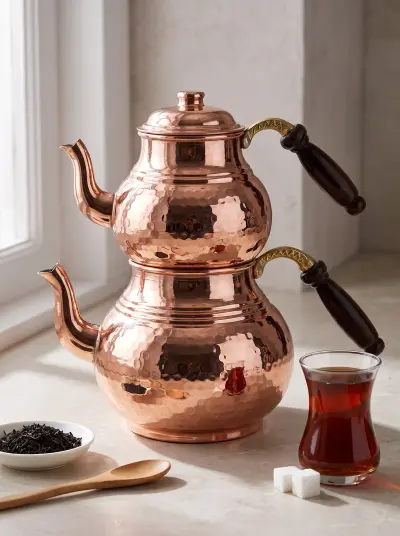
TC10058-1
Usually yes, on trays, tea saucers and the body of a double teapot, but a branded piece is quoted as its own line, separate from stock items, and takes noticeably longer. Artwork, position and method are approved on a sample first. Keep the approved artwork and the full stock code together on file, so pieces reordered later carry the same mark in the same place.
The current catalogue lists copper pieces only and does not list tea glasses or glass holders. Source the tulip-shaped glasses separately, and measure the base of the glass you choose against the copper tea saucer before ordering both in volume. Buying glasses and saucers from different suppliers is normal; confirming the fit on one sample of each avoids a mismatch on the counter.
Yes. Each finish has its own stock code suffix after the dash, so one quote list can mix them line by line. A venue usually picks one finish for everything a guest sees together on the table, while a retailer often stocks two or three finishes of the same design to widen the display. Write the full stock code on every line so the finish cannot be swapped.
Brewed black tea is itself mildly acidic, commonly around pH 5, and fruit infusions, hibiscus and lemon push it lower. The US FDA Food Code (section 4-101.14) does not allow copper to contact food or drink below pH 6, so for US venues the upper brewing pot must be lined for any tea. Confirm the interior per stock code in the written quote; if a fruit or herbal menu is large, brew those drinks in a glass or porcelain pot.
Copper dents rather than breaks, so the risk in transit is dents on spouts and lids and scratches on polished or nickel-plated surfaces. Ask in the quote request how each set is wrapped, whether the upper and lower pots travel nested or separately, and how cartons are marked. Photograph damaged pieces on arrival with the carton label visible before signing for the delivery.
Yes, with two adjustments. A buffet tea station pours continuously for a fixed period, so one larger set on a warmer, or several sets rotated from the kitchen, replaces table-by-table service, and guests serve themselves without a server adjusting strength. Above a certain volume a samovar or tea urn is the better fit. Specify the buffet station as its own section of the quote list, separate from lounge or restaurant sets.
The catalogue does not specify retail packaging, so treat it as a question for the quote request. State whether the sets will be sold on a shelf, as gifts or online, and ask how each set is boxed, whether the box carries any print, and whether neutral or own-brand boxes are possible. Packaging affects carton count and freight, so settle it before the written quote is finalised.
Other guides covering the same stage of the buying process - continue reading here.
How a Turkish, Arab, Persian or Balkan grocery adds a copper housewares shelf: cezves, double teapots, saucers, burners, lokum dishes, seasons and care cards.
How hotels, confectioners and favour buyers use copper Turkish delight dishes and sugar bowls: size by use, lids, which sweets suit them, engraving and stock.
A station-by-station copper fit-out list for a Turkish coffee shop: cezve sizes by cup count, serving trays, sugar and lokum dishes, water service and retail.
Add the products you need to your quote list with quantities and send it by WhatsApp, e-mail or the form. We reply with unit prices and delivery terms.