
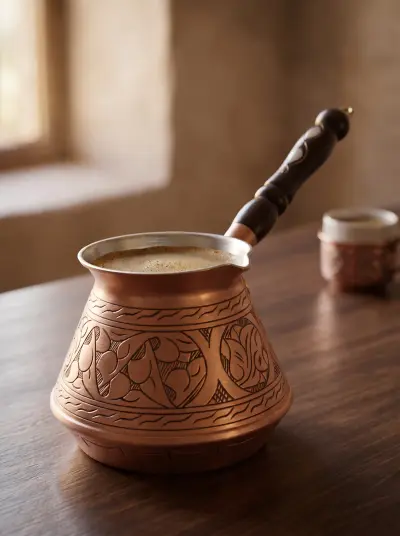
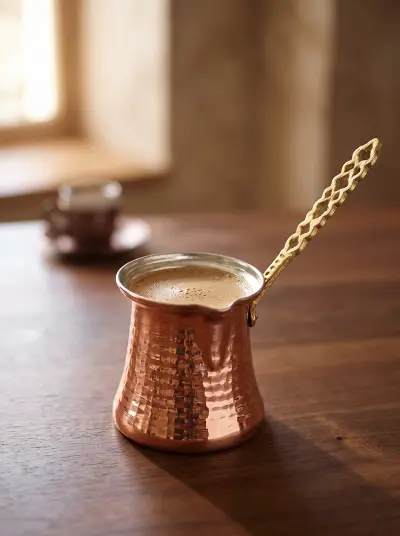
Elit Külhan Copper Turkish Coffee Pot — No. 3, 7 Turkish coffee cups (580 ml), engraved, brushed matt
TC10055-4
How a Turkish, Arab, Persian or Balkan grocery adds a copper housewares shelf: cezves, double teapots, saucers, burners, lokum dishes, seasons and care cards.
Browse the range, add the pieces you need to your quote list and ask for prices in one message. No account, no online prices.
A Turkish or Middle Eastern grocery store buying wholesale copper should stock what its food customers use: cezves next to the Turkish coffee, double teapots and tea saucers by the loose tea, lokum dishes and sugar bowls beside the sweets, and incense burners before Ramadan and Eid. Start with a small tiered range of in-stock codes and grow from sell-through.
Copper sells in a grocery because the customer arrives already holding the reason to buy it. Someone filling a basket with Turkish coffee, black tea from the Black Sea coast, lokum (Turkish delight) or bakhoor (scented wood chips for burning) is a step away from the pot, tray or burner that goes with it, and does not need to be persuaded that the product is useful.
That changes the buying logic compared with a gift shop. A gift store chooses copper for how it looks on a display table and sells it as a present. A grocery chooses copper for how it fits the food on nearby shelves and sells it as a household item, often to the same customer every few years. The copper home and gift assortment guide for stores covers the gift-shop route; this guide is about the food-retail route, where the coffee aisle does the selling.
Three things follow from that:
The Coppery is a single supplier in Turkey with a wholesale catalogue that publishes no prices; the wholesale price, quantities, lead time and shipping come in a written quote for each order.
Cezves sell beside Turkish coffee, double teapots, tea saucers and trays beside loose tea, lokum dishes and sugar bowls beside the sweets, and incense burners beside bakhoor. Order only the families whose aisle already moves well in your store.
| Food aisle in your store | Copper family | Example stock codes | Why it fits |
|---|---|---|---|
| Turkish coffee | cezve (coffee pot) | Kervan TC10008-1, Sultan TC10036-1 | the customer brews at home and needs the right size |
| Loose black tea | double teapot (caydanlik) | Klasik TC10058-1, set with warmer TC10061-1 | Turkish tea is brewed in a two-tier pot |
| Tea glasses and saucers | tea saucer | Otağ TC30041-1, set of six TC30042-1 | replaces the saucers under tulip glasses |
| Lokum and sweets | lokum dish, sugar bowl | Saka TC30061-1, Rumeli TC30052-1 | serving dish for the sweets just bought |
| Bakhoor and oud | incense burner (mabkhara) | Traditional TC50034-1, Klasik TC50035-1 | the burner for the fragrance on the next shelf |
| Spices | spice jar | Safran TC40001-1, set of four TC40005-1 | dry storage for the spices sold loose |
The copper Turkish coffee pots, Turkish double teapots, copper sugar bowls and lokum dishes and copper incense burners are the four categories most grocers start from. Everything else is a second step.
Tea glasses are the one gap to plan around. The catalogue lists copper pieces only, so the tulip glasses that sit on the saucers come from your usual glassware supplier. Check one glass base against one saucer before ordering both in volume.
Build tiers from the variables that drive the written quote: copper sheet thickness, piece weight, capacity, handle material and how much handwork the finish takes. A light-gauge 0.60 mm machine-hammered cezve is the entry piece, a heavier 0.80 to 1.00 mm gauge is the mid tier, and a thick engraved or fully tinned piece is the premium tier.
Each cezve in the catalogue lists capacity, sheet and weight. Compare two pots with the same 150 ml capacity: the light-gauge Kervan No. 2 (TC10008-1) is 0.60 mm and 95 g, while the heavy-gauge Kervan No. 1 (TC10011-1) is 0.70 mm and 124 g. More copper and more forming time sit higher in the quote, so the heavier pot belongs in the next tier up.
| Tier | Line and stock codes | Capacity range | Sheet and weight as listed |
|---|---|---|---|
| Entry | Kervan light gauge, TC10007-1 to TC10010-1 | 90 to 250 ml | 0.60 mm, 62 to 130 g |
| Entry plus | Eylül, TC10021-1 to TC10023-1 | 150 to 230 ml | 0.60 mm, 82 to 130 g |
| Mid | Sultan heavy gauge, brass handle, TC10036-1 to TC10040-1 | 200 to 550 ml | 0.80 mm, 182 to 336 g |
| Mid, smooth | Moda, TC10049-1 and TC10050-1 | 220 and 350 ml | 0.90 and 1.00 mm, 146 and 178 g |
| Premium | Elit Külhan engraved, TC10055-4 and TC10055-6 | 580 ml | 1.25 mm, 350 g |
Capacity in the catalogue name is written as Turkish coffee cups, for example "2 Turkish coffee cups (200 ml)" for the Sultan No. 1. Use that wording on your shelf tag, because customers choose a cezve by how many cups they make at once, not by millilitres. Cup ratings differ between series (a 150 ml Kervan is rated for two cups, while the Sultan reaches two cups at 200 ml), so copy the rating from each stock code rather than applying one scale across the shelf.
Sets do a separate job. The Kervan Small set of three (TC10025-1, Nos. 1 to 3), the Kervan Large set of three (TC10026-1, Nos. 4 to 6), the Sultan set of five (TC10006-1) and the Moda set of three (TC10054-1) are wedding and housewarming presents.
At the premium end the finish changes the interior as well as the look: the Elit Külhan is listed brushed matt (TC10055-4) and fully tinned (TC10055-6). The catalogue does not carry a lining field, so ask in the quote request for the interior of every cezve code you list to be confirmed. The wholesale cezve supply page sets out what to specify for a larger cezve order, and the Turkish coffee shop equipment guide matches pot sizes to cup counts in more detail.
The tea aisle needs three copper pieces: a double teapot (caydanlik, a two-tier pot with the brewing pot sitting on a water kettle), tea saucers for the tulip glasses, and one round tray. Stock the double teapot in two sizes and one finish, and the saucers both singly and as a set of six.
The Klasik double teapot is hand-hammered and listed as No. 1 and No. 3 in light gauge and No. 2 in light and heavy gauge, each in polished copper, nickel-plated and oxidised. A grocery shelf works well with the light-gauge No. 2 in polished copper (TC10058-1) as the everyday pot and the heavy-gauge No. 2 (TC10057-1) as the step-up. For customers who brew for a large family or for guests, the Klasik set with warmer (TC10061-1, No. 2, heavy gauge) adds a stand that keeps the pot warm on the table.
The Otağ tea saucer is hand-hammered at 0.50 mm and comes in polished copper, nickel-plated, oxidised and brushed matt, singly (TC30041-1 to TC30041-4) or in sets of six (TC30042-1 to TC30042-4). Grocery customers usually buy saucers in sixes, so the set is the shelf item and the single is the replacement for a lost saucer.
For a tray, the Çaldıran round tray is 34 cm, hand-hammered, 0.95 mm and 714 g, in polished copper (TC30043-1) or nickel-plated (TC30043-2). It is listed in the copper trays and tea saucers category. A 34 cm tray is large for a narrow shelf, so stand one upright at the back of the bay and keep the rest flat in stock.
The wholesale Turkish tea set guide explains brewing, warmers and service sizes in depth.
Plan the seasonal order around the dates your customers celebrate, and place it early enough to reorder once before the peak. Ramadan and the two Eids drive incense burners, trays, lokum dishes and sugar bowls; weddings, housewarmings and year-end holidays drive cezve sets and tea sets.
Ramadan follows the lunar Islamic calendar, so it moves about 11 days earlier each year in the Gregorian calendar. In 2027 it is expected to begin in early February, with the exact day set by local moon sighting. This guide gives no lead-time figures, because lead time depends on stock and on the order. Ask for it in the quote request and count back from the first week of Ramadan.
What sells in each season:
For the incense burner range itself, the wholesale copper incense burner guide covers models, charcoal use and finishes. The in-stock core as of November 2026 is the Traditional hand-held burner (TC50034-1 and TC50034-3), the Klasik hand-held burner (TC50035-1 and TC50035-3), the footless cauldron (TC50036-1 and TC50036-3) and the Aromatherapy tea-light burner (TC50030-1 to TC50030-4). The cauldron burners No. 1 (TC50032-1 to TC50032-3) and No. 2 (TC50033-1 to TC50033-3) were out of stock in every finish.
Lokum dishes are the easiest seasonal add-on, because the customer is already holding a box of lokum at the till. The guide to copper Turkish delight dishes and sugar bowls compares the dish forms; for a grocery, the Saka round dish at 9 cm (TC30061-1) and 11 cm (TC30055-1) and the Mini casserole sugar bowl set of three (TC30060-1) cover most requests.
Each community buys copper for a different drink or meal, so match the range to the food you stock. South Asian customers buy copper tumblers and serving bowls, Persian customers buy tea pieces and trays, and Balkan customers buy the cezve under the name džezva for Bosnian coffee.
South Asian groceries. A copper tumbler for drinking water is a familiar household item in many South Asian homes. The plain Copper Tumbler No. 1 (TC20011-1, 330 ml, 0.70 mm, 170 g) and No. 2 (TC20001-1, 450 ml, 0.70 mm, 190 g) suit this, both smooth and in polished copper; the No. 2 is also listed nickel-plated, oxidised and brushed matt. Sell them for water only and say so on the card. Keep health claims about copper water off labels and signs. For handi, kadai and thali pieces, the Indian cuisine copper sourcing guide covers sizes and lining.
Persian groceries. Tea is brewed strong and served through the day, often from a samovar or a teapot on a kettle. The Klasik double teapot and Otağ saucers fit the same habit, and the Çaldıran tray carries the glasses. Persian sweets sit well in the Saka lokum dishes.
Balkan groceries. Bosnian and Serbian customers brew coffee in a džezva, which is the same form as the cezve. The small Kervan and Eylül sizes suit the one- and two-cup habit, and the shelf label should carry both names.
Arab groceries. Arabic coffee is usually made in a dallah, which the catalogue does not list as a stocked item. Arab customers who drink Turkish-style coffee buy cezves, and the incense burners, trays and sugar bowls fit Arab hosting customs.
A starter range fits one shelf bay or an aisle-end hook strip. Plan one facing per stock code, two for the best-selling cezve size, and keep sets and heavy pieces in stock behind the counter rather than on the shelf.
A practical layout puts the cezves on hooks at eye level at the end of the coffee aisle, the double teapots and saucer sets on a shelf below, and the lokum dishes near the till where the impulse purchase happens. The hanging cauldron incense burner (TC50031-1) can hang above the bakhoor shelf so that customers see it from the aisle.
Two rules keep the shelf tidy:
Polished copper darkens on an open shelf over weeks, faster near a door or a heater. Keep the stock in its bags until the facing is sold, and rotate the display piece rather than letting one cezve hang for months.
Every copper piece that touches food or heat needs a short care card in the language of your customers. The card should say: fill the pot before it goes on the heat, never heat it empty, wash by hand and dry straight away, and expect the copper to darken with use.
| Product | Care card lines | Why it matters |
|---|---|---|
| Cezve | never heat empty; low to medium flame; hand wash and dry | a tin interior melts at 232 °C, and an empty pot passes that quickly |
| Double teapot | keep water in the lower kettle; never boil dry; hand wash | the lower kettle carries the heat for the whole set |
| Tea saucer, tray | wipe and dry; polish the outside only | water spots and fingerprints show on polished copper |
| Lokum dish, sugar bowl | dry foods only; hand wash | dry contents are the safe use for copper |
| Tumbler | water only; no juice, ayran or lemon water | acidic drinks react with unlined copper |
| Incense burner | hot when lit; hold by the handle; empty cold ash only | copper conducts heat to the body and lid |
On lining, give the customer one accurate sentence. The interior of a cezve or double teapot can be tin-lined, stainless-lined or unlined, and the written quote confirms which, per stock code. A worn tin lining can be renewed by a retinning service. Brewed tea and coffee are mildly acidic, commonly around pH 5, below the pH 6 line in section 4-101.14 of the US FDA Food Code. The FDA Food Code copper guide explains what that means for a US store that also supplies cafés.
A first grocery order covers five families, about ten stock codes and modest quantities, weighted towards the cezve sizes your coffee customers already buy. Put everything on one quote list so that the written quote covers price, quantity, carton and lead time together.
The example below is a starting point for a mid-sized Turkish grocery. The quantities are illustrations, not minimums; the written quote states the real minimum for each line.
| Stock code | Product | Example quantity | Shelf role |
|---|---|---|---|
| TC10008-1 | Kervan cezve No. 2, 150 ml, light gauge | 24 | entry, two-cup size |
| TC10010-1 | Kervan cezve No. 4, 250 ml, light gauge | 12 | entry, family size |
| TC10037-1 | Sultan cezve No. 2, 250 ml, heavy gauge, brass handle | 12 | mid tier |
| TC10025-1 | Kervan Small cezve set of three | 6 | gift set |
| TC10058-1 | Klasik double teapot No. 2, light gauge, polished copper | 6 | everyday tea |
| TC10061-1 | Klasik double teapot set with warmer, No. 2 | 3 | gift and large family |
| TC30042-1 | Otağ tea saucer, set of six, polished copper | 12 | tea aisle |
| TC30061-1 | Saka lokum dish 9 cm, polished copper | 24 | till impulse |
| TC30060-1 | Mini casserole sugar bowl, set of three | 6 | sweets aisle |
| TC50034-1 | Traditional hand-held incense burner, polished copper | 12 | bakhoor shelf, Ramadan |
When you send the list, add four lines to the message: the interior you need for each cezve and teapot code, retail packaging or bulk cartons, any labels you need applied before packing, and the delivery address with the Incoterm you prefer. The first wholesale copper order guide walks through quantities and stock codes for a mixed first order.
The import rules depend on where the store is. Germany, with the EU food contact framework and its own LFGB layer, is covered on the Germany market page, and UK duty and compliance on the United Kingdom market page. Browse the full copper catalogue for second-step lines such as spice jars and hammam bowls, then add the chosen stock codes to the quote list and send it by WhatsApp, e-mail or the form.
TC10055-4
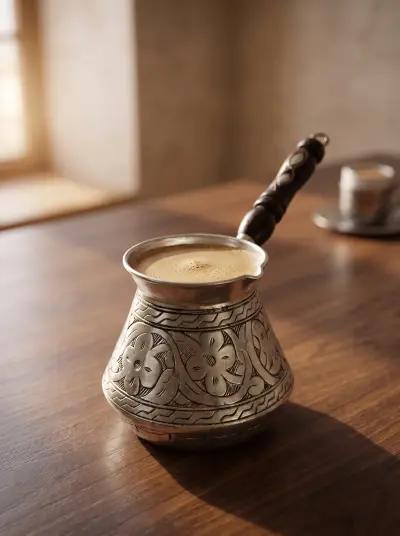
TC10055-6
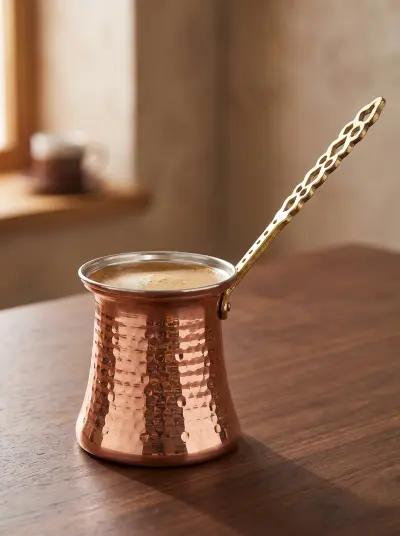
TC10001-1
TC10002-1
They are the same kind of long-handled coffee pot under different names. Cezve is the Turkish word, džezva is used in Bosnia and Serbia, and many English-speaking shoppers call it an ibrik, although in Turkish an ibrik is a water ewer. Put two names on the shelf label, for example cezve and Turkish coffee pot, so that Turkish, Balkan and Arab customers all recognise the product.
Ask in the quote request. EAN numbers are licensed by GS1 to the company that owns the brand on the label; if the goods sell under your name, the codes come from you. Send the code list with your quote request and ask whether labels can be applied before packing; otherwise print and apply them on arrival, before the goods reach the shelf.
Cezves, hand-held incense burners and lokum dishes are small enough to pocket, and copper looks valuable. Leave one display piece of each line on the open shelf and keep the rest behind the till, so a missing piece is noticed at once. A security cable through a cezve handle or a locking hook protects the display piece. Shelf tags that name the stock code let staff fetch the right piece.
Yes, and many grocers already supply a few nearby cafés with coffee and tea. For trade customers, steer them towards the heavier lines, such as the 0.80 mm Sultan cezves or the Elit Külhan at 1.25 mm, and the double teapots sold with a warmer. Most US states adopt the FDA Food Code, which includes a rule on copper and acidic food, so confirm the interior in writing.
Yes, hampers are usually assembled in the store. Pair a cezve with a pack of Turkish coffee, or a hand-held incense burner with a box of bakhoor, and keep each food or fragrance item in its own sealed retail pack with its own label. The copper has its own rules too: a cezve is a food-contact article, so check the food-contact and product-safety labelling for your market. Wrap the copper separately so that it does not scratch the food packaging.
Yes. Each product in The Coppery catalogue carries its name in Turkish, English, Arabic, Russian and German, so shelf labels and hamper tags can be written from the catalogue text. Care and safety information for retail customers usually has to be in a language consumers in the country of sale can easily understand, as set by that country, so print the care card in that language and add a second language if most of your customers prefer it.
Other guides covering the same stage of the buying process - continue reading here.
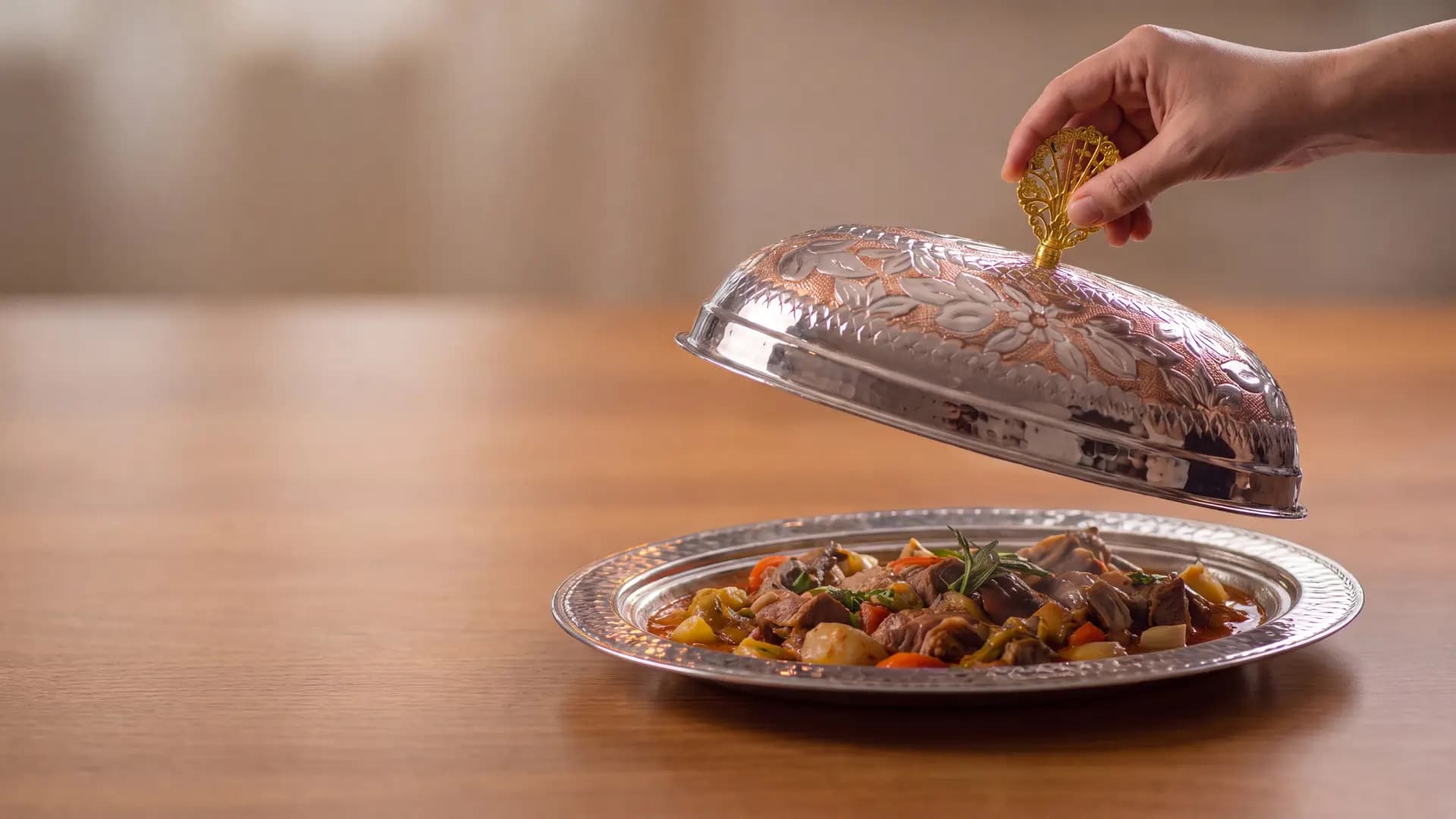
A station-by-station copper checklist for Middle Eastern restaurants: mezze dish sizes, kebab platters, cook-and-serve pans, tea, coffee, linings, quote lists.
A station-by-station copper fit-out list for a Turkish coffee shop: cezve sizes by cup count, serving trays, sugar and lokum dishes, water service and retail.

How cafés, hotels and retailers build a wholesale Turkish tea set: double teapot size and gauge, warmers, trays, tea saucers, sugar bowls and table quantities.
Add the products you need to your quote list with quantities and send it by WhatsApp, e-mail or the form. We reply with unit prices and delivery terms.