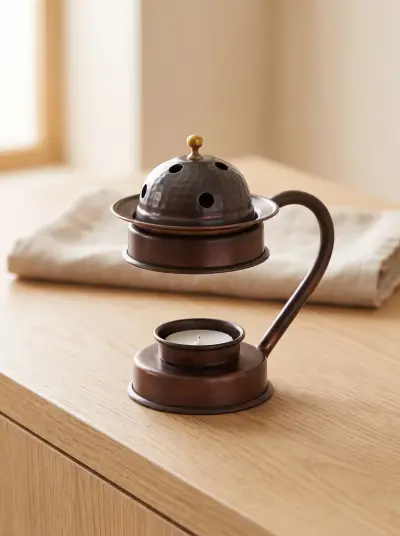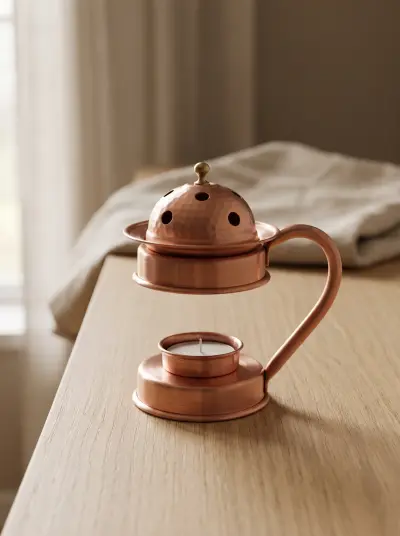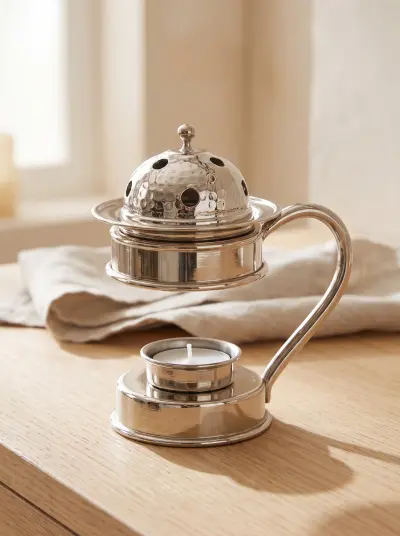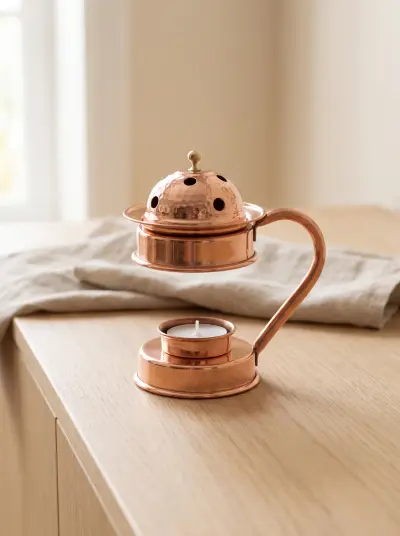
Aromatherapy Copper Incense Burner — polished copper
TC50030-1
Mabkhara and bakhoor burner wholesale from Turkey: copper burner types with real sizes, charcoal and tea-light use, finishes, retail packs and a quote list.
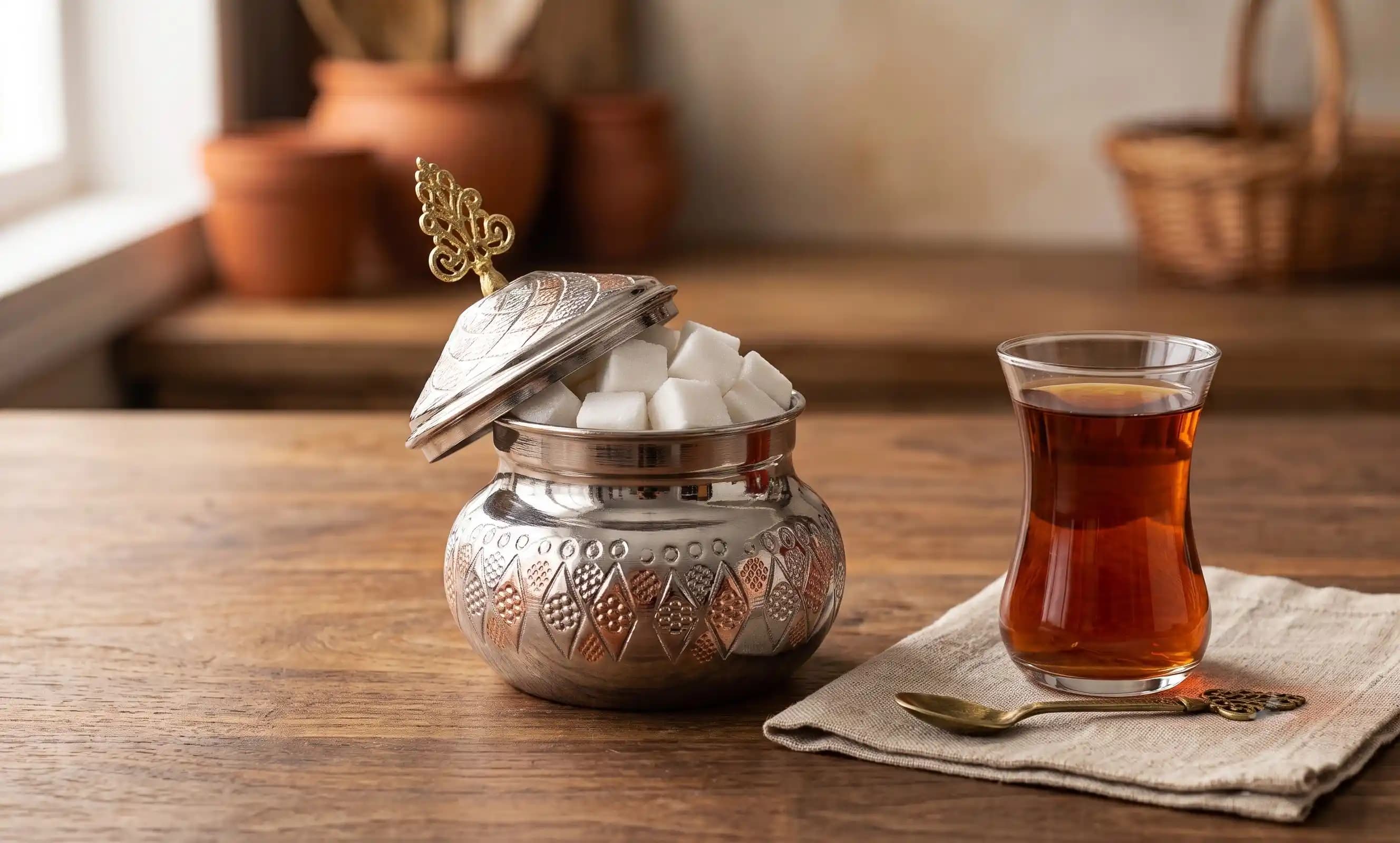
Browse the range, add the pieces you need to your quote list and ask for prices in one message. No account, no online prices.
A wholesale copper mabkhara (Arabic incense burner) order is built by model, finish and quantity: standing, hanging and hand-held burners for bakhoor, resin or cones, specified by stock code with listed height, diameter and weight. A supplier in Turkey such as The Coppery prices each line in a written quote; nothing is priced online.
A mabkhara (also mabkhra or mibkhara) is an Arabic incense burner for bakhoor, the scented wood chips that are heated so they release fragrant smoke. Buyers spell both words in several ways, and wholesale catalogues, customs lines and shop signs use all of them. Knowing the variants helps you search, list and write a quote request that cannot be misread.
The Arabic word for the burner is مبخرة, transliterated as mabkhara, mabkhra or mibkhara; the related form مبخر appears as mabkhar or mubkhar. The fragrance itself is بخور, written in English as bakhoor, bukhoor or bakhour. Bakhoor is usually wood chips soaked in perfume oils, burned on a charcoal disc, while oud refers to agarwood, the resinous wood that is the most prized fragrance in the Gulf, sold as chips or as oil. Frankincense resin and Western sticks and cones can be burned in the same kind of vessel.
For a buyer the practical point is that "incense burner", "bakhoor burner", "mabkhara" and "censer" all describe the same product family. The differences that matter in an order are the heat source the burner is designed for, how it is held or placed, and its size, which is what the rest of this guide works through.
Copper suits this product because it is easy to form and hammer into a lidded vessel, it handles heat without cracking, and it takes the decorative finishes that make a burner a display piece. Its main drawback, also covered below, is that it conducts heat well, so the body and fittings get hot.
The copper incense burner range lists 19 products in six model lines, and 13 of them were in stock as of November 2026. All are made from 0.50 mm copper sheet, weigh between 150 g and 245 g, and carry their height and diameter on the listing, so a buyer can plan display and packing from data.
The four lines most buyers start with are below. Dimensions and weights are as listed in the catalogue; the description of each form comes from the listing photographs.
| Stock code and line | Form | Listed size and weight |
|---|---|---|
| TC50030-1 Aromatherapy burner | standing, tea-light under a dish, perforated dome lid, side handle | 13.0 cm high, 9 cm across, 185 g |
| TC50031-1 Cauldron hanging burner with chain | dish and perforated dome lid on a chain | 6.5 cm high, 11 cm across, 150 g |
| TC50034-1 Traditional hand-held burner | hammered body, perforated lid, long side handle | 6.5 cm high, 6.5 cm across, 154 g |
| TC50036-1 Footless cauldron burner | round belly sitting directly on its base, perforated lid, side handle | 9.5 cm high, 9 cm across, 188 g |
Two further lines complete the range. The Klasik hand-held burner, TC50035-1, shares the Traditional burner's listed 6.5 cm height, 6.5 cm diameter and 154 g. The Copper Cauldron burner comes in No. 1, TC50032-1 at 9.5 cm high, 9 cm across and 224 g, and No. 2, TC50033-1 at 11.0 cm high, 10.0 cm across and 245 g. Both cauldron sizes were out of stock as of November 2026, in all three of their finishes.
The catalogue burners are non-electric copper vessels. The Aromatherapy burner is heated by a tea-light candle in its base, and the other lines hold a lit charcoal disc, a cone or resin inside a lidded bowl.
With charcoal, the usual method is to light a disc until it glows, lay it in the bowl, and place bakhoor or oud chips on top. Many users put a layer of sand or ash under the disc, which spreads the heat and makes emptying easier. Ask in the quote request what each model is intended to hold, and test your own charcoal and bakhoor in a sample of each model, since disc sizes vary between brands.
Electric bakhoor burners, which use a heated plate and are popular for apartments and offices, are a different product with electrical safety requirements of their own. The catalogue lists none and this guide does not cover them, and buyers should not assume a copper vessel can be paired with an electric base unless the written quote confirms the fit.
Copper conducts heat very well, so once charcoal is lit the bowl, lid and metal parts get hot quickly. Three rules apply to every model:
No certification or safety test is claimed for these burners. Where a hotel, retailer or importer needs a declaration for its own market, write that requirement into the quote request so the reply can address it.
Smoke and heat mark every copper finish, but not equally. Polished copper shows soot and heat discolouration first, nickel-plated hides colour change but shows smudges, and oxidised or brushed matt hide both best. Choose by where the burner is used: daily lit service favours the darker or matt finishes, display favours polish.
The incense burners are listed in four finishes, identified by the suffix after the dash in each stock code: polished copper, nickel-plated, oxidised and brushed matt. Not every line comes in every finish. The Aromatherapy burner is listed in all four (TC50030-1 to TC50030-4), the hanging burner in polished, nickel-plated and brushed matt, and the hand-held and footless models in polished copper and oxidised.
| Finish | How it ages with smoke and heat | Best fit |
|---|---|---|
| Polished copper | darkens and shows soot rings; needs regular polishing to stay bright | retail display, gifts, occasional use |
| Nickel-plated | silver tone hides copper colour change; soot wipes off but shows | modern interiors, mixed metal displays |
| Oxidised | already dark, so smoke marks blend in | daily use in a majlis or lobby |
| Brushed matt | hides fingerprints and fine marks | spa and reception counters |
Tarnish on copper is a surface reaction with air, moisture and, here, combustion residue. It does not weaken the burner, but it changes how a shelf looks after a few weeks in a shop window or a few months of daily use. The guide to copper finishes explains how each surface wears and how to write a finish into a purchase line. Nickel plating on a burner is a decorative exterior finish only.
A retail assortment should cover the three ways customers use bakhoor: a hand-held mabkhara for hosting, a standing burner for the home, and a gift piece. Two or three finishes of the same model sell better side by side than a scatter of single designs. Order early enough to reorder before the peak.
Home-fragrance and oud shops in the Gulf sell burners most strongly in the weeks before Ramadan and Eid, and gift shops in Europe and elsewhere see a second peak before year-end holidays. This guide gives no lead-time figures, because they depend on stock and on the order. Treat the in-stock lines as the core of a seasonal order and ask about out-of-stock models early.
| Assortment role | Suggested lines | Why it earns shelf space |
|---|---|---|
| Hosting mabkhara | Traditional TC50034-1 and TC50034-3, or Klasik TC50035-1 and TC50035-3 | the burner passed to guests, the core of a bakhoor shop |
| Home burner | Footless cauldron TC50036-1 or Aromatherapy TC50030-1 | sits in a living room or majlis between uses |
| Display piece | Hanging cauldron TC50031-1 | eye-catching in a window or above a counter |
| Gift add-on | burner with a tray or candle holder in the same finish | lifts the value of a gift set |
A perfume or oud shop can also present a burner next to its own bakhoor as a gift set, assembled locally. The burner comes from the copper supplier and the fragrance from the shop's own range, which keeps the fragrance under the shop's brand.
For gift shops building a broader copper shelf, the guide to a copper home and gift assortment for stores shows how burners sit next to planters, spice jars and hammam bowls. The wider copper home décor range holds the companion pieces: copper candle holders in matching finishes, and small decorative copper objects such as miniature pails and napkin holders that fill a gift table.
Hospitality buyers use incense burners in staffed public spaces: a hotel lobby, a majlis (the Gulf reception room for guests), a restaurant entrance or a spa. The choice is between a display burner that stays in place and a hand-held mabkhara that staff carry to guests, and most properties need both.
A practical way to plan is by space and by who handles the burner:
Presenting the burner on a tray, together with the bakhoor box and tongs, is common in a majlis. The copper trays category lists 34 cm round serving trays, for example the hand-hammered Çaldıran tray TC30043-1 at 714 g. A copper tray conducts heat as well, so the burner on it still needs a heat-resistant surface underneath, or the tray should sit on a stand.
For hotel projects the burners are one line in the operating supplies list. The hotel OS&E copper procurement guide shows how decorative and service pieces are scheduled with the rest, and the Gulf serveware sourcing guide covers the copper service pieces that sit around a majlis. Sizes outside the standard lines described here are a custom request for the written quote.
Yes, a logo or a short text can usually be engraved on the lid rim, the body or the handle collar, quoted as its own line and approved on a sample first. Retail packaging, such as an individual gift box, is also a separate line from transit packing and is specified in the quote request.
Engraving suits these burners because the walls are thin, 0.50 mm, and the logo area is small and curved, so a simple mark reads better than detailed artwork. Typical requests are a perfume house logo on the lid, a hotel crest on the body or an Arabic phrase for a Ramadan edition. The guide to logo printing and engraving on copper compares methods and explains why branded runs take noticeably longer than stock items.
On packaging, separate two things in the request:
Write both into the quote request so the written quote prices them as separate lines.
Copper household articles, including incense burners, are classed under HS subheading 7418.10. Saudi Arabia gives the copper incense burner its own 12-digit line, 741810000010, and charges 12% duty on it plus 15% VAT; the UAE applies 5% duty and 5% VAT under the GCC common tariff, with no reduction for Turkish goods. Confirm the final code and duty with your customs broker before shipping.
Two market pages on this site set out the details with their sources. The Saudi Arabia market page explains the 12-digit lines, why the duty on this subheading in Saudi Arabia is 12% rather than the 5% often quoted, and the SABER conformity route. The UAE market page explains the 5% duty, VAT and the Türkiye–UAE partnership agreement, whose concessions do not cover HS 7418.
For importers combining burners with cookware or serveware, the wholesale copper kitchenware supply page describes how mixed orders from Turkey are consolidated into one shipment.
List each burner by full stock code, finish and quantity, add notes on heat source, branding and packaging, then send the whole list as one quote request. The written quote returns wholesale price per line, minimum quantity, lead time and shipping terms for that order.
Browse the full copper catalogue, add each item to the quote list with its quantity, and send it by WhatsApp, e-mail or the form with your country and delivery address. A worked example for a bakhoor shop preparing for Ramadan might read:
| Stock code | Item and finish | Note for the quote |
|---|---|---|
| TC50034-1 | Traditional hand-held burner, polished copper | handle material, retail box |
| TC50034-3 | Traditional hand-held burner, oxidised | same box as above |
| TC50036-1 | Footless cauldron burner, polished copper | logo on lid, sample first |
| TC50031-2 | Hanging cauldron burner, nickel-plated | chain packing, display use |
| TC50030-4 | Aromatherapy burner, brushed matt | tea-light use, spa counter |
| TC50033-1 | Copper Cauldron No. 2, polished copper | out of stock, ask timing |
Quantities are left out of the example on purpose; they come from your own sales or room counts. Before sending, check that every line has the full code with its finish suffix, that branding and packaging are separate lines, and that you have asked what each model is designed to burn.
If this is your first order from a Turkish supplier, the first wholesale copper order guide walks through samples, written quotes and the first shipment step by step.
No. The catalogue lists copper pieces only, so fragrance and fuel are sourced separately, usually from the perfume house or distributor whose bakhoor you already sell. That split is normal in this trade. Test your own bakhoor and charcoal in one sample burner of each model before ordering in volume, so the bowl size and the lid suit the fuel you actually use.
No. Copper is a reddish metal on its own, while brass is a copper and zinc alloy with a yellow colour. In Arabic both are sometimes called nahas, which causes confusion in orders. The catalogue lists these burners as copper; small parts such as knobs and handle collars can be a different metal, so ask in the quote request what each fitting is made of.
Let the burner cool completely and empty the ash first. Wipe soot from the outside with a soft dry cloth, then a damp one. Resin stuck inside the bowl softens with warm water and mild soap and comes away with a soft brush. Avoid steel wool and harsh abrasives on polished and nickel-plated pieces. Dry the burner fully before the next use.
Yes. Out-of-stock models stay in the catalogue and can be added with a quantity like any other line. The written quote then says whether that model can be produced for your order and how long it takes. If timing matters, for example ahead of Ramadan, list an in-stock alternative on the same request so the reply can price both.
That depends on the property's own fire safety policy and local rules, not on the burner. Many hotels keep lit charcoal to staffed public areas such as the lobby or majlis and offer unlit display pieces or reed diffusers in rooms. Check with the property's safety officer before specifying burners for rooms, and write the decision into the room inventory.
Charcoal discs are sold in several diameters, and the inner bowl of a burner is smaller than its listed outer diameter. Measure the disc you sell against the 6.5 cm body of TC50034-1 and TC50035-1 before choosing them as your hosting mabkhara, and test one sample with your own disc and bakhoor. If the disc is too wide, the footless cauldron burner TC50036-1 at 9 cm across is the next size up.
Yes, as long as the venue's fire rules allow open charcoal. Wind lifts ash and sparks, so keep the perforated lid on while charcoal burns. Stand each burner on stone or a metal tray, keep it well away from tent walls, cushions and drapes, and give staff a metal container for spent charcoal so nothing hot goes into a waste bin.
Other guides covering the same stage of the buying process - continue reading here.
Copper hammam bowl (hammam tas) wholesale from Turkey for spas and hotels: real sizes and finishes, sauna buckets, foot baths, wet-area care and a quote list.
Copper candle holders wholesale from Turkey: real stock codes, candle fit, finishes, wax care, fire safety and seasonal assortments for retail and hotel buyers.
Wholesale copper planters and vases from Turkey: Kabak and Bahar sizes, cachepot use, vase liners, finishes and project specs for designers, by quote list.
Add the products you need to your quote list with quantities and send it by WhatsApp, e-mail or the form. We reply with unit prices and delivery terms.