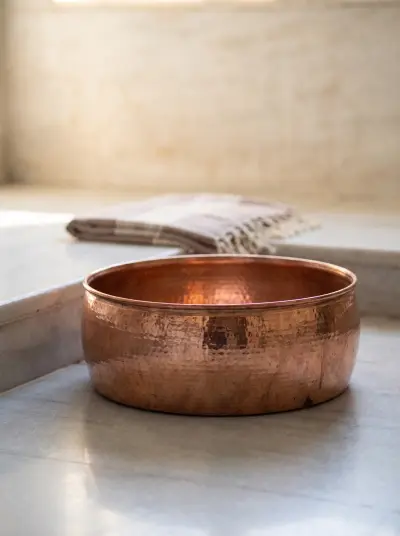
Copper Foot Bath Basin — 40 cm, polished copper
TC50017-1
How a logo is applied to copper, what the metal does to each method, and how tooling cost breaks even across order volume in corporate gift programmes.
Browse the range, add the pieces you need to your quote list and ask for prices in one message. No account, no online prices.
Six methods put a logo on copper: laser marking, mechanical engraving, chemical etching, pad printing, screen printing and die embossing. The right one is decided by three questions rather than by the artwork: is the surface flat, how many pieces, and how long must the mark survive. Copper answers those questions differently from steel or aluminium.
Every method works on copper, but not at the same job. Two remove metal, one reshapes it, three leave a layer on top. That distinction decides durability: a mark cut into or formed from the metal survives polishing, a layer on the surface wears away.
| Method | What it does | Setup burden | Where it fits |
|---|---|---|---|
| Laser marking | Marks the surface with a focused beam | Low, vector file | Fine detail, names, serial numbers |
| Mechanical engraving | Cuts with a diamond or steel tip | Low, tip and jig | Low volume, personalised names |
| Chemical etching | Bites into unmasked areas | Medium, mask preparation | Wide flat fields, crests, plaques |
| Pad printing | Transfers ink with a silicone pad | Medium, per cliché | Small marks, gently curved bodies |
| Screen printing | Pushes ink through a mesh | Medium, per screen and colour | Colour logos, cylindrical bodies |
| Die embossing | Pushes metal out with a die | High, one-off tooling | High volume, repeating programmes |
Mechanical engraving is the oldest and still the most common route in the Turkish clusters, and almost all personalised name work comes off it. Chemical etching gives an even depth across a wide field, which suits trays, plaques and flat panels, though the mask is difficult to seat on a curved body. Screen printing carries colour, but the ink is exposed to wear and is never applied to a food-contact interior. Where these methods sit inside a private-label production flow, and who owns the tooling afterwards, is covered in the contract and OEM copper manufacturing guide.
Pad printing is the promotional industry default because the silicone pad conforms to gentle curvature, so one cliché prints high volumes. It works on copper with two caveats. The ink adheres to the surface rather than bonding into the metal, so a polished or oily surface weakens adhesion and pre-print cleaning becomes a separate operation. And copper is a dark ground: light inks do not cover in one pass and need a white base underneath.
UV printing is the newest catalogue option and does apply to flat copper items. Its advantage is multi-colour detail with no tooling; its limitation is the one every ink method shares. The layer sits above the metal, it abrades, and colour balance shifts as the copper underneath darkens.
Promotional method tables are written material-agnostic: the same grid is reused for aluminium, steel and copper. Three copper behaviours change the outcome, and all three appear on the second production run rather than the first sample.
Reflectivity. Copper reflects a high proportion of incident light. In laser processing, part of the energy returns instead of working into the surface, which narrows the usable parameter window. A setup that produces clean contrast on a brushed item will not reproduce it on a mirror-polished version of the same item. Sample approval is therefore taken per product and finish pairing; a previous job's parameters cannot be inherited.
Oxidation. Copper darkens through contact with air, moisture and hands, and the contrast of a marked surface moves with it: an engraved recess and the bright field around it can fade or sharpen over time. Pieces from the same order processed on different days can differ visibly in tone. That is not a defect, but without an acceptance range agreed in advance it becomes an argument.
Surface flatness. A hand-raised piece is not flat, and it should not be — the hammer texture is the value of the object. A logo that needs a flat field will read unevenly across it. Engraving depth varies between peaks and hollows; a print pad will not contact the whole area at equal pressure. The fix is agreed at order stage: the workshop leaves a defined flat zone on the body, or the mark is reduced to a simpler form. Hand-raised versus press-formed is therefore an input to the branding decision, not only an aesthetic preference.
Two surface treatments constrain method choice, and both are common in corporate gift and hotel amenity programmes.
Tin linings are heat-sensitive. Tin melts at roughly 232 degrees Celsius, and copper conducts heat exceptionally well, so energy delivered to the outer wall of a thin-gauge item reaches the interior lining. Heat-based marking is therefore directed at the base or at thicker sections rather than at a thin rim, and whether the mark goes on before or after lining is decided in advance. Lining care and service life are covered in the tin lining maintenance module.
Lacquer produces two outcomes. Ink over lacquer bonds to the lacquer rather than the metal, so when the lacquer abrades the print goes with it. An engraving under lacquer is protected, but the texture is sealed and the mark cannot be felt by hand. A display piece tolerates print over lacquer; an item that passes from hand to hand justifies a method that reaches the metal.
The most frequently missing item in a corporate gifting brief is the size and position of the mark. Brand guideline artwork is drawn for a flat page; a copper item is usually curved.
Three dimensions belong in the specification: the height and width of the brand area, the size of the mark inside it in millimetres, and where on the body that area sits. On a cylindrical body add the radius of curvature, which determines the printable width for pad and screen printing. Flat items such as trays, plates and panels carry no such limit and are the most forgiving carriers for a wide, detailed mark; they sit in the decorative and gift category. How the usable area narrows on a curved body is described from the product side in the wholesale copper cup sourcing guide.
Fine lines and small type are a separate matter. Methods that work into metal lose legibility below a certain line weight; ink methods fill fine lines in instead. Both have the same answer: approve a simplified single-colour version of the mark, which most brand guidelines already contain.
The decision reduces to one calculation. Every method carries two cost components: a setup paid once and labour repeated on each piece. Engraving and laser have low setup but per-piece time that rises with quantity; embossing carries a one-off die cost then processes each piece quickly.
| Method | One-off setup | Per-piece load | As volume rises |
|---|---|---|---|
| Mechanical engraving | Very low | High, hand labour | Total rises linearly |
| Laser marking | Low, file and sample | Medium, cycle time | Rises slowly |
| Pad printing | Medium, per cliché | Low | Falls quickly |
| Die embossing | High, tooling | Very low | Unit cost falls sharply |
The calculation runs like this: divide the one-off setup by the order quantity, then compare that per-piece share against the extra per-piece labour of the no-tooling alternative. Tooling wins at the volume where its share drops below that difference. The break-even number moves with the product, the mark size and the workshop's equipment, so no single threshold can be quoted.
There is a practical shortcut: ask for pricing at two different quantities rather than one. A wide gap between the two figures means setup dominates and raising the quantity will move the unit price materially; a narrow gap means the cost sits in material and labour, and extra volume will not buy what you expect. The full relationship between quantity, price and lead time is set out in the MOQ, pricing and lead time guide.
Corporate gift buying is two different jobs and one method does not serve both. A one-off order supports a conference, a partner event or an opening: quantity is capped, there is no repeat, and setup stays on a single batch. Low-setup methods are almost always right here.
An annual programme is calculated differently. Tooling is cut once and kept, so the second run does not pay setup again and unit cost falls. A die-based solution that looks expensive on the first batch can be the cheaper option across the programme.
That advantage disappears if two questions are left out of the contract: where the die and marking punches are stored, and who owns them. A lost punch means the second batch differs visibly from the first. Keep a copy of the approved sample on your side as the reference for every subsequent run. The other driver of batch-to-batch consistency, wall gauge and its tolerance, is handled in the copper gauge and specification guide.
Most disputes on branded orders come from mismatched expectations rather than price. Three documents close most of that gap.
Artwork. Vector files are required because the equipment reads outlines. Convert text to curves, keep line weights above hairline, state the colour count. If personalised names are involved, define the list format, the character limit, the handling of accented characters, and who carries responsibility for a spelling error.
Sample. No high-volume branded order starts without an approved sample, and it does not only show the artwork: it shows how the chosen method behaves on that product in that finish. The approved piece is signed off and retained as the production reference.
Acceptance criteria. The contract should carry at least three tolerances: position in millimetres, an accepted range for depth or ink density, and an accepted deviation for colour. The last matters most because copper oxidises. Without written criteria the judgement becomes subjective and both parties can argue in good faith.
In a gifting programme the box is as much a decision as the item. The recipient perceives the two together, and copper is heavy, soft and dents on impact, so protection is a requirement, not a styling choice.
Discuss the box with the product. Most copper items are finished by hand, so piece dimensions vary slightly and the insert has to absorb that variance. If the box is printed, agree the language; if a card goes inside, agree the text; state units per carton. Transit protection and presentation packaging are separate quotation lines: a gift box is not a shipping carton.
Printing on the box is a separate job from marking the product and often comes from a different supplier, so state whether the workshop sources the box and packs the item, delivers it unboxed, or assembles into packaging you supply. Those options differ in price and schedule.
The difference between two quotations for the same job is usually scope, not price. Seven lines make them comparable:
Pick the base pieces from logo-branded production or engraved gift items, add them to the quote list and send those lines with it by WhatsApp, e-mail or the form; The Coppery replies with the wholesale price, minimum quantity, lead time and shipping terms for that order. For the cluster where hand engraving is most concentrated, see the guide to Turkey's four copper clusters.
Marks that live in the metal itself outlast marks that sit on top of it. Embossing and deep engraving survive polishing, cleaning and years of handling because the mark is part of the form. Laser and chemical etching also work into the metal but at shallower depth. Pad printing, screen printing and UV printing leave a layer on the surface, so they wear first on grip areas.
Copper is highly reflective, so part of the beam energy returns instead of working into the surface. That narrows the usable parameter window and makes results sensitive to finish: settings that produce clean contrast on a brushed surface will not repeat on a mirror polish. In practice this means a separate sample approval for every product and finish pairing, not a carried-over setup.
Yes, but the result varies across the piece. A hammered surface is not flat, so engraving depth reads differently on peaks and hollows, and a print pad will not contact the whole area evenly. If the logo needs a flat field, agree it at order stage: the workshop can leave a defined flat zone on the body, or the mark can be reduced to a smaller, simpler form that tolerates texture.
It can, if the method generates heat. Tin melts at roughly 232 degrees Celsius, and copper conducts heat exceptionally well, so energy delivered to the outer wall reaches the interior lining on thin-gauge pieces. Keep heat-based marking on the base or on thicker body sections, and agree with the workshop whether the mark goes on before or after lining.
Divide the one-off setup or die cost by the order quantity, then compare that per-piece share against the extra per-piece labour of a method that needs no tooling. Tooling becomes the cheaper route at the volume where its share falls below that difference. Ask for pricing at two different quantities: the gap between them shows how heavily setup weighs in the total.
Copper oxidises, so surface tone deepens with time and handling. Pieces from the same order marked on different days can show visible contrast differences. That is metal behaviour rather than a defect, but it turns into a dispute when no tolerance is written down. Define an acceptable colour and depth range in the contract and keep the approved sample as the reference piece.
Vector. Engraving, laser and etching equipment reads outlines, and a raster image degrades at the edges when scaled, which makes fine type unreadable. Convert text to curves, keep line weights above hairline, and state the colour count. For single-colour application, supply a simplified one-colour version of the mark alongside the full logo.
Two practical reasons: lead time and order size. Turkish copper workshops ship to Europe by road rather than by sea, and the craft clusters run small hand-finishing lines that accept modest volumes without the tooling commitment large factories require. Verify the workshop itself rather than the country claim, and ask for a sample before committing to the full programme.
Other guides covering the same stage of the buying process - continue reading here.
Copper hammam bowl (hammam tas) wholesale from Turkey for spas and hotels: real sizes and finishes, sauna buckets, foot baths, wet-area care and a quote list.
Copper candle holders wholesale from Turkey: real stock codes, candle fit, finishes, wax care, fire safety and seasonal assortments for retail and hotel buyers.
Mabkhara and bakhoor burner wholesale from Turkey: copper burner types with real sizes, charcoal and tea-light use, finishes, retail packs and a quote list.
Add the products you need to your quote list with quantities and send it by WhatsApp, e-mail or the form. We reply with unit prices and delivery terms.