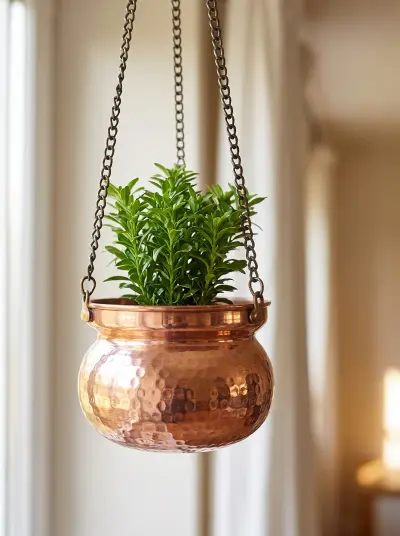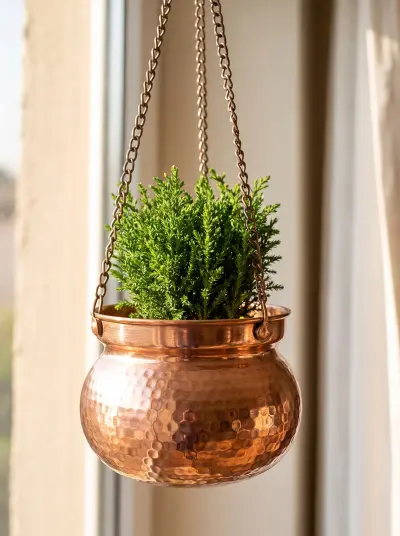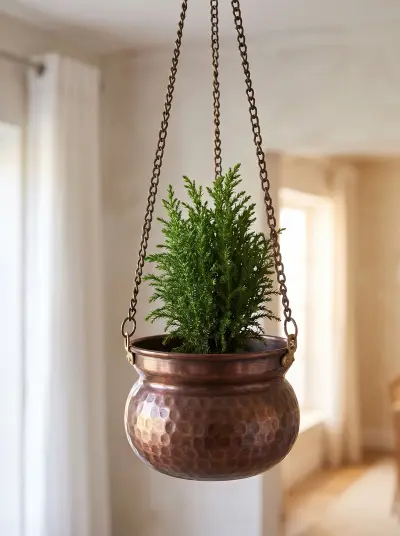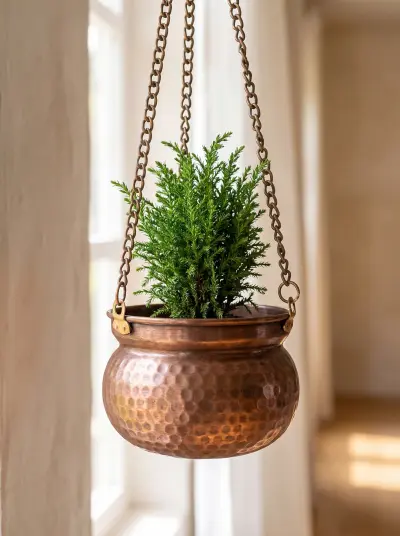
Kabak Copper Planter — No. 3, 17 cm, hand-hammered, oxidised
TC50004-3
Wholesale copper planters and vases from Turkey: Kabak and Bahar sizes, cachepot use, vase liners, finishes and project specs for designers, by quote list.
Browse the range, add the pieces you need to your quote list and ask for prices in one message. No account, no online prices.
Wholesale copper planters and vases are chosen by series, size, set and finish: hand-hammered Kabak planters from 10 to 20 cm, smooth Bahar planters from 8 to 14 cm, and Güldane, Armağan and Sümbüllü vases. Use planters as cachepots with an inner pot, put a liner in vases for fresh flowers, and price each stock code in a written quote.
The catalogue lists 23 copper planters, all shown in stock as of November 2026, and 9 copper vases, of which 4 are shown in stock. Planters come in two series with different surfaces, so the first decision is the look: hand-hammered texture or a smooth body.
The copper planters category holds the Kabak series (hand-hammered, four sizes and three sets) and the Bahar series (smooth, three sizes and a set of 3). The copper vases category holds the Güldane, Armağan and Sümbüllü lines and a plain 15 cm vase. Both sit inside the wider copper home decor range. The table below uses the gauge and weight listed for each stock code; the size in centimetres is the size given in the product name, so ask in the quote request whether it refers to height or diameter before you plan inner pots.
| Stock code | Piece | Size, gauge | Listed weight |
|---|---|---|---|
| TC50005-1 | Bahar planter No. 1, smooth, polished copper | 8 cm, 0.70 mm | 110 g |
| TC50006-1 | Bahar planter No. 2, smooth, polished copper | 10 cm, 0.70 mm | 220 g |
| TC50007-1 | Bahar planter No. 3, smooth, polished copper | 14 cm, 0.70 mm | 375 g |
| TC50010-1 | Kabak planter No. 1, hand-hammered, polished copper | 10 cm, 0.70 mm | 290 g |
| TC50011-1 | Kabak planter No. 2, hand-hammered, polished copper | 15 cm, 0.60 mm | 380 g |
| TC50004-1 | Kabak planter No. 3, hand-hammered, polished copper | 17 cm, 0.60 mm | 450 g |
| TC50012-1 | Kabak planter No. 4, hand-hammered, polished copper | 20 cm, 0.50 mm | 630 g |
| TC50022-1 | Güldane vase, hand-hammered, polished copper | 25.5 cm high, 15 cm diameter, 0.50 mm | 650 g |
| TC50020-3 | Armağan vase, smooth, oxidised | 18 cm, 0.50 mm | 348 g |
| TC50021-1 | Copper vase, smooth, polished copper | 15 cm, 0.45 mm | 352 g |
Every planter above also exists in oxidised, with the suffix -3 in place of -1 (for example TC50012-3), at the same listed gauge and weight except Bahar No. 1 oxidised (TC50005-3, 115 g). The Güldane vase is also listed oxidised as TC50022-3. The Sümbüllü vase (TC50019-1, -2 and -3, 480 g, 0.70 mm) and the Sümbüllü handled vase (TC50018-1 and TC50018-3, around 500 g) are not shown in stock; they can still go on a quote list, and the reply says whether they can be produced for your order.
Copper has a density of 8.96 g/cm³, so at the same gauge a larger piece gains weight quickly. That is why the 20 cm Kabak No. 4 (630 g) weighs more than twice the 10 cm No. 1 (290 g), even though it is made from thinner sheet, 0.50 mm against 0.70 mm. For a retailer, weight is a shipping and shelf-load figure; for a designer, it tells you whether a piece will stay put on a windowsill or a reception desk.
Treat a copper planter as a cachepot: an outer decorative pot that holds a plant still growing in its plastic or terracotta nursery pot. The catalogue lists no drainage hole for any planter, so assume there is none and confirm it per stock code in the written quote rather than drilling or promising one to customers.
Planting directly into copper creates two problems. Without drainage, water collects at the bottom and roots sit wet. And damp soil against the metal tarnishes the interior and can form green deposits at the waterline. An inner pot avoids both: the plant drains into a saucer or a layer of gravel inside the copper, and it can be lifted out for watering at the sink.
Plant shops and florists can sell the plant and the copper planter together, with the plant still in its nursery pot.
Pick a copper planter whose inner opening is a little wider than the top rim of the nursery pot, so the pot drops in and lifts out freely; nursery pots are usually sold by that rim diameter. Before you build an assortment around plant sizes, ask in the quote request for the inner opening diameter and the inner depth of each planter you intend to stock. Then pair each copper size with the plant pot size you buy most.
A useful method for a garden centre or florist:
Small Bahar sizes at 8 and 10 cm suit succulents, cacti and small cuttings sold at the till. The Kabak No. 3 and No. 4 at 17 and 20 cm suit medium houseplants on a floor-standing shelf or a reception counter.
Copper reacts with moisture and air, so any planter or vase that sees water will change colour over time. Polished copper darkens towards brown, and where water stands or splashes, a green layer known as verdigris can form. Customers read this change as a fault unless they are told about it first, so put it on the care card.
The change shows first in three places: the inside base where water collects, the waterline of a vase, and the outside where drips run down after watering. An inner pot and a saucer keep most water away from the metal. For vases, a liner does the same job.
Lacquer is the other question to settle in writing. A clear lacquer slows tarnish on decorative copper, but the catalogue has no lacquer field, so ask in the quote request whether a given stock code is lacquered or can be. Lacquer suits pieces that are handled rarely and kept dry; once scratched, it lets tarnish spread under the film in patches. Our guide to copper surface finishes explains where lacquer works and how natural patina differs from an applied antique finish, and copper care and service life covers cleaning for the end customer.
Copper planters can stand outdoors, but outdoor weather changes the surface far faster than indoor use. Rain, humidity and air pollution darken polished copper much sooner than indoor air does and, over a longer period, can turn it green. A buyer who places copper outside should choose the finish and the setting with that change in mind.
| Setting | What happens to the copper | Finish that fits |
|---|---|---|
| Indoor, dry shelf or desk | Slow darkening, little or no green | Polished copper or oxidised |
| Indoor, near a sink or in a bathroom | Darkening plus spots from splashes | Oxidised |
| Covered terrace or winter garden | Faster darkening, green at drip lines | Oxidised |
| Open garden, balcony or roof terrace | Full weathering towards brown and green; rain collects inside if there is no drainage hole | Oxidised, only with an inner pot raised on gravel and emptied after rain |
For an outdoor project, show the client a weathered surface rather than the bright catalogue photo, so the change is agreed before installation. Without a confirmed drainage hole, rainwater stays in the copper, so empty it after heavy rain; in cold climates, bring the planter under cover before frost, because water frozen at the base can press on the copper wall.
For fresh flowers, place a glass or plastic liner inside the copper vase and put the water in the liner. Water standing in an unlined copper vase tarnishes the interior, can leave green deposits at the waterline and makes the vase harder to clean between arrangements.
The Güldane vase, at 25.5 cm high and 15 cm in diameter, is the largest vase listed and the natural choice for a lobby table, a reception desk or a florist's window. The Armağan vase at 18 cm and the 15 cm copper vase suit table arrangements in restaurants and smaller gifting. When you plan liners, ask in the quote request for the inner opening of each vase; a liner that fits the opening tightly is harder to lift out, so leave a little clearance.
Florists who sell vases with arrangements can keep a stock of plain liners in two or three sizes and pair each copper model with one of them. That way the shop sells the copper vase as a reusable piece and the customer refreshes flowers in the liner without touching the metal.
Sets sell as finished gifts and singles let customers build their own group, so most stores carry both. The planter range is built for this: the Kabak series comes as a set of 3 (Nos. 1–3, TC50009-1), a second set of 3 (Nos. 2–4, TC50013-1) and a set of 4 (Nos. 1–4, TC50014-1), and the Bahar series as a set of 3 (TC50008-1). Ask in the quote request for the weight and box size of each set, because the listed weight on the set lines does not describe the full set.
A worked example for a home and garden store opening a copper display:
Placing the hammered Kabak beside the smooth Bahar also explains handwork without a sign. If customers ask how the texture is made, our guide on hand-hammered versus machine-pressed copper gives you the honest wording. For the wider gift shelf, including food-contact pieces and labelling, see copper home and gift assortment for stores; for a decor shelf built around candles, the companion guide on wholesale copper candle holders and decor covers that side, and wholesale copper incense burners covers the fragrance side.
A project specification fixes the stock code, finish, quantity per area and a reference piece, so that every planter installed matches the approved sample. For hotels, offices and restaurants, planters and vases are usually part of the decor or FF&E package, and they should be scheduled with the same detail as furniture.
Count quantities per area, not per building. Walk the drawings room type by room type and write down where each planter or vase goes, then multiply by the number of identical rooms or tables.
| Schedule field | What to write | Why it matters |
|---|---|---|
| Stock code | Full code with suffix, for example TC50011-3 | The suffix fixes the finish |
| Location and quantity | Area name, pieces per area, number of areas | Totals stay traceable to the drawings |
| Inner pot or liner | Pot size or liner type for each piece | Prevents planting into copper on site |
| Reference piece | Approved sample kept by the designer or owner | Basis for checking delivery and reorders |
| Spares | A small reserve beyond the counted total | Covers dents and later additions |
An illustrative example: a boutique hotel with 40 identical rooms, a lobby and a restaurant might schedule one Bahar No. 2 on each room desk (40), two Kabak No. 4 at the lobby entrance, a Kabak set of 3 on the reception counter, and one Armağan vase on each of 20 restaurant tables, plus a small reserve of each line. The quantities are an illustration, not a minimum; your own layout sets them.
Hand-hammered texture and the depth of an oxidised finish vary slightly from piece to piece and between production runs. For one project, order the full quantity of each line in a single order, approve a sample before production, and keep one approved piece as the reference for delivery checks. If the project opens in phases, say so in the quote request so the written quote can address whether the phases can come from one run.
Hotel buyers can follow the same steps they use for tableware; our hotel OS&E copper procurement guide covers sample approval, labelling by outlet and opening schedules, and the wholesale copper kitchenware supply page explains how written quotes, lead times and shipping are handled for mixed orders.
Choose polished copper for a bright, warm look in dry indoor spaces, oxidised for damp, outdoor or high-handling settings, and brushed matt when you want a quieter surface. All planters are listed in polished copper and oxidised; brushed matt is listed only on the Bahar set of 3 (TC50008-4). Among vases, nickel-plated is listed only on the Sümbüllü vase TC50019-2, which is not shown in stock.
Polished copper shows the metal at its brightest and photographs well for retail, but it shows fingerprints and water spots first and darkens unless it is polished from time to time. Oxidised copper starts dark, so further darkening and handling marks show far less; it is the low-maintenance choice for hotel rooms, terraces and hire stock. Brushed matt sits between the two and reads as contemporary in an office or a minimal interior.
For a retail shelf, two finishes per line is usually enough: one bright, one dark. For a project, choose one finish per area and write it into the schedule, because a guest notices one polished planter among oxidised ones far more than any difference in size.
Build the quote list by stock code, finish and quantity, add the questions this guide raised, and send it to the supplier in Turkey by WhatsApp, e-mail or form. The written quote returns the wholesale price, minimum quantity, lead time and shipping for that order; no prices are shown online.
If this is your first order from Turkey, the first wholesale copper order guide walks through payment, samples and shipping step by step. If you are building a decor business around copper, starting a copper import business covers channels and landed cost, and UK buyers can check duty and market notes on the United Kingdom market page.
Yes, if the herbs stay in their own nursery pot and the copper works only as the outer cachepot. The soil and the leaves then never touch the copper, and the pot can be lifted out for watering and swapped when the herb is cut back. Planters are decorative pieces, not food-contact items, so do not plant herbs straight into the copper or use it to hold food.
Yes, dried arrangements are the easiest use for a copper vase because there is no water inside, so the interior does not tarnish or form green deposits. Check the opening diameter in the written quote against the stems you plan to use. Tall, light stems such as pampas grass can tip a narrow vase, so weigh the base with sand or pebbles in a bag.
Partly, and usually not evenly. The oxidised finish is an applied darkening of the surface, so a polish removes it first from the high points and leaves the recesses dark. On hand-hammered Kabak planters that gives a two-tone look some customers like, but the result cannot be matched to a polished copper piece. Order the finish you want to sell rather than converting stock later.
It can, mainly through moisture. Water that runs out of the inner pot, or condensation under a cold planter, collects at the base and can mark wood, stain marble or leave a green ring. Use a plastic saucer inside the planter or felt pads under it, and wipe the base dry after watering. Tell hotel housekeeping teams this before the planters go into rooms.
It can be asked for, but an unlisted finish, such as nickel-plated or brushed matt on a single planter, is a production request rather than a stock item, so ask for it by stock code and target finish in the quote request. The written quote then says whether it can be made, the minimum quantity and the extra lead time.
They suit hire stock when the kit is built for repeated use. Keep one finish per kit so mixed returns still match, pack each nesting Kabak set as one unit with a cloth between the pieces, and include inner pots so venues never plant into the copper. On return, check each piece for dents and standing water, and dry it fully before it goes back into the box.
Other guides covering the same stage of the buying process - continue reading here.
Copper hammam bowl (hammam tas) wholesale from Turkey for spas and hotels: real sizes and finishes, sauna buckets, foot baths, wet-area care and a quote list.
Copper candle holders wholesale from Turkey: real stock codes, candle fit, finishes, wax care, fire safety and seasonal assortments for retail and hotel buyers.
Build a copper home and gift assortment for your store: which families to open with, stock status, finish variants, food-contact labels, packaging, care cards.
Add the products you need to your quote list with quantities and send it by WhatsApp, e-mail or the form. We reply with unit prices and delivery terms.