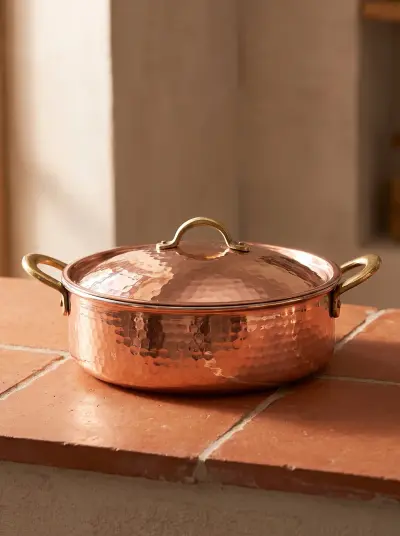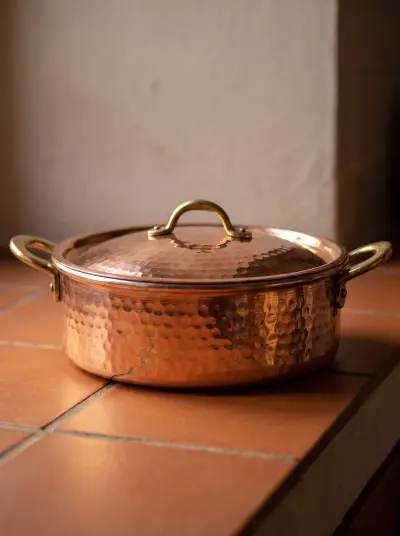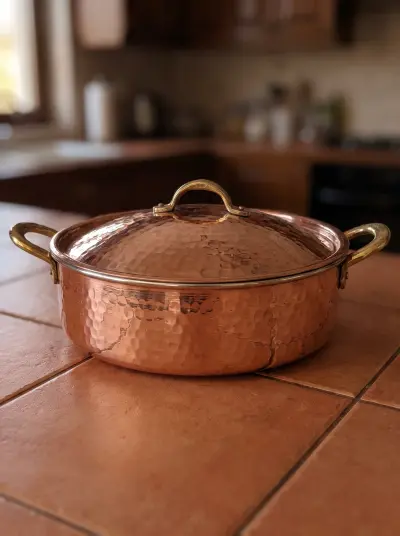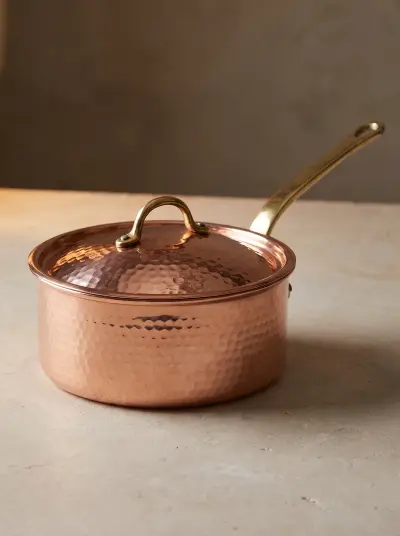
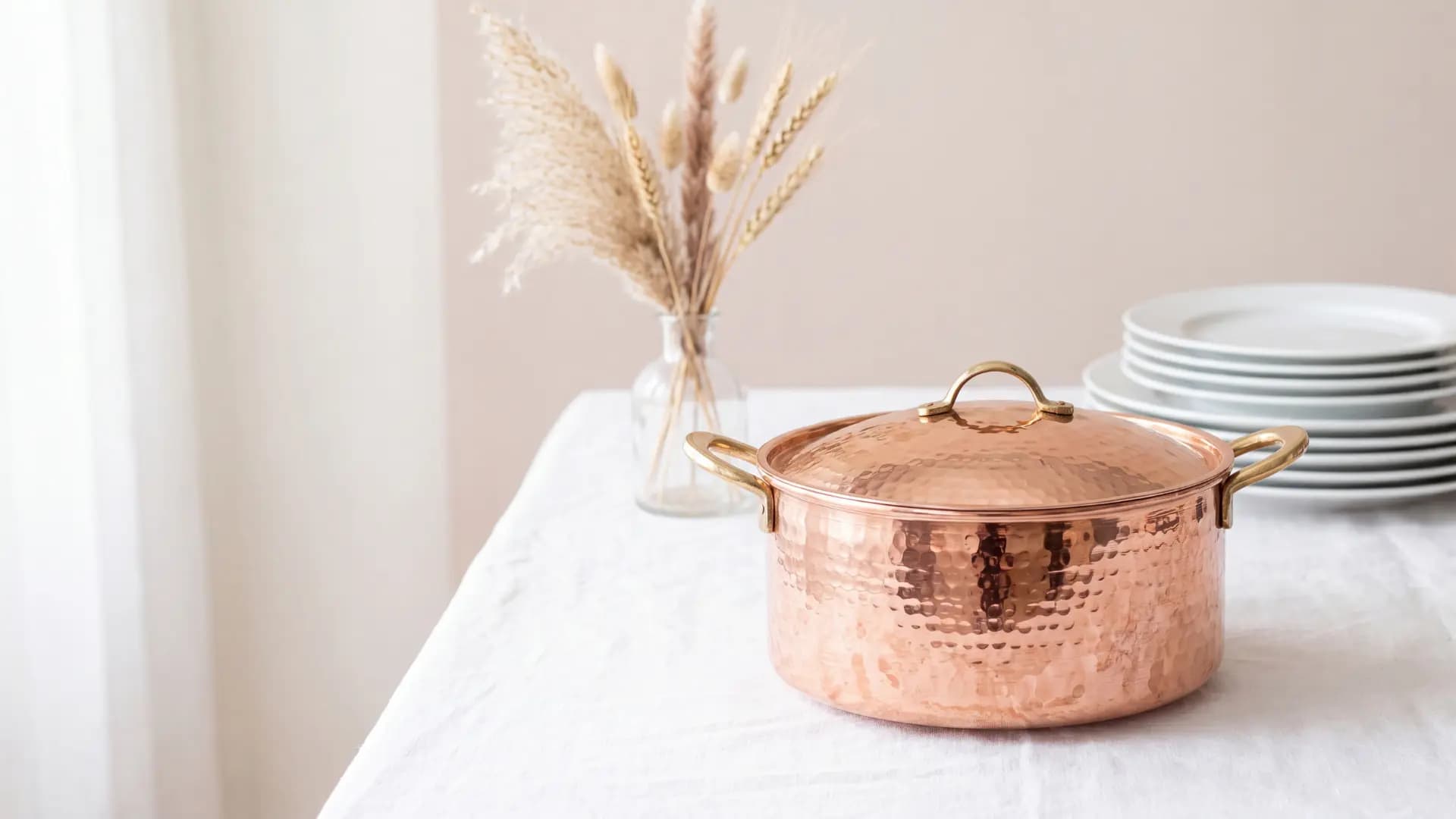
Copper Saucepan — No. 5, 26 cm, hand-hammered, polished copper
TC10083-1
How to buy wholesale copper pots, frying pans and Turkish tea kettles from Türkiye: sizes, sheet gauge, lining, finish, price drivers and one RFQ for all three.
Browse the range, add the pieces you need to your quote list and ask for prices in one message. No account, no online prices.
Wholesale copper pots, frying pans and Turkish tea kettles are ordered best on one list, with diameter, sheet gauge, finish and lining written on every line. The Coppery's catalogue holds 49 copper pots, 50 frying pans and 23 Turkish double teapot sets from Türkiye; the price comes back per line, for your quantities.
Most buyers who ask for wholesale copper cookware are not buying one item. A restaurant opening a Turkish or Middle Eastern menu needs pots for the line, small pans for eggs and sizzling dishes, and a tea service for after the meal. A hotel needs braising pots for banqueting, pans for the breakfast station and tea kettles for the breakfast room. A kitchen shop or an importer wants all three on the shelf because customers buy them together.
Ordering the three groups on one list has practical benefits:
The rest of this guide goes through each group, then sets out what drives the price and how to write the quote list. For Turkish coffee pots, which have their own size system, see the cezve sourcing guide.
The copper pots category lists 49 pots, all in stock and all hand-hammered according to their product names. Three large lines carry most of a kitchen order, and two small lines cover table service.
| Line | Sizes | Diameter | Typical use |
|---|---|---|---|
| Casserole Pot | 11 sizes | 16 to 36 cm | Stews, sauces, rice |
| Rondeau | 11 sizes | 16 to 36 cm | Searing and braising |
| Low Single-Handle Pot | 11 sizes | 16 to 36 cm | Line cooking, small batches |
| Maraş Casserole | 3 sizes | 18 to 22 cm | Cook and serve at the table |
| Mini Casserole | 3 sizes and a set of 3 | 12 to 14 cm | Single portions, meze |
The three large lines step up in 2 cm increments. That is what makes them suitable for wholesale: a buyer can take a nested run of diameters from one line and get the same shape, handle and gauge across every size. A retailer can sell the same run as single pieces or as a set.
Capacity is listed for 36 of the 49 pots and runs from 450 ml to 7000 ml. Weight runs from 260 g for the smallest pots to 2583 g for the largest. Order by diameter in centimetres, not by number: numbering is not identical across lines, and two pots in one line can share a number.
Seven pots, the Maraş and Mini casseroles, are also offered nickel-plated. The silver tone suits hotel tableware where other plated metal is already in use.
The frying pans category lists 50 pans in seven model lines, all polished copper and all in stock. Five lines start at 14 cm and step up in 2 cm increments, so the same diameters are available in different surfaces and gauges. Diameters run from 14 to 27 cm.
That overlap is useful when you build a range. A breakfast café usually takes 14 to 18 cm pans from one hand-hammered line, because eggs are cooked and served in the same pan. A hotel breakfast station takes heavier pans of 18 to 22 cm. An importer often offers two lines in the same sizes as a good and better tier.
Three facts from the catalogue matter for the order:
For deeper stir-fry pans, the separate wok category holds the Ziyafet series in eleven diameters from 16 to 36 cm.
A Turkish double teapot, or çaydanlık, is the tea kettle used in Turkish tea service. It is a stacked pair: a larger kettle boils the water below, and a small teapot on top brews a strong tea concentrate that is diluted in the glass. In English listings the same item appears as Turkish copper tea kettle, Turkish double teapot or Turkish tea set.
The Turkish double teapots category lists 23 copper sets, of which 20 are in stock. Four lines define each set in a quote:
| Line | Options |
|---|---|
| Size | No. 1, No. 2, No. 3 |
| Gauge | Light or heavy |
| Finish | Nickel-plated, polished copper, oxidised |
| Set | Kettle and teapot, or set with a copper warmer |
Seven sets come with a warmer that keeps the brewed tea hot during service; tea houses and hotel breakfast rooms usually choose these. Capacity is not listed for this line, so ask for the kettle and teapot volume of each size in the reply. Where a sheet thickness is listed, it is 0.80 mm.
Before you compare quotes from several suppliers, check one thing: is the top teapot included? A single tea kettle without the teapot is a different, cheaper product, and a quote for it is not comparable with a quote for a full set.
Buyers placing a first wholesale order often ask how many lines to start with. A narrow range from a few lines is easier to reorder and to check on delivery than one piece from every line. The table below shows typical starting points; adjust them to your menu and your space.
| Buyer | Pots | Frying pans | Tea kettles |
|---|---|---|---|
| Restaurant | One large line, 4 to 6 diameters | 14 to 18 cm, one line | No. 2 sets for after-meal service |
| Hotel | Rondeaus for banqueting, Maraş for the buffet | Heavier gauge, 18 to 22 cm | Sets with warmer for the breakfast room |
| Kitchen shop | Mini casserole sets | Sets of three | Light gauge in all three finishes |
| Importer | Two lines at different gauges | Two lines in the same sizes | No. 1 to No. 3 in one finish |
A second order is then built from what sold, not from what was guessed.
Gauge is the thickness of the copper sheet in millimetres. It is the figure with the strongest effect on price, because copper is sold by weight and a heavier sheet means more metal in every piece. It also decides how long a pot or pan survives daily commercial use.
| Group | Gauge in the catalogue | For daily commercial use | For retail and table service |
|---|---|---|---|
| Pots | 0.50 to 1.00 mm | 0.80 to 1.00 mm | 0.50 mm |
| Frying pans | 0.50 to 1.30 mm | 1.00 mm and above | 0.60 to 0.70 mm |
| Tea kettles | Light or heavy | Heavy | Light |
A heavier sheet resists dents, holds its shape over years on a gas ring and spreads heat more evenly. A lighter sheet heats faster, weighs less in the hand and keeps the shelf price accessible. Neither is better in general; the right choice depends on how often the piece will be used. Our wall thickness guide shows how to write gauge into a specification so that it can be checked on delivery.
Write gauge on every line of the quote list as a number. A word such as heavy or professional means different things to different workshops.
Copper that touches food is normally lined on the inside. Tin is the traditional lining in Türkiye: it is applied by hand, it is food-safe, and it melts at about 232 °C, which is why a tinned pot or pan must never be heated empty. Tin wears over years of daily use and can be renewed. Stainless steel lining lasts longer but changes the cost and the way the piece is made. Our guide to tin versus stainless lining compares the two.
In this catalogue, the interior lining is not a separate data field; it is stated only where the product name says tinned. Ask for the lining of each line to be confirmed in writing in the quote. If your market has food-contact rules, ask also for the documents the workshop can provide for that lining.
The outside finish is a separate question. Polished copper is the bright traditional look and darkens with use unless it is cleaned. Nickel plating gives a silver tone. Oxidised copper has a darker, aged surface that hides fingerprints and heat marks well on a busy counter.
Induction is the other question kitchens ask. Copper is not magnetic, so a plain copper pot or pan does not work on an induction hob. Our induction guide explains the options.
The Coppery does not publish prices. Wholesale prices for copper cookware are built from five inputs, and every one of them is a line on your list:
Our guide to MOQ, price and lead time explains how these inputs combine, and the wholesale copper cookware sourcing page covers landed cost, Incoterms and supplier checks.
A quote list that a supplier can price in one pass has the same fields on every line. Use this order:
Then add three facts about the order: your country, your hob type if you need induction, and any branding or packaging note. Add the products to the quote list and send it by WhatsApp, e-mail or the form. The reply gives the price per line, the minimum quantity, the lead time and the shipping terms for your order. In-stock pieces appear first in every category, so the top of each listing is what can ship soonest.
A list written this way also protects you after delivery. Each line states what was ordered in figures that can be measured, so a pot that arrives in a lighter gauge or a set without its teapot is easy to identify and raise with the supplier.
There is no single catalogue-wide minimum. Minimum quantities are set per product line and confirmed in the quote, together with lead time and shipping terms. Send the list with the quantities you actually need; the reply tells you where a line needs a higher quantity before you commit to the order.
Yes. The quote list accepts any mix of categories, lines, sizes and finishes, each with its own quantity. The reply prices every line separately, so you can see how quantity changes each one and remove or resize lines before the order is fixed.
For daily commercial use, choose 0.80 mm or heavier for pots and 1.00 mm or heavier for frying pans that stay on a hot station. Lighter gauges of 0.50 to 0.70 mm cost less and weigh less, which suits retail, gifting and table service rather than all-day cooking.
In wholesale listings the names usually describe the same set: a kettle below and a small teapot on top, known in Turkish as a çaydanlık. A single kettle without the top teapot is a different product, so ask every supplier whether the teapot is included before comparing quotes.
Copper cookware for food is normally lined, and tin is the traditional lining in Türkiye. In this catalogue the lining is not a separate data field, so ask for the interior surface of each line to be confirmed in writing in the quote, especially if your market has food-contact rules.
Not on their own. Copper is not magnetic, so a plain copper pot or pan does not trigger an induction hob. Kitchens that run on induction use an interface disc between hob and pan, or choose pieces with a magnetic base layer; confirm this per line in the quote.
Wholesale prices for copper depend on the copper price at the time of the quote, the gauge, the finish and the quantity on each line. A fixed list price would be wrong within weeks. The quote is made for your list and comes back with a validity period.
Other guides covering the same stage of the buying process - continue reading here.

Sourcing copper samovars and tea urns at wholesale: heat source, working capacity in litres, tin lining, wall thickness, tap assembly and spare part supply.
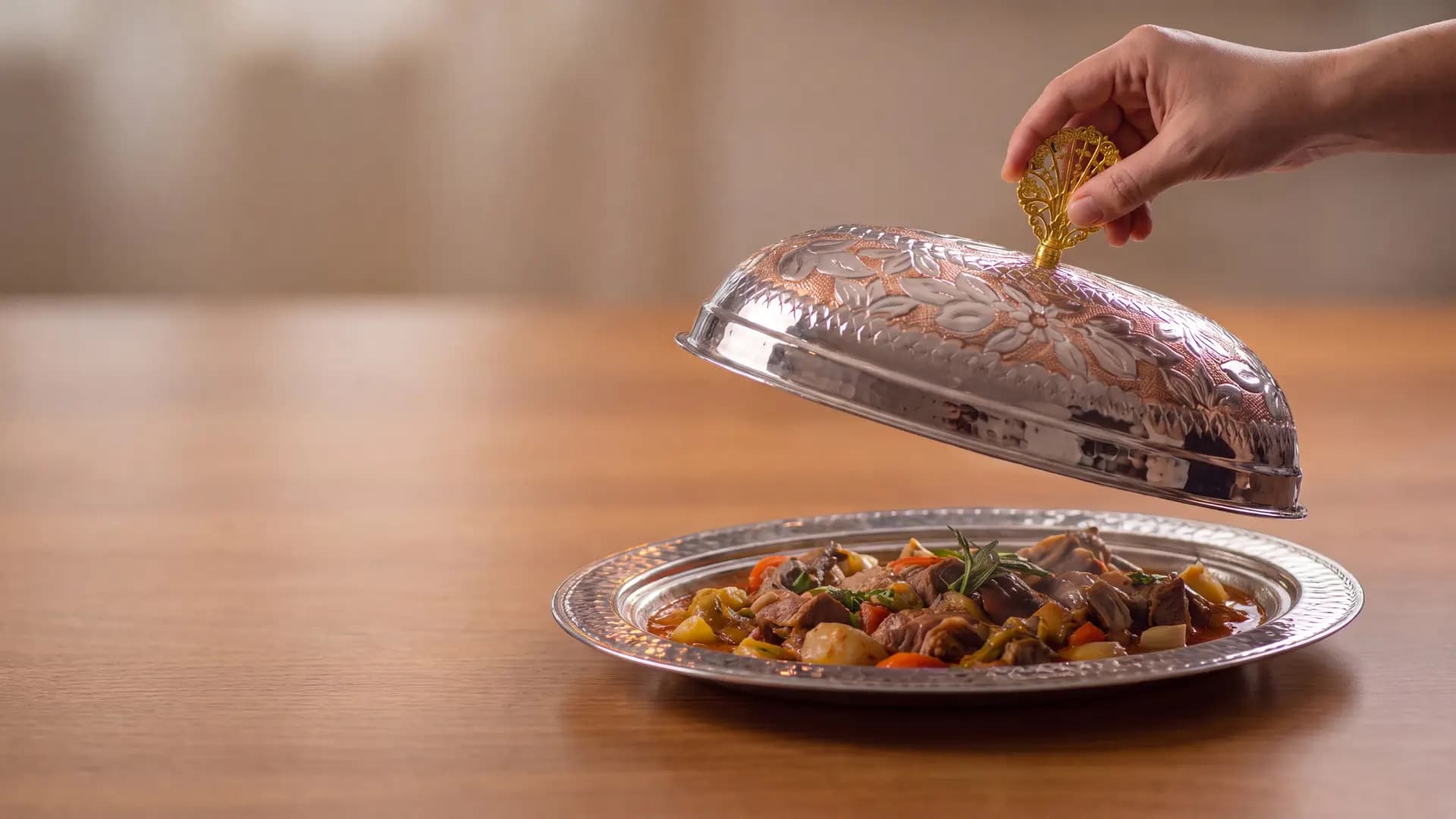
How to specify copper serving trays, chafing dish sets and mezze bowls for hospitality: telling solid copper from copper-plated stainless, lining and packing.
How restaurants choose copper cook-and-serve casseroles: mini and sharing sizes, capacity per portion, gauge, heat sources, linings, lids, handles, quantities.
Add the products you need to your quote list with quantities and send it by WhatsApp, e-mail or the form. We reply with unit prices and delivery terms.