
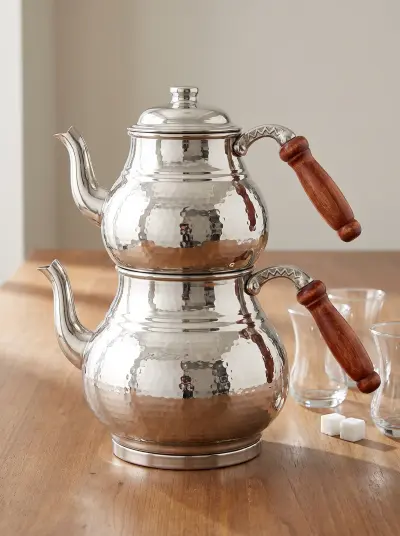
Klasik Copper Turkish Double Teapot — No. 3, light gauge, hand-hammered, nickel-plated
TC10060-2
An honest comparison of copper cookware sourcing in Turkey, India and China: craft character, batch size, customisation, logistics, compliance and landed cost.

Browse the range, add the pieces you need to your quote list and ask for prices in one message. No account, no online prices.
Choosing a sourcing country for copper cookware is not a quality ranking. It answers three separate questions: which production character you need, which batch size you buy in, and which logistics reality you live with. Turkey leads on hand work, tinning and proximity, India on catalogue breadth and low entry thresholds, China on high-volume standard output.
Sourcing conversations usually open with one line: where should we buy copper. The line looks singular but contains three independent decisions, and they can point at different origins.
Production character. Is the visible hand work the reason your customer buys, so hammer marks and a tinned interior are the product itself, or is this a standard line item where every piece must be indistinguishable from the next? Those two products do not come off the same floor and do not cluster in the same country.
Batch size. Are you buying a few hundred pieces a year or tens of thousands? Working with a supplier who accepts a low entry quantity and driving unit cost down across a long run are two different capabilities, and no manufacturer has to be strong at both.
Logistics reality. Where is your warehouse, how often do you replenish, and does a delayed shipment empty a shelf? This question has nothing to do with price and frequently decides the country on its own.
Comparing without separating the three puts non-comparable quotations side by side: three numbers quoted on different forming methods, quantities and Incoterms, with the gap read as a country difference. Most of that gap comes from the specification itself: gauge, lining and the tolerance language that goes with them.
The most honest place to start this comparison is an industry observation published by an independent quality inspection body. It reports that cold-email response rates sit around 30 to 35 percent for European and Turkish suppliers against roughly 50 percent in China, and that finding a European supplier online is markedly harder than searching a large trading platform.
That observation has to be read in both directions.
One direction is Turkey's weakness, and there is nothing to hide about it. A large share of Turkish copper workshops are small to mid-sized operations. They do not staff a multilingual export desk, they do not photograph their catalogue on a schedule, and they have little online presence aimed at a foreign buyer. None of that says anything about what they can make; it says you are unlikely to reach them. An importer searching the usual platforms often never sees the workshop that matches the production character they are looking for.
The other direction is that this gap is closeable, because it is an interface problem rather than a manufacturing one. Verified business records, a multilingual catalogue, imagery from the forming stage and a structured quotation flow remove most of the entry barrier. The geography is set out in the guide to Turkey's four copper clusters, The Coppery's own range is in the catalogue, and the verification discipline is set out in how to verify a copper supplier.
The table below is not a quality ranking. Each row describes which way of working is common in that country, and every country holds workshops that sit outside the pattern.
| Axis | Turkey | India | China |
|---|---|---|---|
| Production character | Hand work and forging alive, workshop scale dominant | Broad hand-work base, large workshop network | Predominantly mechanised series production |
| Tinning tradition | Living trade, relining capacity available | Widespread, varies by region | Limited, alternative linings more common |
| Catalogue breadth | Deep on cookware and service | Very broad, decorative weighted | Very broad, copper often a side line |
| Batch flexibility | Comfortable in mid-sized runs | Low entry threshold, wide range | Most efficient at high volume |
| Customisation | Flexible on sizes, forms and handles | Flexible on sizes and decoration | Strong on repeatable tooled work |
| Europe logistics | Road and short sea, groupage common | Sea led, long transit | Sea led, very high sailing frequency |
| Documentation culture | European export practice established | High export volume, practice varies by workshop | Largely standardised through platforms |
The single sentence to take from the table: three countries do the same job with different economics. Turkey's edge is a living craft base and distance; India's is catalogue breadth and a low entry threshold; China's is scale and repeatability. None of these is the absence of the others.
The tinning row deserves particular attention, because it defines the food-contact surface of a copper pan. Tin melts at 232 degrees Celsius, so a tinned vessel will need relining at some point in its service life. That is a property of the metal rather than a defect, but it has a procurement consequence: the trade that applies the lining has to be alive somewhere in your supply chain. Sourcing from a cluster where tinners still train apprentices means the relining service will still be findable years later.
Minimum order quantity in copper is set by the forming method, not by the border. A stock item carries a typically low threshold; an item needing a dedicated die, a bespoke dimension or a printed logo sits markedly higher, because set-up cost is divided across the run. That mechanism is identical in all three origins. What changes is where flexibility is easier to find.
Turkey's real advantage on this axis is the middle of the range: mixed orders of a few hundred to a few thousand pieces across several lines fit workshop scale well, and the sample loop is short. The same order becomes an awkward job on a long series line. On a single standard item in the tens of thousands the table inverts and Turkey's scale advantage is limited. Saying that up front is better than learning it through a delayed shipment.
In contract and private-label work the decisive factor is not the country but the workshop's sample discipline: how many rounds it takes to read the brief correctly, how faithfully the approved sample survives into production, and how tooling ownership is defined. That whole subject is covered in the OEM and contract copper manufacturing guide, and the line structure sits under the contract and private-label heading of the catalogue. How quantity, price and lead time set one another is covered in MOQ, pricing and lead times in copper cookware.
Reading logistics as kilometres alone is misleading. Four variables decide it: transit time, route diversity, groupage availability and sailing frequency.
Turkey's proximity to Europe and the Middle East pays off on three of the four. Road and short-sea routes run in parallel, groupage is an ordinary service rather than an exception, and that combination makes regular replenishment possible without filling a full container. The practical result is that a buyer working with small, frequent shipments can hold less stock.
The Far East picture is different but not automatically worse. Sailing frequency is high, line capacity is large, and on full container loads the freight component per unit falls. Against that, transit is long and the planning horizon stretches, so correcting a mistake costs a shipping cycle. In copper this matters more than in most categories, because the product is heavy and dent-prone: as the route lengthens, packaging quality converts directly into damage rate. Packing and container planning are detailed in the copper export packaging and container guide.
For food-contact copper, compliance obligations attach to the destination market rather than the country of origin. The same pan shipped to the European Union, to the Gulf and to Russia calls for three different document sets, and those sets do not change because the maker sits in a different country. So the right question in a country comparison is not which origin is compliant, but which workshop has already prepared the dossier your destination market asks for. The general map is in the food-contact copper compliance guide; the binding obligation is always confirmed with your own customs broker.
What genuinely differs between origins is documentation culture: how quickly a request is understood, how test reports are kept, and how complete the shipping file arrives. This tracks scale rather than nationality. Manufacturers working through large platforms have standardised paperwork flows; small workshops keep it person-dependent, which puts more follow-up on the buyer.
The most common mistake in a country comparison is lining up three ex-works prices and taking the lowest. The comparable figure is the cost of the goods once they are in your warehouse, and it has at least six components: unit price, freight and insurance, customs handling, rework found at goods-in, unsellable or returned pieces, and the hours your team spends on correspondence.
The last two never appear on an invoice and are entirely real. On a long transit an acceptance failure slips into the next cycle; on a short one the same failure is corrected within weeks. Equally, the difference between a specification settled in three emails and one settled in fifteen is measured in buyer time. How the cost stack is assembled, and which declared data drives it at customs, is walked through in HS codes and landed cost in copper imports.
One caution about price itself: copper is an exchange-traded commodity, so the metal component of every quotation follows the same world price in all three origins. The difference between countries comes from labour, scale and logistics rather than from the metal. That is why no fixed percentage gap can be quoted, while reading a quotation as metal plus workmanship always can.
| Order profile | Binding constraint | Look here first |
|---|---|---|
| Boutique hotel opening, mixed lines, a few hundred pieces | Lead time and mid-range flexibility | Turkey |
| Single SKU, tens of thousands, standard form | Unit cost and exact repeatability | China |
| Broad decorative catalogue, low entry batch | Catalogue breadth and low threshold | India |
| Tinned cookware line with recurring relining | A living tinning trade | Turkey |
| Private label, printed logo, mid-sized run | Sample discipline and tooling terms | Turkey or India |
| Frequent small replenishment into Europe | Transit time and groupage | Turkey |
Read the right-hand column as a starting order for collecting quotations, not as an instruction. Lining choice on tinned cookware is a decision in its own right and is covered in tin versus stainless lining; the choice between hand work and pressing is a forming decision taken independently of origin.
Risk grows when the country decision is framed as one-off and irreversible. Three practices bring it down.
A trial order. The test is representativeness, not quantity: the batch should include at least one item covering every forming method, every lining type and every packaging format the production run will use. A single-item sample says nothing about consistency.
Dual sourcing. Placing high-volume standard lines where scale is cheapest and hand-worked or tinned lines with a nearshore supplier protects unit cost and replenishment speed together. The same structure means a disrupted route slows supply rather than stopping it.
Staged growth. Rather than committing the full target volume on the first order, increasing across the second and third runs tests a capacity claim against actual production. The gap between a stated capacity and delivered units only becomes visible on repeat business.
All three rest on one principle: the country is an opening filter, not the decision. The decision is made by comparable quotations gathered against one specification. How those are collected on the Turkish side is defined in the buyer request flow, and the cookware line structure is visible in the cookware category.
TC10060-2

TC10055-4
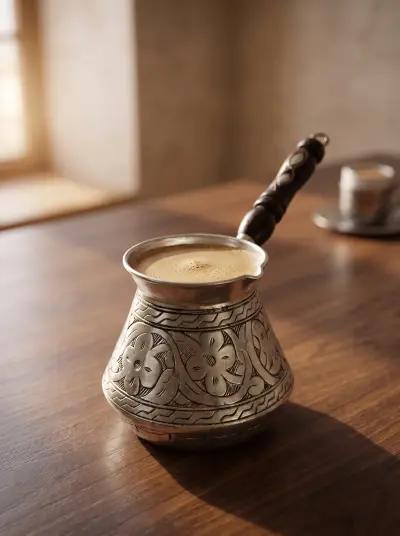
TC10055-6
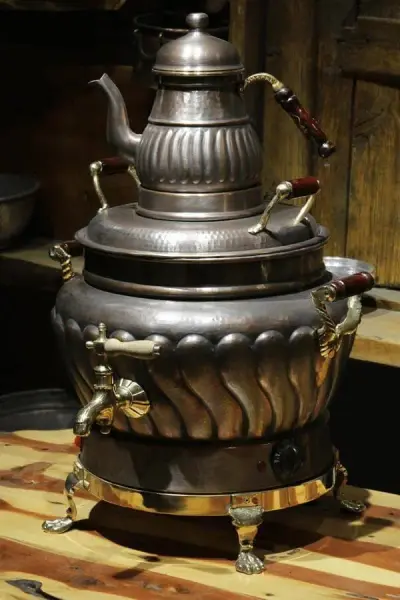
TC10076-3
The question cannot be answered at country level, because quality is set by the workshop and the specification rather than the border. All three origins hold workshops working at the top of the market and workshops working to a price. What does differ by country is character: which forming methods are common, which batch sizes are natural, which shipping routes run. Gauge, lining and sample approval decide quality.
In mid-sized, mixed-line orders that involve hand work or tinning and ship to Europe or the Middle East. Proximity shortens transit and makes groupage practical, so buyers can replenish frequently without filling a container. Tinning survives as a working trade rather than a heritage claim, so relining capacity actually exists. On very large single-SKU standard runs the scale advantage is limited.
Two places. Scale first: on tens of thousands of identical units the unit-cost curve struggles against high-volume manufacturing hubs. Visibility second: many Turkish copper workshops are small to mid-sized, keep no multilingual sales desk and maintain little online presence, so finding and verifying them through directories takes noticeably more buyer effort than searching a large trading platform.
If your line card is mixed, splitting is usually healthier. Placing high-volume standard items where scale is cheapest and hand-worked or tinned items with a nearshore supplier protects unit cost and replenishment speed at the same time. A two-source structure also means a disruption on one route slows supply rather than stopping it.
No. The comparable figure is landed cost, not ex-works price: freight, insurance, customs handling, packaging loss, rework found at goods-in, unsellable or returned pieces, and the buyer hours spent on correspondence. A shorter transit with lower damage rates can finish ahead on total cost even when the unit price is higher.
There is no fixed number, and the test is representativeness rather than quantity. A trial batch should include at least one item covering every forming method, every lining type and every packaging format that the production order will use. A single-item sample tells you nothing about consistency across a mixed run.
An industry observation from independent quality inspection puts cold-email response rates for European and Turkish suppliers around 30 to 35 percent against roughly 50 percent in China, and notes that European suppliers are markedly harder to find online than on large trading platforms. The cause is scale, not indifference: small workshops rarely staff an export sales desk.
Present origin as a verifiable production story rather than a marketing claim: which city, which forming method, which lining. Workshop photography, footage of the forming stage and a documented sample history carry that story. Origin claims that cannot be evidenced tend to come back at the first audit and damage the brand more than they helped it.
Other guides covering the same stage of the buying process - continue reading here.
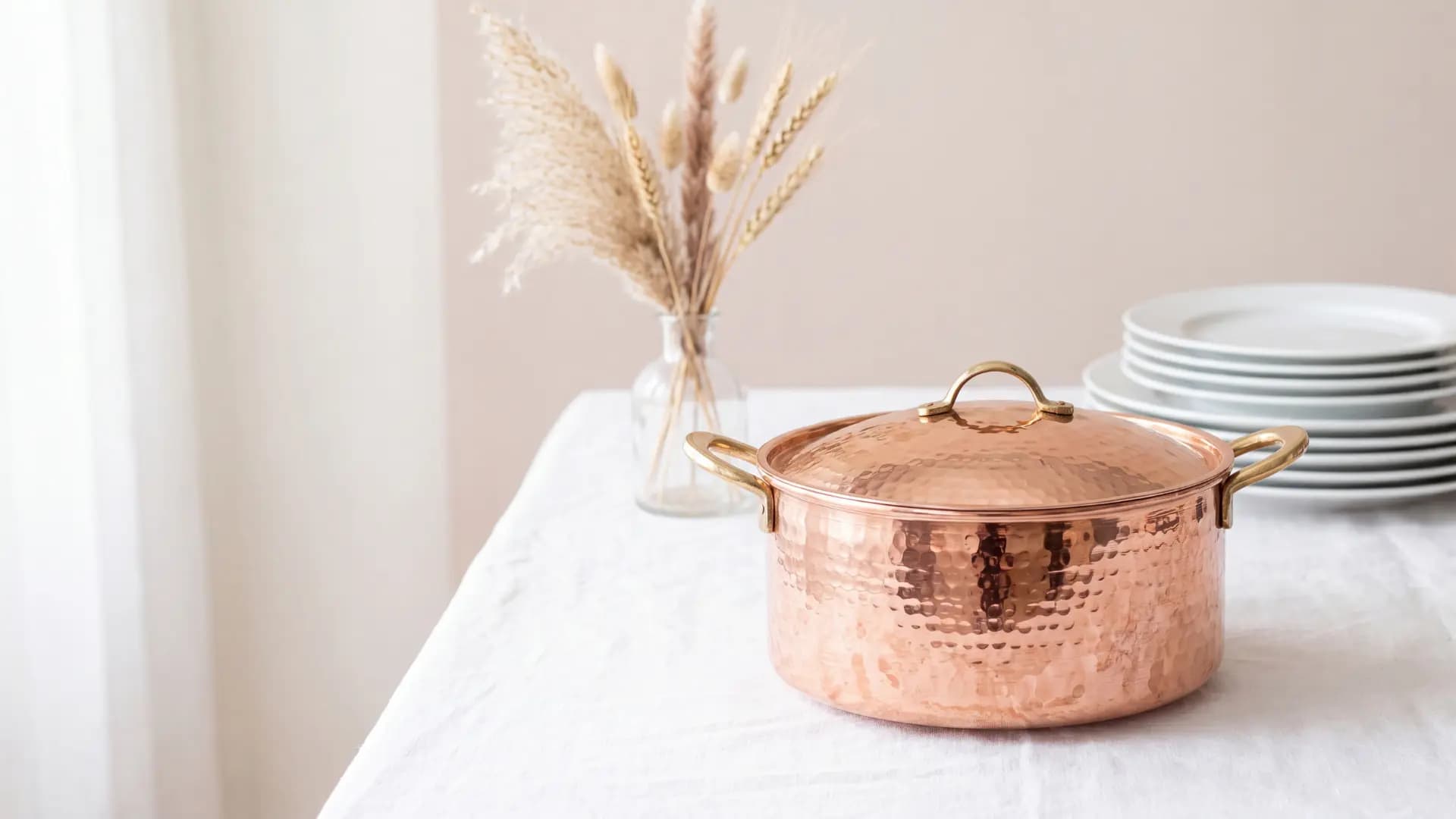
How thick copper cookware should be, where thickness is measured, why forming thins the wall, and how to write gauge and tolerance into a sourcing spec.
Which copper pan goes from stove to table: frying pan, lidded sahan, sac and wok pan or round gratin tray. Gauge, heat sources, tin limits and stock planning.

Copper, brass and cupronickel share one tariff heading but are three materials. Alloy definitions, the lead question and the spec lines that separate them.
Add the products you need to your quote list with quantities and send it by WhatsApp, e-mail or the form. We reply with unit prices and delivery terms.