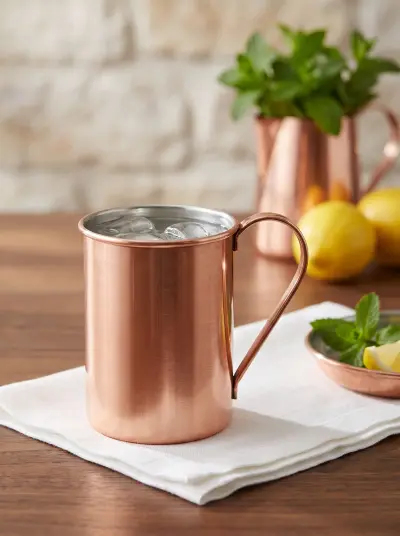
Lungo Copper Tumbler — 530 ml, smooth, polished copper
TC20020-1
How to buy wholesale copper tumblers and water cups from Turkey: capacities, smooth or hammered, finish codes, singles versus sets, care, branding, quote lists.
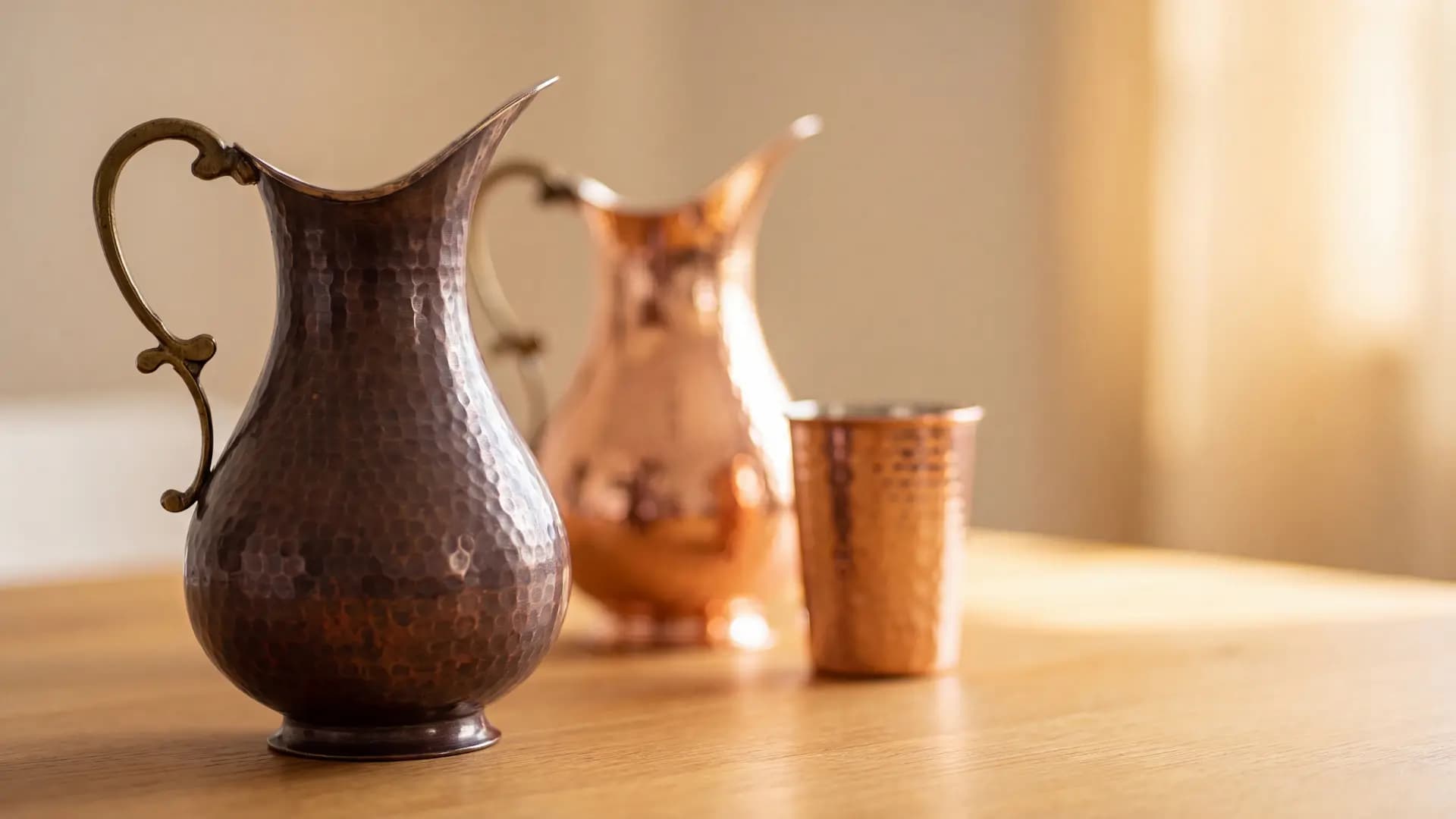
Browse the range, add the pieces you need to your quote list and ask for prices in one message. No account, no online prices.
Buy wholesale copper tumblers by stock code: choose the series and capacity, then the surface (smooth or hand-hammered) and the finish suffix, and order singles, because as of November 2026 the singles are in stock while the sets of 2, 4 and 6 are not. Use unlined copper for water only. Send the quantified list for a written quote.
The copper cups and tumblers category is the deepest in the catalogue, with 141 listings. They come from 21 base stock codes, each listed in several finishes and pack sizes, so the real choice is smaller than the count suggests: model, capacity, surface, finish and pack.
Every listing carries a stock code built the same way. The first part, TC plus five digits, identifies the model and capacity: TC20001 is the Copper Tumbler No. 2 at 450 ml, TC20005 is the Bevanda at 300 ml, TC20004 is the Debito at 600 ml. The suffix after the dash identifies the finish, and on sets it also carries the pack size. Reading the suffix correctly is the most useful skill in this category, because two listings with nearly identical names can differ only in that last digit.
| Suffix | Meaning | Example | Stock status in catalogue |
|---|---|---|---|
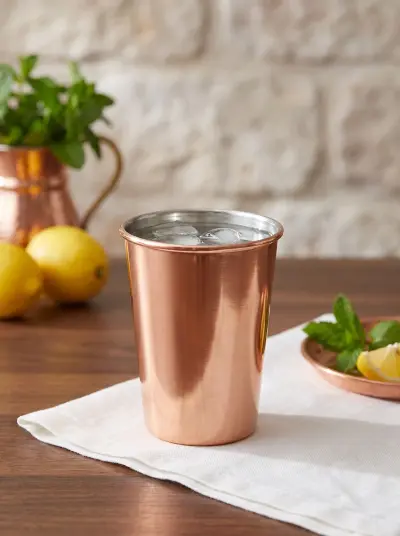
| -1 | Polished copper, single | TC20001-1, No. 2 450 ml | In stock |
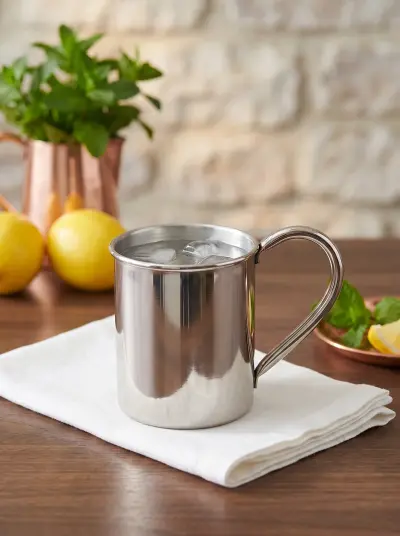
| -2 | Nickel-plated, single | TC20001-2, No. 2 450 ml | In stock |
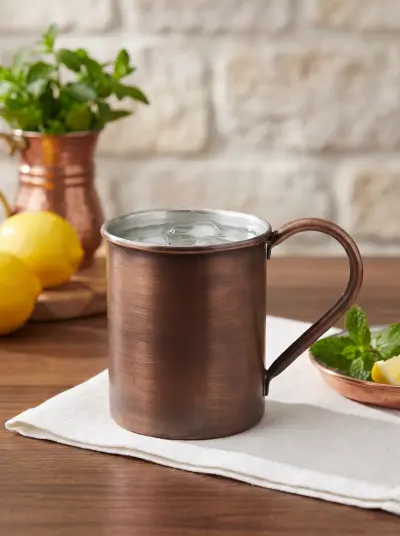
| -3 | Oxidised, single | TC20005-3, Bevanda 300 ml | In stock |
| -4 | Brushed matt, single | TC20004-4, Debito 600 ml | In stock |
| -21, -41, -61 | Set of 2, 4 or 6, polished copper | TC20001-61, set of 6 | Out of stock |
| Two-digit suffix | Set: first digit = pack size (2, 4, 6), second = finish (1 polished, 2 nickel-plated, 3 oxidised, 4 brushed matt) | TC20003-44, Luna set of 4 brushed matt | Out of stock |
The category also holds the pieces that complete a drinks offer: shot glasses at 30 ml (TC20012-1) and 40 ml (TC20009-1), the Apple cocktail cup with straw at 250 ml (TC20013-1), copper drinking straws (TC20019-1, about 27 g) and Moscow mule mugs. The mugs have their own sizing and handle questions and are covered in the wholesale copper mug guide, so this guide stays with handleless tumblers and water cups. Cups with handles sit in a separate category, copper handled cups, with models from the 100 ml Zemzem mini cup (TC20031-1) to a 300 ml hand-hammered cup (TC20029-1).
Order singles. As of November 2026, 53 of the 141 tumbler listings are in stock, and every one of them is a single piece; all 87 set listings, from sets of 2 to sets of 6, are out of stock. A set is easy to rebuild from singles of the same stock code, while waiting for a set listing to return delays the whole order.
The pattern holds across the range. The Copper Tumbler No. 2 is in stock as a single in all four finishes (TC20001-1 to TC20001-4), but its set of 6 in polished copper, TC20001-61, is not. The same goes for the Bevanda, the No. 1 at 330 ml and the Debito, each available as singles in polished, nickel-plated, oxidised and brushed matt. One single breaks the pattern, which is why stock is worth checking line by line: the Grande No. 1 at 500 ml is out of stock in polished copper (TC20017-1) while its oxidised and brushed matt singles (TC20017-3, TC20017-4) are in stock.
For a hotel or restaurant, singles are the natural unit anyway, because quantities are counted per cover, not per box. For a retailer who wants to sell a boxed set of four, the practical route is to order the singles in multiples of four and ask in the quote request whether they can be packed together as a set. Stock status changes, so treat these figures as a snapshot and let the written quote confirm availability on the day you order.
Choose 300 to 360 ml for a table water cup, 400 to 500 ml for still long drinks over ice, and the 1000 ml Grande only where a large serving is the point; juice and most cocktails are below pH 6 and need a lined interior confirmed per stock code, not unlined copper. Listed capacity is the brim-full volume, so the working pour sits well below it.
The catalogue gives height and, for some models, diameter, which matters as much as volume. A short, wide cup reads as a water cup on a table setting; a taller, narrower one reads as a long-drink glass. The table pairs real models with the use each one suits best.
| Model and stock code | Capacity and size | Wall and weight | Best use |
|---|---|---|---|
| Bevanda TC20005-1 | 300 ml, 10.8 cm high, 8.7 cm across | 0.70 mm, 156 g | Table water cup, room sets |
| Copper Tumbler No. 1 TC20011-1 | 330 ml, 9.5 cm high | 0.70 mm, 170 g | Water service, smaller hands |
| Luna TC20003-1 | 360 ml, 8.3 cm high, 7.6 cm across | 0.70 mm, 150 g | Low tumbler, bedside or bathroom |
| Copper Tumbler No. 2 TC20001-1 | 450 ml, 10.5 cm high | 0.70 mm, 190 g | Everyday water, still drinks over ice |
| Lungo TC20020-1 | 530 ml, 11.0 cm high, 8.3 cm across | 0.60 mm, 160 g | Long drinks, light to carry |
| Debito TC20004-1 | 600 ml, 13.0 cm high | 0.80 mm, 250 g | Tall long drinks, heavier feel |
| Grande No. 2 TC20006-1 | 1000 ml, 14.5 cm high | 0.90 mm, 380 g | Large servings, display pieces |
Juice and cocktails change the question from size to interior: unlined copper is for water only. The small water cup served beside Turkish coffee is usually a 300 to 330 ml model such as the Bevanda or the No. 1; the full café setting is in the Turkish coffee shop copper equipment guide. For a bar programme built around cocktail glasses, goblets and ice buckets, see the copper bar supplies guide; jugs that pair with these tumblers on a table are in copper pitchers and jugs.
A smooth tumbler shows a clean, even surface and every fingerprint on it; a hammered tumbler carries small facets that scatter light and hide handling marks. Most of the range is smooth. The only hand-hammered handleless tumbler in the catalogue is the Riva at 550 ml, in stock in polished copper (TC20007-1) and oxidised (TC20007-3); a hand-hammered Moscow mule mug, TC20016-3, is covered in the mug guide.
Surface and wall thickness are separate decisions. Across the tumblers, listed wall thickness runs from 0.40 mm on the Verona (420 ml, about 140 g in the oxidised version TC20010-3) to 0.90 mm on the Grande No. 2. The shot glasses are listed thicker, at 0.90 mm (TC20012-1) and 1.10 mm (TC20009-1). Thickness drives two things buyers notice: how solid the cup feels in the hand and how well it resists dents in a hotel room or on a busy restaurant table. A 0.40 mm wall suits a gift shelf; a 0.70 to 0.90 mm wall copes better with daily service.
Weight is the quickest check on a sample. Copper has a density of 8.96 g/cm³, so a thinner sheet or a smaller cup weighs noticeably less, and a listed weight lets you compare a sample with the catalogue entry. A tumbler far lighter than its listing deserves a question before you order in volume. Write the thickness you approve on the sample into the order, so the production batch can be held to it.
Hammered work also brings variation. No two hand-hammered pieces show the same pattern, which is the appeal for a gift buyer and a consideration for a hotel that wants identical cups on every table. If uniformity matters more than texture, choose a smooth model.
Use unlined copper for water and other non-acidic drinks only. Acidic drinks react with copper, and the US FDA Food Code (section 4-101.14) does not allow copper to contact food or drink below pH 6. Juice, lemonade, wine, most cocktails, and water with lemon all fall below that line.
The catalogue lists body material, capacity, thickness and finish for each tumbler, but it has no interior field, so the listing does not tell you whether a given tumbler is unlined, tin-lined or stainless-lined. Ask for the interior per stock code in the written quote and accept one of those three answers. If you plan to serve juice or cocktails in tumblers, ask whether a lined version can be supplied and confirm it in writing before production. Two details catch buyers out: carbonated water is mildly acidic because of its dissolved carbon dioxide, and water with a slice of citrus in it is no longer plain water.
Nickel plating and lacquer are exterior finishes, not food-contact linings. A nickel-plated tumbler is a copper body with a silver-toned surface; it does not answer the interior question on its own.
Some buyers, wellness and yoga stores among them, stock copper water cups because their customers ask for them for traditional reasons. This guide makes no claim about health effects, and a retailer should be careful about repeating such claims on labels or product pages, since the seller carries responsibility for what its own listings say. What a buyer can state with confidence is the material, the capacity, the finish and the care routine. Background on how copper behaves in contact with food and drink, and why linings exist, is in copper vessel safety for buyers. Buyers supplying US hotels and restaurants should also read why US food codes expect tin-lined copper and the United States market page for import notes.
Polished copper looks warmest and tarnishes fastest; oxidised and brushed matt hide fingerprints and accept natural darkening; nickel-plated keeps a steady silver tone. Pick the finish by the care the end user will actually give, because every copper tumbler is washed by hand and dried straight away.
The care rules are the same for all four finishes. No dishwasher: hot cycles and alkaline detergents spot and darken copper and wear any lining or lacquer. No abrasive pads or chlorine cleaners. Wash in warm water with a mild detergent, dry immediately with a soft cloth, store dry. Polished copper can be brought back with a copper cleaner; an oxidised finish should not be polished, because polishing removes the dark tone and leaves a patchy surface.
For a hotel room or a restaurant table, oxidised and brushed matt finishes keep a consistent look with the least attention. For a retail shelf, polished copper sells the colour of the metal, but it starts to tarnish in the store, so stock rotation and a soft cloth at the display matter. Nickel-plated suits interiors with silver or chrome fittings. Fuller care routines by product group, including what to tell staff and customers, are in the guide to copper care and service life.
Build tiers by construction and finish rather than by price: an entry tumbler that introduces copper, a core range offered in several finishes, and a display piece with hand-hammered texture. Three tiers give a shelf or a room programme a clear story without dozens of stock codes.
The catalogue supports this structure because four series are in stock as singles in all four finishes: the No. 1 at 330 ml, the No. 2 at 450 ml, the Bevanda at 300 ml and the Debito at 600 ml. Any of them can anchor the core tier.
| Tier | Role | Catalogue examples | Why it works |
|---|---|---|---|
| Entry | Introduce copper at a small size | Bevanda TC20005-1, Luna TC20003-3 | Small, light, giftable |
| Core | Main range in several finishes | No. 2 450 ml, TC20001-1 to TC20001-4 | Same shape, four looks |
| Feature | Texture and craft story | Riva hand-hammered TC20007-1, TC20007-3 | Visible handwork |
| Add-on | Raise the basket | Straw TC20019-1, shot glass TC20009-1 | Low-cost companion items |
Retail buyers should plan packaging as its own line. The catalogue lists the products, not the retail box, so individual boxing, space for your barcode, set packing and an inserted care card are questions for the quote request and answers for the written quote. The copper home and gift assortment guide covers shelf planning, labelling and gift packaging in more detail.
No. The catalogue currently lists no copper tumbler or cup with a lid. Buyers looking for a copper cup with a lid for bedside or travel use can ask about a custom lid in the quote request, which is a development item with its own timeline. The pitcher listings do not mention lids either, so a covered jug is the same kind of request; see copper water pitchers for restaurants.
Yes. A tumbler body curves in one direction only, so a flat logo sits on it more cleanly than on a goblet bowl. The method follows the finish and the quantity, as set out in the logo guide linked below.
Place the mark on the straight part of the wall, clear of the rim and the base, and keep its width to a fraction of the circumference so it does not wrap out of sight. A 7.6 cm Luna and an 8.7 cm Bevanda give different usable areas, so ask for a proof on the actual model. Approve a branded sample before production and keep it as the reference.
A branded tumbler stops being a stock item: the artwork, position, size and method must stay on record for every reorder. Hotels that brand room tumblers should order a reserve with the first run, because replacements in small numbers cost more per piece to brand later. Methods, quantities and acceptance checks are in the copper logo and engraving guide.
A good quote list names every line by full stock code, gives a quantity per line, and adds the questions the catalogue cannot answer: interior, packing and branding. The example below is for a boutique hotel equipping rooms and a restaurant.
| Stock code | Item | Quantity | Note for the quote |
|---|---|---|---|
| TC20005-3 | Bevanda tumbler 300 ml, oxidised | 240 | Rooms, two per room plus reserve; confirm interior |
| TC20001-4 | Copper Tumbler No. 2 450 ml, brushed matt | 180 | Restaurant water service; confirm interior |
| TC20007-1 | Riva hand-hammered 550 ml, polished copper | 24 | Suite rooms; laser logo, proof required |
| TC30079-3 | London pitcher 2000 ml, oxidised | 30 | Water only at tables |
Quantities follow from the operation: rooms times cups per room, covers times turns, plus a reserve for loss and dents that you measure after the first months and adjust on reorder. Retailers do the same with shelf facings and expected sell-through.
If this is your first order from Turkey, the first wholesale copper order guide walks through samples, payment and delivery. Buyers combining tumblers with cookware and serveware in one consignment will find the wider process on the wholesale copper kitchenware sourcing page.
Not for longer. Copper conducts heat very well, around 400 W/m·K, so a tumbler filled with cold water feels cold in the hand at once and beads with condensation quickly. The same property lets the warmth of the hand and the room reach the water faster. Ice and serving temperature keep the drink cold; the copper mainly changes how the cup feels.
It is better not to. A thin copper wall carries heat straight to the fingers, so a handleless tumbler filled with a hot drink becomes uncomfortable to hold within seconds. Brewed tea and coffee are also mildly acidic, commonly around pH 5, which is below the pH 6 limit in the US FDA Food Code (section 4-101.14). For hot drinks, choose a vessel with a handle and a confirmed lined interior.
Copper oxidises in air and moisture. Even darkening is ordinary tarnish; small green spots, known as verdigris, usually form where water was left to dry on the surface or where the cup stood wet. Drying each tumbler straight after washing prevents most of it. Existing spots come off with a copper cleaner, followed by a rinse and a thorough dry.
You can, as long as you build the set from single stock codes and keep one finish per set. Mixing two capacities from the same series, for example the No. 1 330 ml and No. 2 450 ml tumblers, gives a coherent pair because profile and finish match. Mixing series with different heights and rims looks deliberate only when the display explains it.
Keep the full stock code including the finish suffix, plus one approved piece as a reference sample. A polished No. 2 tumbler is TC20001-1, and the oxidised version is TC20001-3; ordering by product name alone invites a finish mix-up. Hand-finished copper varies slightly between batches, so the reference piece is what the new batch is compared against.
Keep display pieces away from sinks, misters and direct sun, and out of reach of handling where possible, since fingerprints and moisture speed up darkening. Show one tester of each finish and keep the stock wrapped in the back. Wipe testers with a dry soft cloth on a fixed schedule, and rotate polished pieces so older stock leaves the shelf first.
Other guides covering the same stage of the buying process - continue reading here.
Wholesale copper water pitchers for restaurants: capacity per table, spout and handle, solid vs plated, lining for lemon water, finish, care and quantities.
How to plan a first mixed wholesale copper order from Turkey: choosing a trial range, reading stock codes, setting quantities and writing a quote request.
Wholesale copper mugs for bar and hotel buyers: solid copper versus plated, lining options, capacity, finishes, custom engraving and what belongs in an RFQ.
Add the products you need to your quote list with quantities and send it by WhatsApp, e-mail or the form. We reply with unit prices and delivery terms.